
Max Weinberg: Drummer, Bandleader, and Beat of the E Street Band
Max Weinberg has been sitting behind the kit for Bruce Springsteen and the E Street Band since 1974, and the simple arithmetic of that fact does not begin to capture what it has actually meant for American rock music.
He is not just a drummer who stayed with one band for a long time.
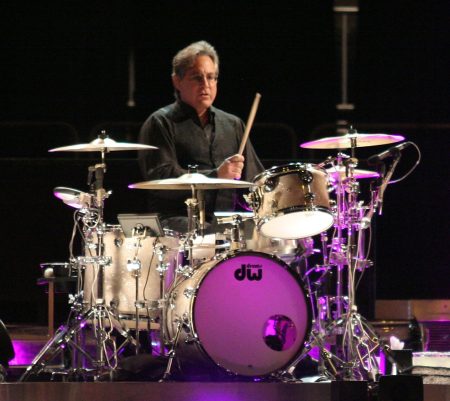
Photo: Wikimedia Commons
Quick Navigation
- Max Weinberg: Growing Up in New Jersey and Finding the Drums
- The Audition That Changed Everything
- Max Weinberg and Bruce Springsteen: Fifty Years Behind the Kit
- Born to Run and the Record That Announced a Generation
- Max Weinberg Behind the Kit: Style, Power, and Precision
- Darkness on the Edge of Town and the Next Level
- Max Weinberg, Late Night Television, and the Conan Years
- The Nebraska Era: When the Drummer Stepped Back
- Max Weinberg and the E Street Band Reunion
- Watch: Staying in Shape with Max Weinberg
- Max Weinberg on the Road: The Land of Hope and Dreams Tour 2026
- The Albums That Required Mighty Max
- How to Follow Max Weinberg Today
He is the rhythmic foundation upon which one of the most studied catalogs in rock history was built, and the consistency he has brought to that role across five decades is something that the music could not exist without.
Max Weinberg is a drummer’s drummer, a bandleader, a television institution, and the reason that every E Street Band record since 1975 has had the bottom end it needed to hold everything else together.
Max Weinberg: Growing Up in New Jersey and Finding the Drums
Max Weinberg was born on April 13, 1951, in South Orange, New Jersey, and grew up in a household where music was present and where his own interest in rhythm showed up before most children his age were paying attention to any instrument at all.
He started playing drums as a young child, the kind of early start that typically indicates either a genuine calling or a parent who did not sleep well for several years.
In Weinberg’s case it was the former, and by his early teens he was studying seriously, taking the drums as seriously as any young musician takes the instrument they understand is going to define their life.
He absorbed everything that was around him in the New Jersey and New York music scene of the early 1970s, a scene that was competitive, diverse, and producing the kind of musicians who would go on to matter.
Max Weinberg arrived in that environment with something most young drummers do not have: the combination of technical discipline and physical power that makes a drummer feel not just heard but physically felt in a room.
That combination was what got him the audition, and what he did in the audition is what got him the job.
Did You Know
Max Weinberg’s son Jay Weinberg followed his father into professional rock drumming and went on to become the drummer for Slipknot from 2013 to 2023, making the Weinbergs one of the only father-son pairs in which both achieved major-label rock prominence behind the kit. Jay’s aggressive, technically precise style drew comparison to his father’s approach while taking it in a direction that his father’s work with Springsteen never explored. You can hear what Jay did with the band on Amazon, where several Slipknot records are available on vinyl.
The Audition That Changed Everything
In 1974, Bruce Springsteen was building the band that would record Born to Run, and the drummer position was the last critical piece of the lineup that needed to be filled.
Dozens of drummers auditioned for the spot, and the accounts of those sessions make clear that Springsteen and manager Jon Landau were looking for something specific: not just technical ability, but the capacity to drive the music from behind the beat while making it feel like the most natural thing in the world.
Max Weinberg walked in and delivered exactly that.
He has described the audition in interviews as one of the more straightforward experiences of his life, which is the account of someone who had prepared so completely that the moment felt inevitable rather than nerve-racking.
The fit between his playing style and the demands of Springsteen’s arrangements was immediate and mutual, and the working relationship that began that day has now stretched across more than fifty years of records, tours, and performances.
That kind of sustained creative partnership between a bandleader and a rhythm section player is rarer in rock than most people appreciate, and it has produced something that neither party would have reached without the other.
Max Weinberg and Bruce Springsteen: Fifty Years Behind the Kit
Max Weinberg’s relationship with Bruce Springsteen is not the relationship of a hired musician and his employer.
It is a creative partnership in which the drummer’s choices have shaped the character of the music at every level, from the tempo of individual phrases to the overall feel of records that have defined what American rock sounds like over five decades.
Springsteen has spoken about Max Weinberg’s drumming in ways that make clear he understands the band’s sound is inseparable from the drummer’s particular approach to the instrument.
The official E Street Band profile at brucespringsteen.net documents the formal record of that partnership, but the real documentation is in the music itself.
Put on any E Street Band studio album from Born to Run through the most recent release and the drumming is not just a supporting element: it is an active voice in the conversation, pushing the songs toward a physical intensity that the arrangements demand and that no other drummer in the band’s history has delivered the same way.
Fifty years in, that voice is still the one at the center of the rhythm section.
Born to Run and the Record That Announced a Generation
The Born to Run album, released in 1975, announced the E Street Band to the world as something that had not existed in quite that form before: a rock band capable of the grandeur of Phil Spector’s Wall of Sound and the directness of a garage rehearsal, simultaneously.
Max Weinberg’s drumming on that album is foundational to why it works as well as it does.
On “Thunder Road,” his contribution is mostly restraint, a disciplined approach that lets the piano and saxophone lead before the full band arrives.
On “Jungleland” and the title track, he drives the arrangements with a force that matches the ambition of everything else happening in the music without overwhelming it.
The title track itself, Born to Run, remains one of the most analyzed rock songs ever recorded, and the drum work is a central part of what analysts keep returning to: the way it builds, the way it breathes, and the way it makes the listener feel like the song is moving faster than the tempo actually is.
That is a sophisticated piece of musical intelligence, and Max Weinberg was 23 years old when he played it.
Max Weinberg Behind the Kit: Style, Power, and Precision
Max Weinberg does not play like a jazz drummer who learned rock, or a hard rock drummer who grew up in arena bands.
He plays like someone who studied both and then discarded everything that did not serve the specific demands of the music he was asked to make.
His grip, his timing, and his approach to fills are all rooted in a formal discipline that produces a pocket so consistent that the band around him can take risks knowing the bottom is not going anywhere.
He is sometimes described as a “straight-ahead” drummer, which is accurate as a technical description but misses the degree to which Max Weinberg shapes the character of the music through what he chooses not to play.
The space he leaves is as deliberate as the notes he plays, and it is that discipline in negative space that separates great rock drummers from very good ones.
His physical stamina across a career that has involved some of the longest and most demanding live sets in rock history is another dimension of what he brings to the band, and it is the subject of the video in the section below.
Darkness on the Edge of Town and the Next Level
Darkness on the Edge of Town, released in 1978, is where the E Street Band became the toughest version of itself, and Max Weinberg’s drumming took on a harder, more muscular quality that matched the stripped-back ferocity of Springsteen’s writing.
The Born to Run sessions had been elaborate and layered; Darkness was leaner, more confrontational, and the drums were at the front of that shift.
Tracks like “Badlands” and “Adam Raised a Cain” required a drummer who could push the band to the edge of breakdown while keeping the arrangements from actually going over, which is a very specific kind of controlled aggression that is harder than it sounds.
The River followed in 1980, a double album with a wider emotional range than anything the band had done before, and Max Weinberg moved through it with the same adaptability he had shown on every previous record, driving the anthems, restraining himself on the ballads, and never stepping on the songs he was serving.
The River remains one of the most complete statements the E Street Band made, and the drumming is a significant reason why the range of the record feels earned rather than inconsistent.
Did You Know
Max Weinberg published a book in 1984 called “The Big Beat: Conversations with Rock’s Great Drummers,” in which he interviewed legends including Ringo Starr, Charlie Watts, Keith Moon, Buddy Rich, and others about their craft, their influences, and the mechanics of how they approached the instrument. The book is one of the most substantive documents of rock drumming ever assembled, because Weinberg asked the questions that only a working drummer who had thought deeply about the instrument would know to ask. You can find copies on Amazon and it rewards reading whether you play drums or not.
Max Weinberg, Late Night Television, and the Conan Years
In 1993, Max Weinberg became the bandleader and drummer for Late Night with Conan O’Brien on NBC, a role that gave him a second career in television that ran in parallel with his work in the E Street Band for nearly two decades.
The Max Weinberg 7, as his late night band was called, performed on more than 2,500 episodes of late night television, making Max Weinberg one of the most frequently seen live musicians in American television history without most viewers fully registering the significance of that number.
He followed O’Brien to The Tonight Show in 2009 and then to Conan on TBS in 2010, staying with the host through the full arc of what became one of the more unconventional careers in late night history.
The Conan years were not a detour from his identity as a rock drummer but an extension of the same qualities that had made him valuable to the E Street Band: reliability, adaptability, and the ability to serve the moment rather than dominate it.
He balanced both careers with a professionalism that impressed everyone who worked with him in both settings, and the discipline required to maintain that balance for nearly twenty years is something that does not get nearly enough credit in accounts of his overall career.
The Nebraska Era: When the Drummer Stepped Back
The release of Nebraska in 1982 was one of the more surprising pivots in Springsteen’s career: a solo, home-recorded album of stark acoustic songs that had no place for the E Street Band’s full sonic weight.
Max Weinberg was not on the Nebraska record, which is one of the most minimal and emotionally direct things Springsteen ever released, and the album is the better for that decision even if it meant that the band sat out one of the most discussed records in the catalog.
The live context for what Max Weinberg contributed to that material can be explored at bruce-springsteen-nebraska-live, which documents how the band eventually brought those songs into a live setting where the full drum kit became part of their presentation.
The Born in the USA album in 1984 brought Max Weinberg and the E Street Band back to the center of the commercial picture with a force that confirmed neither the band nor its drummer had lost anything during the quieter period.
The Born in the USA tour became one of the most attended rock tours in history, and the drumming at the center of it was as precise and powerful as anything he had done before.
Max Weinberg and the E Street Band Reunion
After the E Street Band’s effective dissolution in the early 1990s, when Springsteen pursued solo work and the band scattered into other projects, Max Weinberg continued performing with his late night band and kept the drumming muscles engaged through work that was different in character but equally demanding in its own way.
The reunion came in stages, beginning with the 1999 Reunion Tour that brought the band back together with an energy that made it clear the decade apart had not cost them anything in terms of chemistry or commitment.
The Rising, released in 2002, was the first full studio record from the reunited E Street Band, and the drumming Max Weinberg brought to it carried both the weight of what the album was addressing and the confidence of a musician who had spent thirty years learning how to serve that kind of material.
Fellow E Street Band guitarist Nils Lofgren returned to the band in that same period, and the combination of Lofgren’s guitar work with Weinberg’s drumming restored a sonic foundation the live shows had been built around since the 1980s.
The reunion record and the tour that followed it reminded the music world that the E Street Band’s chemistry was not a product of a specific cultural moment but of the specific people in the room.
Watch: Staying in Shape with Max Weinberg
Max Weinberg has maintained an unusually demanding physical regimen throughout his career, and the video below offers a direct look at the discipline behind the endurance that has allowed him to perform at this level into his 70s.
It is a brief but revealing window into the work that most people never see when they watch a drummer make a three-hour E Street Band show look easy.
Max Weinberg on the Road: The Land of Hope and Dreams Tour 2026
The Land of Hope and Dreams Tour finds Max Weinberg and the E Street Band making approximately 20 stops through late May 2026, continuing the touring commitment that has defined this band’s relationship with live performance for five decades.
The 2026 American tour dates represent another chapter in a live story that has no equivalent in rock music in terms of consistency, scale, or duration.
Max Weinberg takes the stage for these shows at 74 years old, which makes his performance on any given night a genuine statement about what it means to take care of the instrument your body represents in a physically demanding profession.
The 2026 lineup also includes Tom Morello, who has joined the E Street Band’s guitar section in recent years and added another dimension to the live show’s sonic palette.
The combination of the core band’s fifty-year chemistry with the energy that Morello brings as a more recent addition is one of the more interesting live dynamics in current rock, and Max Weinberg is at the center of it, holding the rhythm section together the way he has always held it together.
Did You Know
Max Weinberg has cited jazz drumming legend Buddy Rich as a primary influence on his approach to the instrument, and has described attending Rich’s live performances as a teenager as the experience that showed him what physical power and technical precision could accomplish together when they were aimed at the same musical goal. Rich’s approach to the kit, combining speed, force, and musicality rather than treating them as competing values, is visible in everything Weinberg has done behind a drum kit in fifty years of professional performance. Buddy Rich’s legacy is well documented across his catalog, which you can explore on Amazon.
The Albums That Required Mighty Max
The catalog that Max Weinberg has contributed to with the E Street Band spans nearly every kind of rock record the format allows.
Born to Run is the announcement: loud, layered, and designed to overwhelm.
Darkness on the Edge of Town is the correction: stripped back, harder, and more honest about the weight of what the songs were carrying.
The River is the expansion: a double album that required a drummer who could move between Hungry Heart’s pop rhythm and Point Blank’s devastating quietness without losing the thread.
Wrecking Ball in 2012 brought contemporary production techniques into contact with the band’s established identity, and the drumming navigated that challenge with the same adaptability Weinberg has shown across every phase of the catalog.
Letter to You in 2020, recorded live in the studio over just four days, demonstrated that the E Street Band could produce a document of that quality at pace, and the drumming is a central reason the record sounds as alive as it does.
Every phase of that catalog required a specific version of what Max Weinberg does, and he has delivered the right version every time.
How to Follow Max Weinberg Today
The official hub for Max Weinberg’s touring, projects, and updates is at maxweinberg.com, which is the cleanest starting point for anyone who wants to stay current on what he is doing outside the E Street Band context.
On Instagram, his account at @mightymaxweinberg documents life on the road and behind the scenes with the kind of directness that longtime fans will recognize from his public presence.
On Facebook, his page at facebook.com/maxmweinberg maintains a presence for announcements and show information.
For coverage of the full classic rock artist landscape, including bios and news for artists across the era, the complete roster is at classicrockartists.com/category/artists.
Affiliate Disclosure: This post contains affiliate links. If you purchase through them, we may earn a small commission at no extra cost to you.
The full E Street Band catalog, including vinyl, CD, and box sets, is available on Amazon, and fifty years of records built on the foundation that Max Weinberg has laid behind the kit is waiting for anyone who has not heard all of it.