

Baker Gurvitz Army stands as one of the most underrated supergroups to emerge from the fertile rock landscape of the early 1970s.
Forged from the raw talent of drumming legend Ginger Baker and the formidable Gurvitz brothers, Adrian and Paul, the band delivered a potent blend of hard rock, progressive textures, and soulful blues that set them apart from the crowd.
Ginger Baker arrived carrying the enormous weight of his post-Cream reputation, a drummer widely regarded as one of the greatest who ever lived.
The Gurvitz brothers brought their own battle-tested credentials, having already earned recognition on the British rock scene throughout the late 1960s and early 1970s.
Together, they created three albums between 1974 and 1976 that deserve far more attention than history has granted them.
Their music was ambitious, emotional, and technically stunning in ways that still reward careful listening today.
This biography digs deep into the origins, peak years, challenges, and enduring legacy of Baker Gurvitz Army, telling the full story of a band that truly punched above its weight.
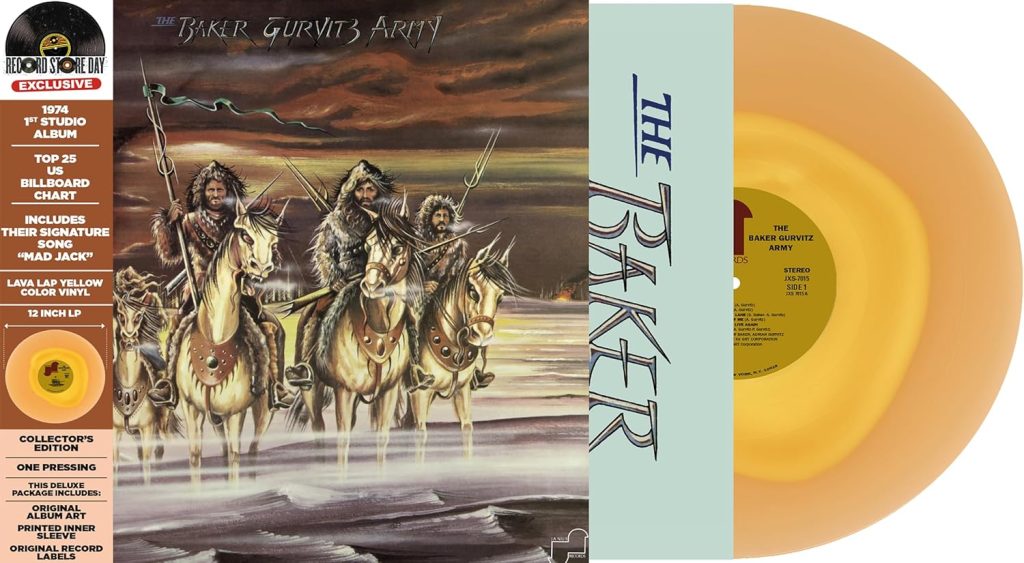
Table of Contents (Click to Expand)
- Early Life and Musical Roots of Ginger Baker
- The Gurvitz Brothers: From Gun to Three Man Army
- Baker Gurvitz Army: The Formation of a Supergroup
- Baker Gurvitz Army’s Signature Albums and Sound
- Career Challenges and the Road Behind
- The Legacy and Revival of Baker Gurvitz Army
- Recognition and Lasting Influence
- Essential Discography
- Frequently Asked Questions
Early Life and Musical Roots of Ginger Baker
Peter Edward Baker, known to the world as Ginger Baker, was born on August 19, 1939, in Lewisham, south London.
His father, Frederick, died during World War II when Ginger was just four years old, leaving a deep emotional scar that would shape his turbulent personality for life.
Baker first gravitated toward cycling as a sport before discovering his true calling behind a drum kit in his teenage years.
He was largely self-taught in the beginning, but he developed an insatiable hunger for jazz, soaking up the music of Baby Dodds, Phil Seaman, and Max Roach.
Phil Seaman, a brilliant but troubled British jazz drummer, became Baker’s most important early mentor and a profound influence on his rhythmic approach.
By the late 1950s, Baker was already performing professionally on the London jazz circuit, building a reputation for extraordinary technique and fierce intensity.
He joined the Graham Bond Organisation in 1962, a pivotal British rhythm and blues group that also featured a young Jack Bruce on bass.
His clashes with Bruce were already legendary even at that early stage, a rivalry that would continue to smolder for decades.
Baker’s time in the Graham Bond Organisation cemented his status as one of the most gifted and ferociously original drummers on the British scene.
The Gurvitz Brothers: From Gun to Three Man Army
Adrian Gurvitz was born on June 26, 1949, in London, and his younger brother Paul followed on July 26, 1947, in the same city.
The brothers grew up immersed in music, developing a sibling chemistry that would prove invaluable throughout their careers.
Adrian emerged as a gifted guitarist with a flair for melodic hooks and searing leads, while Paul established himself as a solid and dependable bassist.
Their first significant breakthrough came with Gun, a British rock trio they formed in the late 1960s.
Gun scored a surprise UK hit in 1968 with “Race with the Devil,” a hard-driving rocker that reached the top five of the British charts.
Despite the promising start, Gun struggled to sustain commercial momentum and eventually disbanded in the early 1970s.
The brothers then formed Three Man Army, a harder-edged power trio that further honed their sound.
Three Man Army released several albums and toured extensively, building valuable experience and tightening the musical rapport between Adrian and Paul.
Importantly, Three Man Army connected the Gurvitz brothers to the wider world of 70s classic rock, positioning them perfectly for their next, most ambitious chapter.
Baker Gurvitz Army: The Formation of a Supergroup
After the dissolution of his beloved Cream in 1968, Ginger Baker had thrown himself into a series of ambitious and eclectic projects.
He worked with Eric Clapton in Blind Faith, a short-lived supergroup that produced one acclaimed album before falling apart under the weight of commercial pressure.
He then assembled Ginger Baker’s Air Force, a sprawling jazz-rock collective that explored African percussion and big-band arrangements.
Baker also spent time in Nigeria, studying African drumming traditions under the tutelage of the legendary Fela Kuti, an experience that permanently deepened his rhythmic vocabulary.
By 1974, Baker was looking for a new creative outlet, something more focused and commercially minded than his previous experiments.
His meeting with Adrian and Paul Gurvitz came at exactly the right moment for all three musicians.
The chemistry was immediate and undeniable, with Baker’s thunderous polyrhythmic drumming providing the perfect foundation for Adrian’s melodic guitar work.
The three men formed Baker Gurvitz Army in 1974, and the name itself broadcast their ambition, a disciplined force with rock royalty at its core.
They signed to Mountain Records and quickly set about recording their debut album with remarkable speed and focus.
Baker Gurvitz Army’s Signature Albums and Sound
The band’s self-titled debut, released in 1974, announced their arrival with confidence and genuine musical ambition.
The album opened with the thunderous “Help Me,” a hard rock statement of intent driven by Baker’s characteristically complex drum patterns.
Adrian Gurvitz’s guitar tone was thick and expressive, drawing on blues-rock traditions while pushing toward something distinctly more progressive.
Paul Gurvitz provided a bass performance that was muscular and melodic, holding the groove with quiet authority throughout the record.
Critics noted that the debut showcased a band still finding its identity, but the raw talent on display was impossible to dismiss.
You can experience the full power of the debut album in this complete 1974 album performance on YouTube, which captures the band at their most raw and vital.
The band then toured relentlessly to support the record, building a devoted live following in the UK and parts of Europe.
Their live shows were electrifying events, centered on Baker’s extraordinary drum solos, which often stretched to twenty minutes or more.
The second album, “Elysian Encounter,” released in 1975, represented a significant creative leap forward.
The production was richer and more layered, reflecting both the band’s growing confidence and their expanded creative ambitions.
Adrian Gurvitz’s songwriting came into sharper focus on “Elysian Encounter,” with tracks that blended hard rock energy with genuinely melodic sensibilities.
The album’s centrepiece, “The Dreamer,” was a sprawling progressive rock suite that demonstrated the band’s willingness to push beyond conventional song structures.
Baker’s drumming on the record was nothing short of sensational, deploying his African-influenced polyrhythms within a hard rock context to stunning effect.
The inclusion of keyboard textures on several tracks added a new dimension to the band’s palette, broadening their appeal without diluting their core identity.
Musically, Baker Gurvitz Army occupied a fascinating space between the classic rock supergroup tradition and the forward-thinking prog rock movement of the mid-1970s.
Their third and final studio record, “Hearts on Fire,” arrived in 1976, and it signalled a more polished, radio-friendly direction.
Producer Eddie Offord, who had previously worked with Yes and Emerson, Lake and Palmer, brought a more commercial sheen to the production.
Adrian Gurvitz’s pop instincts were given more room to breathe on “Hearts on Fire,” with several tracks showcasing his talent for memorable, hook-driven songwriting.
The album suggested the band was pivoting toward mainstream success, but the timing proved cruelly unfortunate.
The mid-1970s rock landscape was shifting dramatically, with punk rock gathering momentum and threatening to sweep away the progressive and hard rock scenes the band inhabited.
Across all three records, the band demonstrated a consistent ability to merge Baker’s jazz-inflected polyrhythms with the Gurvitz brothers’ hard rock instincts, a combination that felt genuinely unique in the crowded 70s rock landscape.
The trio also benefited from an extraordinary live reputation, with Baker’s drum solos becoming the undisputed centerpiece of every concert they performed.
Those who saw them live consistently described the experience as unforgettable, placing the band in a category alongside the great live acts of their era.
Career Challenges and the Road Behind
Despite their considerable talents, Baker Gurvitz Army faced formidable challenges throughout their brief existence.
Ginger Baker’s well-documented struggles with heroin addiction cast a long shadow over his professional life throughout the 1970s.
His fierce and unpredictable temperament, legendary even by rock star standards, made sustained collaboration difficult for everyone around him.
The broader music industry was also undergoing seismic change during the band’s active years, with changing tastes threatening to make their hard rock sound feel suddenly out of fashion.
Financial pressures compounded these personal difficulties, as the band struggled to achieve the commercial breakthrough their talent deserved.
The relationship between Baker and the Gurvitz brothers, while productive, was never without its tensions, partly due to Baker’s volatile nature and his always complicated relationship with authority and expectation.
By 1976, these accumulated pressures proved too great, and the band dissolved without a definitive farewell.
It was a quiet ending for a band that had made a great deal of noise during its short life.
The Legacy and Revival of Baker Gurvitz Army
Following the band’s break-up, all three members moved forward with their respective careers, though with varying degrees of commercial success.
Adrian Gurvitz achieved the most immediate mainstream recognition as a solo artist, scoring a significant UK hit in 1982 with the warm and melodic “Classic.”
That solo success revealed the full extent of his songwriting gifts, which had perhaps been slightly constrained by the heavier requirements of the band format.
Paul Gurvitz pursued session and production work, contributing to various projects while staying active in the music industry behind the scenes.
Ginger Baker continued his restless artistic journey, forming new groups, collaborating with jazz and world music artists, and repeatedly demonstrating that his drumming powers remained extraordinary into old age.
His work in critically acclaimed albums across multiple genres kept his legacy very much alive in the years after the band’s dissolution.
Interest in Baker Gurvitz Army grew steadily in the decades following their break-up, fuelled by reissues, rock documentary coverage, and the tireless advocacy of dedicated fans.
The compact catalog the band left behind gained a second life through CD and digital reissues, introducing their music to entirely new generations of classic rock enthusiasts.
The band’s reputation as one of the most talented and criminally underappreciated acts of the 1970s has only grown stronger with time.
Music journalists revisiting that era have repeatedly highlighted Baker Gurvitz Army as a group that deserved far greater commercial success than they received.
Recognition and Lasting Influence
Ginger Baker was inducted into the Rock and Roll Hall of Fame in 1993 as a member of Cream, cementing his place among the immortals of rock drumming.
Rolling Stone magazine has consistently placed Baker among the greatest drummers in rock history, a recognition that extends by association to his work with Baker Gurvitz Army.
Baker’s influence on generations of drummers is immeasurable, from jazz fusion to heavy metal, virtually every drummer who came after him has had to reckon with the standard he set.
The Gurvitz brothers’ contributions to British rock history are also increasingly acknowledged by historians of the genre, particularly their groundbreaking work with Gun in the late 1960s.
Adrian Gurvitz’s ability to navigate multiple musical genres, from hard rock to pop to soul, marks him as a genuinely versatile and undervalued talent in the broader story of British music.
Ginger Baker passed away on October 6, 2019, leaving behind a legacy that transcended any single band or project.
Tributes poured in from musicians across every genre, confirming what Baker Gurvitz Army fans had always known: that their drummer was one of the most singular artists rock music ever produced.
The influence of the members of Cream on rock history cannot be overstated, and Baker’s post-Cream work, including his time with Baker Gurvitz Army, deserves to be viewed as a vital part of that larger legacy.
Essential Baker Gurvitz Army Discography
Affiliate Disclosure: I am an Amazon Associate and may earn a small commission at no extra cost to you if you purchase through any Amazon links on this page. This helps support the site and keeps the classic rock content coming.
- Baker Gurvitz Army (1974): The band’s powerful debut album, introducing their hard rock sound built around Baker’s thunderous drumming and Adrian Gurvitz’s searing guitar work.
- Elysian Encounter (1975): A confident creative step forward, featuring richer production, more ambitious songwriting, and some of Baker’s most inspired drumming on record.
- Hearts on Fire (1976): The band’s polished farewell, showcasing Adrian Gurvitz’s gift for melodic hooks while retaining the group’s hard rock foundation.
Explore the full Baker Gurvitz Army discography and add these classics to your collection: Browse Baker Gurvitz Army Albums on Amazon.
Frequently Asked Questions About Baker Gurvitz Army
Who were the members of Baker Gurvitz Army?
Baker Gurvitz Army consisted of three core members: Ginger Baker on drums, Adrian Gurvitz on guitar and lead vocals, and Paul Gurvitz on bass guitar and backing vocals.
Ginger Baker was the most internationally famous of the three, celebrated for his earlier work with Cream alongside Eric Clapton and Jack Bruce.
What band was Ginger Baker in before Baker Gurvitz Army?
Before forming Baker Gurvitz Army, Ginger Baker had been a member of several significant groups.
His most famous prior band was Cream, the groundbreaking trio he formed with Eric Clapton and Jack Bruce in 1966.
After Cream disbanded in 1968, he co-founded Blind Faith before leading Ginger Baker’s Air Force, a large jazz-rock ensemble.
How many albums did Baker Gurvitz Army release?
Baker Gurvitz Army released three studio albums during their active years from 1974 to 1976.
These were Baker Gurvitz Army (1974), Elysian Encounter (1975), and Hearts on Fire (1976).
A live album was also released posthumously, giving fans a further taste of the band’s exceptional concert performances.
Why did Baker Gurvitz Army break up?
The band dissolved in 1976 due to a combination of personal tensions, Ginger Baker’s ongoing struggles with addiction, and the rapidly changing music landscape that saw punk rock beginning to overshadow the hard rock and progressive styles they played.
Commercial pressures also played a role, as the band never achieved the breakthrough chart success that their considerable talent warranted.
What is Baker Gurvitz Army’s most important legacy?
Baker Gurvitz Army’s most enduring legacy is their three studio albums, which together represent a genuinely unique fusion of jazz-influenced drumming, hard rock guitar, and melodic British songwriting.
The band also helped demonstrate that Ginger Baker’s creative gifts extended far beyond his work with Cream, cementing his reputation as one of rock’s most versatile and adventurous percussionists.
For fans of classic rock who want to explore deeper cuts from the 1970s, Baker Gurvitz Army remains one of the most rewarding and richly musical discoveries available on ClassicRockArtists.com.
More than four decades after their final album, Baker Gurvitz Army endures as a testament to what happens when exceptional musicians trust each other and swing for the fences, leaving behind a body of work that deserves to be heard by every serious fan of classic rock.