

Livin on a Prayer by Bon Jovi reached number one on the US Billboard Hot 100 in February 1987 and held the position for four weeks, becoming the band’s biggest hit and one of the defining hard rock anthems of the entire decade.
The story of Tommy and Gina, a working-class couple facing financial hardship and holding each other together through sheer determination, struck a chord with an audience that recognized both the struggle and the refusal to surrender.
Affiliate Disclosure: As an Amazon Associate I earn from qualifying purchases. This helps support the site at no extra cost to you.
| Song | Livin on a Prayer |
| Artist | Bon Jovi |
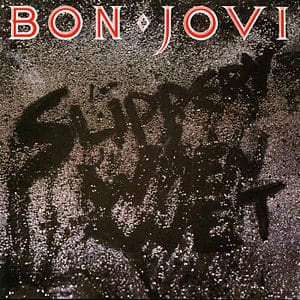
| Album | Slippery When Wet (1986) |
| Written by | Jon Bon Jovi, Richie Sambora, Desmond Child |
| Produced by | Bruce Fairbairn |
| Released | 1986 |
| Genre | Hard Rock, Glam Metal |
| Record Label | Mercury Records |
| Chart Peak | #1 US Billboard Hot 100 |
Table of Contents
Background and Meaning
Bon Jovi was formed in Sayreville, New Jersey by Jon Bon Jovi in 1983, and by 1986 had assembled a lineup around guitarist Richie Sambora, keyboardist David Bryan, bassist Alec John Such, and drummer Tico Torres.
Slippery When Wet was their third studio album, produced by Bruce Fairbairn, and the record that transformed the band from a promising New Jersey hard rock act into one of the biggest-selling groups in the world.
Livin on a Prayer was co-written with Desmond Child, a professional songwriter whose melodic instincts helped sharpen the song’s hook into the kind of chorus that arena audiences could sing back at full volume without rehearsal.
The song’s characters, Tommy and Gina, were drawn from the working-class experience of New Jersey, grounding a hard rock anthem in a specific social reality that gave its emotional appeal a credibility most songs in the genre did not reach for.
The bridge section, which modulates the key upward for the final chorus, became one of the most celebrated moments in live rock performance, a structural choice that has generated one of the most consistent audience singalong responses in concert history.
Musical Composition of Livin on a Prayer
The track opens with Richie Sambora’s talkbox guitar effect, a processed sound created by routing the guitar signal through a plastic tube held in the performer’s mouth, producing the distinctive half-vocal, half-instrument phrase that announces the song before the drums and bass enter.
That introduction is one of the most recognizable openings in hard rock, functional as a hook and immediately evocative of the song’s specific sonic identity.
Jon Bon Jovi’s vocal delivers the verses with conversational intimacy before unleashing the full range of his voice on the chorus of Livin on a Prayer, a dynamic contrast that mirrors the lyric’s movement between despair and defiance.
Fairbairn’s production is immaculate without losing the live energy that Bon Jovi had built through years of concert performance, keeping the recording physical and immediate despite its technical polish.
The key change before the final chorus is a deliberate compositional choice designed specifically for live performance, raising the emotional stakes at exactly the moment when an arena audience is most prepared to respond.
Chart Success and Impact
The single reached number one on the Billboard Hot 100 and stayed there for four weeks, making it Bon Jovi’s first American chart-topper and one of the longest-running number ones of the year.
Slippery When Wet reached number one on the US Billboard 200 and became the best-selling rock album of 1986 and 1987 combined, certified multiplatinum many times over in the United States alone.
The MTV video gave Livin on a Prayer enormous visual exposure, and the combination of the band’s photogenic presence and the song’s working-class narrative generated the kind of fan investment that turns a hit into a career-defining moment.
The song reached the top ten in the United Kingdom and across Europe, confirming that Bon Jovi’s appeal was not limited to American hard rock audiences but extended to every market where arena rock had an established following.
The album’s success made Bon Jovi the dominant force in mainstream hard rock for the rest of the decade and established the template for the melodic hard rock sound that would define the genre’s commercial peak through 1988 and 1989.
Lasting Legacy of Livin on a Prayer
Few rock songs of any era have become as completely embedded in the fabric of public life as Livin on a Prayer, which plays at sporting events, weddings, karaoke nights, and radio stations with a frequency that has barely diminished in four decades.
The song’s working-class narrative gives it a resonance that purely sonic anthems often lack, connecting to listeners on the level of shared human experience rather than just shared taste in music.
Jon Bon Jovi has performed it at virtually every concert appearance since 1986, and the moment when the key change arrives and the audience takes over the vocal has become one of rock’s most reliable and moving rituals.
Classic rock radio treats it as a cornerstone of the format, and it appears on virtually every list of the essential hard rock singles of the 1980s without exception.
More than forty years after its release, Livin on a Prayer by Bon Jovi endures as the defining statement of a specific kind of American hard rock optimism, the belief that holding on together is enough to make it through.
Watch the Official Video
Frequently Asked Questions
FAQ
- Who wrote Livin on a Prayer?
-
Jon Bon Jovi, Richie Sambora, and Desmond Child wrote it together, with Child’s professional melodic instincts helping sharpen the hook into the arena-ready chorus that made it so effective at live shows.
- What is the talkbox sound at the beginning?
-
Richie Sambora plays a talkbox guitar effect, routing the guitar signal through a plastic tube held in his mouth to create the distinctive half-vocal, half-instrument phrase that opens the track.
- How long did it stay at number one?
-
It held the number one position on the US Billboard Hot 100 for four weeks beginning in February 1987, one of the longest runs at the top for a rock single that year.
- Who are Tommy and Gina?
-
Tommy and Gina are fictional characters representing a working-class New Jersey couple facing financial hardship, drawn from the real experiences and social environment that surrounded the band during their formative years.
- What album is it from?
-
It is from Slippery When Wet, released by Bon Jovi in 1986 and produced by Bruce Fairbairn, the best-selling rock album of 1986 and 1987 combined.
You Might Also Like
Built on a talkbox guitar hook, a key change that has made a million arena audiences lose their minds, and a story of working-class love that never sentimentalizes its subject, Livin on a Prayer by Bon Jovi is one of the hardest and most human rock anthems the 1980s produced.