

Ginger Baker: The Most Explosive Drummer in Classic Rock History
Ginger Baker stands as one of the most ferocious, innovative, and technically gifted drummers in the entire history of rock music.
Born Peter Edward Baker on August 19, 1939, in Lewisham, South London, he transformed drumming from a supporting role into the centrepiece of a band’s identity.
His jazz-infused polyrhythmic style challenged every convention of popular music and set a standard that drummers still study and revere today.
With the legendary supergroup Cream, he helped forge the foundational blueprint for hard rock, blues rock, and heavy metal.
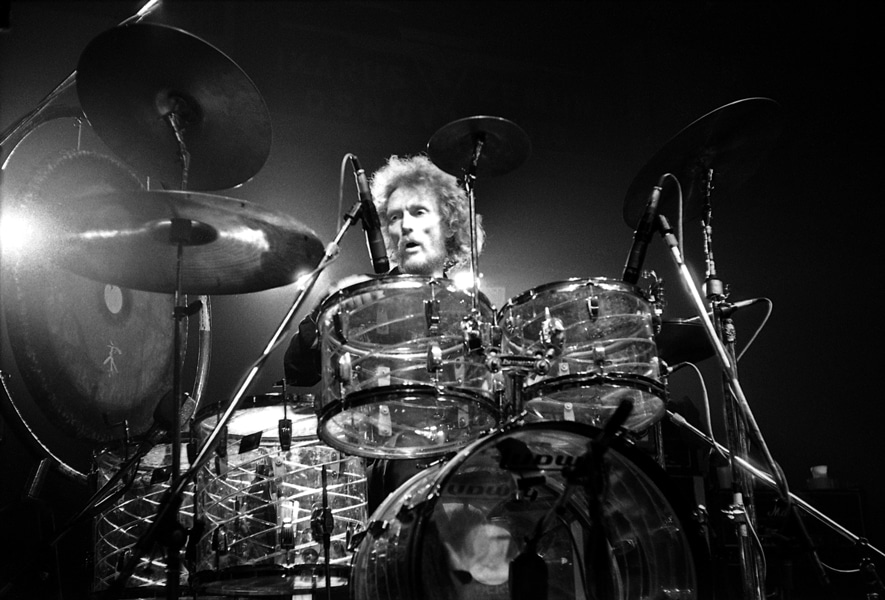
His thunderous double bass drum technique and almost supernatural sense of timing made audiences question what was physically possible behind a kit.
Beyond Cream, he explored West African rhythms in Nigeria, formed groundbreaking ensembles, and recorded jazz albums that revealed remarkable artistic depth.
He was also a deeply complex and often difficult personality: a man whose turbulent life rivalled the raw intensity of his music.
Here at ClassicRockArtists.com, we celebrate the artists who defined a generation.
Few musicians in the world of 1960s classic rock left a mark as permanent, as thunderous, and as unmistakably human as Ginger Baker.
☰ Table of Contents
Ginger Baker: Early Life and Musical Beginnings
Peter Edward Baker came into the world on August 19, 1939, during a period of immense upheaval in Britain.
His father, Frederick Baker, was a bricklayer who was killed during the Second World War when Peter was just four years old.
That early absence shaped a young man who grew up restless, rebellious, and searching for an identity he could claim as entirely his own.
He discovered the drums in his mid-teens and took to them with an obsessive intensity that alarmed his neighbours and enchanted anyone who witnessed it.
He was nicknamed “Ginger” because of his fiery red hair, a name that stuck and eventually became synonymous with volcanic musical power.
His primary musical inspiration was not rock and roll but rather jazz, particularly the hard bop and African-influenced rhythms of drummers like Phil Seamen, Max Roach, and Elvin Jones.
Phil Seamen became a particularly important mentor figure, teaching Baker the fundamentals of jazz time-keeping and African polyrhythm.
Baker began sitting in on jazz sessions across London, developing a reputation as a technically overwhelming young drummer who played with a passion bordering on violence.
He was equally notorious for his fierce temper, which would follow him throughout his entire career and personal life.
His early work with the jazz outfit Blues Incorporated, led by Alexis Korner, placed him at the very heart of the emerging British blues revival.
It was through these blues and jazz circles that he would form the connections that launched his career into the stratosphere.
The Graham Bond Organisation
In 1962, Baker joined the Graham Bond Organisation, a pioneering British rhythm-and-blues group that became one of the most important incubators of British rock talent.
Led by organist and saxophonist Graham Bond, the band was fiercely experimental and technically demanding.
It was within this group that Baker first worked alongside bassist Jack Bruce, a musician whose talents were as extraordinary as they were abrasive.
The Baker-Bruce partnership was one of the most creatively electric and personally volatile relationships in rock history.
The two men famously clashed with a ferocity that sometimes turned physical, yet their musical chemistry was undeniable and irreplaceable.
Baker reportedly fired Bruce from the Graham Bond Organisation at one point due to the intensity of their personal conflict.
Despite this, their ability to lock into a shared groove and push one another far beyond the expected was unlike anything else in British music.
The Graham Bond Organisation recorded two landmark albums in 1965 that captured the raw, forward-thinking sound they championed.
Furthermore, the group served as a finishing school for Baker’s developing concept of the drums as a lead instrument equal in importance to any guitar or vocal.
In contrast to the typical rhythm-section role expected of drummers, Baker was already pushing toward a style that would soon redefine what rock music could be.
Ginger Baker and Cream: The Greatest Trio in Rock History
In the summer of 1966, Baker approached guitarist Eric Clapton with a simple but audacious proposal: form a band together.
Clapton agreed almost immediately, and when Baker insisted on including Jack Bruce despite their personal history, Cream was born.
The full story of Cream’s lineup and legacy reveals just how extraordinary this gathering of talent truly was.
Three virtuosos operating at the absolute frontier of their instruments: a concept that had never quite been executed at this level in popular music before.
Cream was built not on song structure but on improvisation, extended playing, and the collision of three towering musical personalities.
Baker’s role within the group was transformative not just for Cream but for the very concept of drumming in a rock band.
He pioneered the use of two bass drums simultaneously, a technique that unlocked polyrhythmic possibilities that simply did not exist in the drumming vocabulary of mainstream rock.
Significantly, his African jazz influences gave Cream’s rhythmic foundation a texture and complexity that set them apart from every contemporary band.
The Fresh Cream Era: Rewriting the Rules of Rock
Cream’s debut album, Fresh Cream, arrived in December 1966 and announced the group as a genuine phenomenon.
The record introduced British audiences to a ferocious blend of Chicago blues, psychedelic improvisation, and hard-edged rock.
Baker’s drumming on tracks like “Toad” was a revelation: a nearly full track of unaccompanied percussion that introduced the world to the rock drum solo as a legitimate art form.
The piece demonstrated how Baker thought of the drums as a melodic and narrative instrument, not merely a timekeeping device.
Furthermore, his interplay with Jack Bruce’s busy, melodic bass lines created a rhythmic conversation that pushed Clapton’s guitar playing to extraordinary heights.
Cream became the first rock band to genuinely frighten other musicians with the technical standard they set.
In contrast to the verse-chorus formulas dominating radio, Cream played live with extended improvisations that could stretch a blues standard into a twenty-minute journey.
Disraeli Gears, Wheels of Fire, and the Cream Legacy
The second album, Disraeli Gears (1967), brought Cream their commercial breakthrough and their most enduring songs.
The hypnotic riff at the heart of Sunshine of Your Love became one of the most recognisable guitar lines in rock history, powered by Baker’s deep, propulsive groove.
The album cemented the band’s status on both sides of the Atlantic and broke them wide open in the United States.
Their third album, Wheels of Fire (1968), was a double record: one disc of studio recordings and one captured entirely live at the Fillmore in San Francisco.
The live disc documented Baker at perhaps his most fearsome, delivering an expanded version of “Toad” that clocked in at over sixteen minutes.
It became one of the most celebrated drum performances ever preserved on record and is studied in music schools to this day.
Wheels of Fire debuted at number one on the Billboard 200 and became the world’s first platinum double album.
Despite these extraordinary heights, the tensions between Baker and Bruce were escalating dangerously, and the band’s internal relationships were deteriorating.
Cream announced their breakup later in 1968, and their farewell record, Goodbye (1969), was assembled partly from live recordings and partly from new studio tracks.
The album reached number two in both the UK and US charts, a fitting coda to one of the most spectacular careers in rock history.
Cream gave two extraordinary farewell concerts at the Royal Albert Hall in London in November 1968, performances that are still regarded as among the greatest live events in rock history.
Decades later, Cream staged a celebrated reunion at the Royal Albert Hall in 2005, captured on film and preserving Baker’s relentless power for a new generation.
You can watch a highlight from that reunion, including a stunning performance of Stormy Monday, to see Baker’s undiminished ferocity at the age of 65.
Cream Farewell Concert (Extended Edition) — featuring Ginger Baker at the Royal Albert Hall 2005.
Career Challenges and Personal Struggles
The dissolution of Cream left Baker without a creative home for the first time in years, and the years that followed were marked by both extraordinary ambition and painful personal battles.
In 1969, Baker reunited with Clapton in Blind Faith, a so-called “supergroup” that also included vocalist and keyboardist Steve Winwood and bassist Ric Grech.
The band carried enormous commercial expectations and sold out stadiums on the strength of its members’ reputations alone.
Their sole, self-titled album was a powerful if uneven record, and a full review of the Blind Faith album illustrates both its strengths and the pressure the band was under.
Blind Faith collapsed after a single American tour, undone by creative friction, exhaustion, and the impossible weight of public expectation.
In 1970, Baker responded with characteristic boldness by forming Ginger Baker’s Air Force, a sprawling ensemble of up to fifteen musicians.
The Air Force incorporated jazz, rock, and West African percussion into a genuinely adventurous live experience that was ahead of its time.
The ensemble was brilliant on stage but financially chaotic to maintain, and it dissolved within two years.
Running through all of this was Baker’s long battle with heroin addiction, a struggle that consumed enormous amounts of his energy, money, and personal relationships.
His addiction had begun in the mid-1960s and, by his own accounts, controlled much of his life during these turbulent years.
In 1972, Baker made a bold and deeply personal decision: he relocated to Lagos, Nigeria, built a recording studio, and immersed himself in the West African musical traditions that had always fuelled his rhythmic imagination.
He formed a close friendship with the legendary Afrobeat pioneer Fela Kuti, a collaboration that profoundly influenced both men.
He also reunited briefly with Jack Bruce and Eric Clapton in the short-lived project Baker Bruce Moore, later known as BBM, in the early 1990s.
Ginger Baker’s Later Career and the Revival Years
The 1970s brought Baker back to Britain with renewed creative focus and a determination to find musical territory that was entirely his own.
In 1974, he formed Baker Gurvitz Army alongside guitarists Adrian and Paul Gurvitz, recording a series of albums that blended hard rock with Baker’s trademark rhythmic complexity.
The group achieved moderate success and gave Baker a focused vehicle for his playing through the mid-seventies.
The late 1980s saw Baker pursue jazz more seriously than ever, recording a series of albums with world-class jazz musicians that earned him respect in circles far beyond rock.
He relocated to Colorado and then to Italy and South Africa at various points, always restless and always searching for new rhythmic challenges.
During the 1990s, Baker experienced a remarkable creative resurgence when he contributed his thunderous drumming to Masters of Reality on the album Sunrise on the Sufferbus (1992).
This collaboration exposed him to an entirely new generation of rock fans and reminded the world that his power remained absolutely undiminished.
He continued recording jazz trio albums well into the 2000s and 2010s, pairing with artists like Bill Frisell and Charlie Haden on records that received genuine critical acclaim.
You can explore his official discography and legacy at gingerbaker.com, and follow his ongoing presence and tributes on the official Facebook page.
Baker also developed a passionate love for polo, which he pursued with the same ferocious commitment he brought to music, eventually becoming a serious and competitive player.
His later years were marked by serious health challenges, including congestive heart failure, but he continued to perform and record as long as his health allowed.
Ginger Baker passed away on October 6, 2019, in Canterbury, England, at the age of 80.
Recognition and the Legacy of Ginger Baker
In 1993, Ginger Baker was inducted into the Rock and Roll Hall of Fame as a member of Cream, receiving one of the most coveted honours in popular music.
Rolling Stone magazine ranked him the third greatest drummer of all time, behind only John Bonham and Keith Moon.
That ranking alone places him in the absolute apex of an extraordinarily competitive field.
His influence on subsequent generations of drummers is so pervasive that it is almost impossible to fully catalogue.
Artists from Neil Peart to Dave Grohl have cited Baker as a primary influence on their approach to the drums.
His pioneering use of double bass drums became standard practice in hard rock and heavy metal, shaping the sonic landscape of those genres permanently.
He is widely credited with elevating the status of the rock drummer from background player to front-and-centre virtuoso.
Significantly, his integration of African rhythmic traditions into rock music anticipated the world-music fusion movements of the following decades by more than twenty years.
The documentary Beware of Mr. Baker (2012), directed by Jay Bulger, offered a vivid portrait of his life and received widespread critical praise, winning the Grand Jury Prize at SXSW.
Stay current with tributes, anniversaries, and the latest classic rock coverage in our news section, and check our tours and concert listings for events celebrating Baker’s legacy and his fellow classic rock legends.
In the end, the legacy of Ginger Baker is the legacy of music played with complete, uncompromising commitment and a refusal to ever settle for the ordinary.
Essential Discography
The following selection represents the essential recordings across Ginger Baker’s career, from his era-defining work with Cream through his remarkable solo and collaborative output.
- Fresh Cream (1966) — Cream’s debut record announced a new era in rock music, built on blues, jazz improvisation, and Baker’s groundbreaking double bass drum technique.
- Disraeli Gears (1967) — The psychedelic classic that broke Cream internationally and housed some of the most iconic riffs in rock history.
- Wheels of Fire (1968) — A landmark double album featuring Baker’s legendary “Toad” solo performed live, and the first platinum double album in recording history.
- Goodbye (1969) — Cream’s bittersweet farewell record, combining studio tracks with searing live performances that showcased Baker at full intensity.
- The Sound Of ’65 / There’s A Bond Between Us (1965) — A twofer reissue capturing the Graham Bond Organisation’s raw, visionary recordings and featuring Baker’s extraordinary early performances.
- Live In Bremen 1970 (1970) — A document of Ginger Baker’s Air Force performing at full flight, capturing the ambition and explosive energy of his post-Cream big band experiment.
- The Baker Gurvitz Army (1974) — The debut from Baker Gurvitz Army, blending hard rock drive with Baker’s rhythmic sophistication in a tight, focused trio setting.
- Horses And Trees (1986) — A jazz-oriented solo album demonstrating Baker’s restless musical curiosity and his ability to hold his own among the finest jazz musicians of his era.
- Going Back Home (1994) — A stripped-down jazz collaboration with Bill Frisell and Charlie Haden, widely regarded as one of the most intimate and accomplished recordings of Baker’s career.
- Falling Off The Roof (1996) — A compelling jazz trio record that confirmed Baker’s status as a serious jazz artist as well as a rock legend.
- Coward of the County — A testament to Baker’s adventurous recording career and his lifelong refusal to be confined by genre or expectation.
- No Material — A jazz recording showcasing Baker’s late-career mastery and the timeless quality of his natural musical voice.
- Why? — A later jazz offering that continues to reward listeners with Baker’s unparalleled combination of raw power and refined rhythmic intelligence.
- Live With Ginger Baker — An excellent live document capturing the legend in performance, delivering the ferocious energy that defined his entire career.
Explore the full catalogue: Browse Ginger Baker’s extensive discography on Amazon. As an Amazon Associate, I earn a small commission on qualifying purchases made through this link, at no extra cost to you. I thank you in advance.
Frequently Asked Questions
What Band Was He Most Famous For?
Ginger Baker is most famous for his role as the drummer in Cream, the power trio he formed in 1966 with guitarist Eric Clapton and bassist Jack Bruce.
Cream is widely regarded as one of the greatest and most influential rock bands of all time.
The band released landmark albums including Fresh Cream, Disraeli Gears, and Wheels of Fire before disbanding in 1968.
When Did He Pass Away?
Ginger Baker passed away on October 6, 2019, at a hospital in Canterbury, England.
He was 80 years old and had suffered from serious heart problems in the years preceding his death.
His passing was mourned by musicians and fans across the globe as the loss of one of rock music’s most irreplaceable figures.
Was He Considered the Greatest Drummer in the World?
Baker was consistently ranked among the very best drummers who ever lived.
Rolling Stone magazine placed him third on their list of the greatest drummers of all time, behind only John Bonham and Keith Moon.
Many musicians and critics have argued that his technical mastery, musical intelligence, and raw physical power surpassed even those legends.
His influence on the evolution of rock drumming is arguably unmatched.
What Did Jack Bruce Do After Cream?
Following the breakup of Cream, Jack Bruce built a distinguished solo career rooted in jazz, blues, and experimental rock.
His first solo record, Songs for a Tailor (1969), is widely considered one of the finest solo albums to emerge from the late-1960s British rock scene.
He followed it with equally adventurous work including Harmony Row (1971) and the critically acclaimed Out of the Storm (1974).
Bruce continued to record and perform internationally until his death in 2014, collaborating with Baker and Clapton again in the BBM project in 1994.
What Other Bands Did He Play With?
Beyond Cream, Baker performed with an impressive range of ensembles across several decades.
He played with the Graham Bond Organisation in the early 1960s, Blind Faith in 1969, Ginger Baker’s Air Force in 1970, and Baker Gurvitz Army throughout the mid-1970s.
He collaborated with Afrobeat legend Fela Kuti in Nigeria during the early 1970s and contributed to the Masters of Reality album Sunrise on the Sufferbus in 1992.
He also recorded extensively as a jazz drummer, working with artists including Bill Frisell and Charlie Haden well into his seventies.
From the jazz cellars of 1950s London to the stadiums of the late 1960s and the recording studios of three continents, Ginger Baker lived a musical life of breathtaking scope, and the seismic impact of his drumming will continue to be felt for as long as people play rock music.