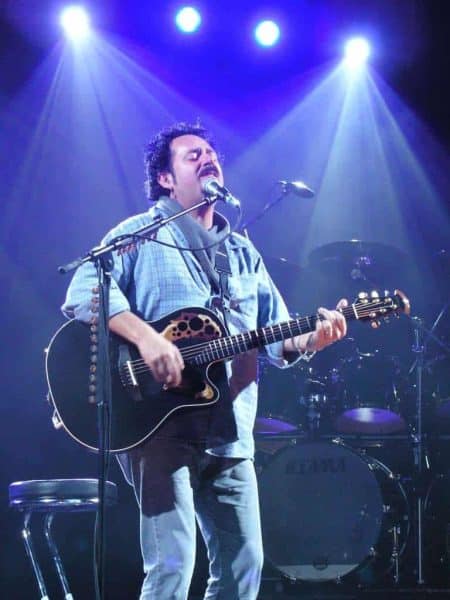

Joe Satriani is the guitarist who made instrumental rock not just listenable, but impossible to ignore.
From a football field in New York where he heard that Jimi Hendrix had died, to sold-out concert halls across four decades, his story is one of total commitment to the guitar.
What followed that moment of inspiration became one of the most remarkable careers in rock music history.

Affiliate Disclosure: This post contains affiliate links. If you purchase through our Amazon links, we may earn a small commission at no extra cost to you. This helps keep Classic Rock Artists running.
Quick Navigation
- Joe Satriani’s Early Life and a Guitar That Changed Everything
- Teaching the Next Generation: Steve Vai and Kirk Hammett
- Not of This Earth: The Album That Launched a Career
- Surfing with the Alien: Joe Satriani Breaks Through
- The Mick Jagger Tour of 1988: The World Takes Notice
- Flying in a Blue Dream and a Bolder Sound
- Joe Satriani and the Making of The Extremist
- Deep Purple and the Birth of G3
- Chickenfoot: Joe Satriani Joins the Supergroup
- Flashback Friday: The 1992 Guitar Legends Festival
- The Ibanez JS Series and the Sound of Joe Satriani
- A Discography Built for the Ages
- Why Joe Satriani Remains a Guitar Icon Today
Joe Satriani’s Early Life and a Guitar That Changed Everything
He was fourteen years old, standing on a football field in Westbury, New York, when the announcement came.
Jimi Hendrix had died, and in that moment, Joe Satriani decided he would dedicate his life to the guitar.
It was October 18, 1970, and that single decision would shape everything that followed.
Born on July 15, 1956, in Westbury, New York, Joe Satriani grew up in a household where music was taken seriously.
His mother played piano, and she encouraged her children to develop a relationship with music from an early age.
Joe Satriani threw himself into the instrument with an intensity that his peers rarely matched.
By his late teens, he was already performing in local bands and developing the melodic vocabulary that would later define his recorded work.
He studied with jazz guitarist Lennie Tristano, absorbing music theory that most rock players never bother to encounter.
He eventually moved to the San Francisco Bay Area, where the city’s fertile musical environment gave him both the inspiration and the audience to push his ideas further.
That theoretical foundation became the invisible structure beneath every melodic phrase he would later commit to tape.
Joe Satriani did not arrive at his style by accident. He built it, deliberately and patiently, over years of study and performance.
Teaching the Next Generation: Steve Vai and Kirk Hammett
Before Joe Satriani’s name appeared on a single album, he was quietly shaping the players who would define a generation of rock guitar.
Joe Satriani gave private lessons in the San Francisco Bay Area through the late 1970s and early 1980s, and the student list that passed through his studio is extraordinary.
Steve Vai studied under him and has consistently credited Satriani as one of the most important figures in his early development.
Kirk Hammett, before he auditioned for Metallica, sat across from Satriani with a guitar and absorbed lessons that would later inform his work on some of the most famous metal records ever made.
Larry LaLonde of Primus was another student who went on to a career of wide recognition.
Charlie Hunter and David Bryson of Counting Crows also passed through his teaching studio during those years.
The fact that so many of Satriani’s students became recognized players in their own right says everything about the quality of his instruction.
He taught not just technique but musical thinking, and that rarer skill leaves a mark on every player who encounters it.
You can still hear that influence in the phrasing of every guitarist who ever sat across from him with something to learn.
Not of This Earth: The Album That Launched a Career
In 1986, Joe Satriani released his debut full-length, “Not of This Earth,” on Relativity Records.
The album was entirely instrumental, built around ideas that most rock guitarists of the era would not have attempted.
It sold modestly but drew immediate attention from critics and musicians who recognized something genuinely different in his approach.
He was playing with a warmth and melodic intelligence that felt more like singing than shredding, a distinction that mattered enormously in a landscape crowded with technique-first players.
The album established his core identity: technically demanding music that never sacrifices the melody to demonstrate the player’s skill.
That balance, between precision and feeling, runs like a thread through his entire catalog from this debut onward.
“Not of This Earth” did not make Satriani a star overnight, but it announced his arrival in terms that no serious guitarist could afford to ignore.
The record also proved that an instrumental guitar album could find an audience in a market dominated by vocalists and radio-ready pop.
It was a quiet beginning that set up everything that came next.
Surfing with the Alien: Joe Satriani Breaks Through
Joe Satriani released “Surfing with the Alien” in October 1987, and the record changed the conversation around instrumental guitar music.
The album hit number 29 on the Billboard 200 and eventually went platinum, a rare achievement for an entirely instrumental guitar record at any point in rock history.
It remains one of the best-selling instrumental rock albums ever made.
The title track opens with a riff so immediately recognizable that it functions like a signature: you hear it once and it stays with you.
Tracks like “Satch Boogie,” “Always with Me, Always with You,” and “Ice 9” demonstrated that Satriani had a complete musical vision, not a collection of technical exercises dressed up as songs.
The cover featured Marvel’s Silver Surfer, a choice reflecting Satriani’s love of science fiction and giving the album a visual identity as striking as its sound.
Joe Satriani had licensed the image directly from Marvel, and the combination of that cover with the music made “Surfing with the Alien” feel like an event rather than just a release.
Guitar players bought it in large numbers, and many traced a path from that album to a new understanding of what the instrument could do.
The record’s success gave Satriani a platform from which he would spend the next four decades building one of the most consistent bodies of work in rock music.
The Mick Jagger Tour of 1988: The World Takes Notice
In 1988, Mick Jagger was preparing his first solo world tour and needed a guitarist capable of holding the stage alongside one of rock’s greatest frontmen.
He chose Satriani, who spent the better part of a year performing in Japan and other international markets as the lead guitarist in Jagger’s touring band.
Playing arenas at that level exposed Satriani to audiences who might never have sought out an instrumental guitar album on their own.
The experience sharpened his instincts as a live performer and gave him a new understanding of how to command a large crowd.
It also introduced him to a standard of production and professionalism that informed how he would organize his own tours going forward.
The Jagger connection gave Satriani a global profile at exactly the moment when his recorded output was generating real momentum.
He returned from that tour with both experience and credibility that no marketing campaign could replicate.
It was one of those career moments that looks inevitable in retrospect but required everything Satriani had built up to that point to make it happen.
Flying in a Blue Dream and a Bolder Sound
In 1989, Satriani released “Flying in a Blue Dream,” which surprised listeners by adding vocals to several tracks alongside his instrumental work.
The album hit number 23 on the Billboard 200, an improvement on “Surfing with the Alien” and a signal that his audience had grown considerably.
Tracks like “The Phone Call” and “I Believe” featured Satriani’s own voice, revealing a side of his artistry that audiences had not previously encountered.
The instrumental tracks on the record, particularly “The Forgotten,” showed that his melodic writing had deepened and broadened since his previous record.
“Flying in a Blue Dream” confirmed that Satriani was not a one-trick artist content to repeat what had already worked.
He was willing to take genuine risks and test the expectations of an audience that had come to him specifically for guitar-forward music.
That willingness to stretch rather than repeat has been one of the consistent qualities of his approach across more than thirty years of recording.
The album also reached listeners who had missed “Surfing with the Alien,” broadening his base at a moment when the guitar’s profile in mainstream culture was still high.
Joe Satriani and the Making of The Extremist
Joe Satriani’s 1992 album “The Extremist” is widely considered his most commercially successful and creatively unified record.
It reached number 22 on the Billboard 200 and included tracks that entered permanent rotation on classic rock radio stations across North America and Europe.
“Summer Song,” the album’s lead single, combined melodic sophistication with a warmth that was immediately accessible to listeners well outside the guitar world.
“Friends” showed a lyrical quality in Satriani’s playing that placed it alongside the most emotionally resonant guitar work of the decade.
The production, handled by John Cuniberti, gave the album a clarity and physical punch that made it sound powerful on any system.
Joe Satriani had now released three consecutive records that demonstrated sustained creative development rather than the decline that often follows an artist’s initial breakthrough.
The Extremist era represents the moment when Satriani’s name crossed from guitar magazines into the wider music conversation.
The subsequent world tour brought him to audiences across Europe, North America, and Japan, reinforcing his status as one of the most compelling live performers in instrumental music.
You could argue this was the peak of his commercial visibility, but it was also the launching pad for everything that came next in his career.
Deep Purple and the Birth of G3
In 1994, Joe Satriani joined Deep Purple as a touring guitarist following Ritchie Blackmore’s departure from the band.
He recorded no studio album with Deep Purple but toured extensively alongside them, holding his own in one of rock’s most established lineups.
The experience reinforced Satriani’s standing in the wider rock world, connecting him to a lineage stretching back to the early 1970s.
Then, in 1996, Satriani co-founded the G3 concert tour with Steve Vai and Eric Johnson, creating one of the most enduring events in guitar music history.
The concept was simple: three elite guitarists would each perform their own set, then close the evening together with a collective jam.
Over subsequent years, G3 featured players including Steve Lukather, Carlos Santana, John Petrucci, Robert Fripp, and many others from across the spectrum of guitar music.
The tour validated Satriani’s conviction that there was a large audience specifically for instrumental guitar performed at the highest level of skill.
G3 continued to evolve across the following decades, with Satriani guiding it through dozens of iterations involving some of the greatest guitarists alive.
It stands today as one of the most successful recurring concert concepts in rock history, built entirely on the quality of the playing rather than any commercial formula.
Chickenfoot: Joe Satriani Joins the Supergroup
Joe Satriani formed Chickenfoot in 2008 alongside Sammy Hagar, Michael Anthony, and Chad Smith of the Red Hot Chili Peppers.
The band released their self-titled debut in 2009, and it debuted at number four on the Billboard 200.
Chickenfoot gave Joe Satriani his first sustained experience of playing in a band with a powerful rock vocalist, and Hagar’s presence pushed Satriani to approach his parts differently than he did on his solo records.
The music was hard rock in the classic tradition, drawing on the same energy that had defined arena rock in the 1970s and 1980s.
Michael Anthony’s bass and backing vocals brought a sound that listeners familiar with his work alongside Van Halen recognized immediately.
A second album, “Chickenfoot III,” followed in 2011 and continued the band’s momentum both critically and commercially.
Chickenfoot allowed Joe Satriani to show a different side of his playing, one grounded in groove and swagger rather than solo guitar exploration.
The project remains one of the most genuinely successful supergroup efforts of its era, generating a fan base that overlaps but is distinct from the individual audiences of each member.
For Joe Satriani, it was a reminder that collaboration could unlock dimensions of his playing that the solo format did not demand.
Flashback Friday: The 1992 Guitar Legends Festival
Few events in the history of guitar music gathered as much concentrated talent in a single place as the 1992 Guitar Legends Festival in Seville, Spain.
Satriani appeared alongside an assembly of players that made the event feel like a summit meeting for the instrument at its peak cultural moment.
The clip below captures something of that atmosphere: guitarists performing for an audience that understood exactly what it was witnessing.
Watching footage from that festival now, you can see how Satriani commanded the stage with a confidence built from years of performing at the highest levels of the business.
The 1992 Guitar Legends Festival stands as a document of a specific moment in rock history, one when the guitar was still the dominant voice of popular music.
Events like this shaped the culture that made Joe Satriani’s career possible and gave him a stage worthy of the music he was creating.
The Ibanez JS Series and the Sound of Joe Satriani
Joe Satriani has worked with Ibanez guitars since the late 1980s, when the company began developing what would become the JS series of signature instruments.
The JS1000 and its many variants are designed around his specific requirements: a fast neck profile, a responsive tremolo system, and a tonal range that moves between warmth and edge without losing clarity.
The DiMarzio pickups installed in most JS models were developed in direct collaboration with Satriani, reflecting his preference for a particular kind of harmonic richness and dynamic response.
Joe Satriani’s tone is immediately recognizable, and that quality separates the great guitarists from the merely excellent ones.
He has also worked extensively with Vox amplifiers and a range of effects processors, building a live rig that is technically complex but always in service of the music rather than the gear.
The JS series has become one of the best-selling signature guitar lines in the world, used by players at every level who want to approach the instrument with the same philosophy Satriani brings to it.
Joe Satriani’s partnership with Ibanez is one of the longest and most successful artist-manufacturer relationships in rock guitar history.
That commercial success reflects not just Satriani’s name but the practical quality of the instruments themselves, built to perform the way serious musicians need them to.
A Discography Built for the Ages
Joe Satriani’s recorded output spans more than three decades and covers a range of moods and approaches that most artists never attempt across a career.
From the raw energy of “Not of This Earth” to the ambient textures of “Engines of Creation” to the muscular playing on “Shockwave Supernova,” his catalog refuses to stand still.
“Crystal Planet,” released in 1998, is a fan favorite that combines technical precision with genuine emotional warmth across nearly an hour of music.
“Is There Love in Space?” from 2004 leaned into groove and accessibility without sacrificing his core identity as a player.
“The Elephants of Mars,” released in 2022, showed that Satriani’s creative energy had not diminished after four decades of recording.
He has been nominated for fifteen Grammy Awards across his career, more nominations than nearly any other instrumental guitarist in rock history.
The full scope of his releases can be explored at the Joe Satriani discography on Wikipedia, which documents every album in detail.
His official home at satriani.com serves as the primary hub for news, tour announcements, and direct access to his music.
Follow his ongoing work via his Facebook page and his YouTube channel, where decades of live footage and studio content remain available to explore.
Why Joe Satriani Remains a Guitar Icon Today
Joe Satriani has outlasted trends, survived the collapse of guitar-driven radio, and continued to sell out concert halls well into the streaming era.
He has taught, performed, recorded, and collaborated at the highest levels of rock music for more than four decades.
The reason he endures is not technical ability alone, though that ability is extraordinary by any measure.
It is the fact that every note he plays sounds like it comes from somewhere real: a place of genuine feeling rather than calculated display.
Young guitarists still study his technique, still transcribe his solos, still name him as the player who first made them understand what the instrument could express.
That is not the mark of a trend.
That is the mark of an artist who found something true in the music and has never let it go.
Joe Satriani remains, after everything, one of the most compelling and original guitar voices the rock world has ever produced.