

John McVie is one of rock music’s most respected bass guitarists, best known for his steady, melodic playing as a founding member of Fleetwood Mac.
Born in London during the post-war era, he developed a distinctive bass style that became the rhythmic foundation for one of the world’s most successful rock bands.
His partnership with drummer Mick Fleetwood created one of rock’s most enduring rhythm sections, anchoring countless hit records across five decades.
The band itself was named after him and Fleetwood, a testament to his central role in its formation and longevity.
His bass lines on albums like Rumours and Tusk helped define the sound of 1970s rock while maintaining a subtle, supportive approach that served the song rather than seeking the spotlight.
Despite personal challenges including health battles and the dissolution of his marriage to bandmate Christine McVie, he remained committed to his craft.
His influence extends beyond commercial success to the technical realm, where bassists study his economical yet effective playing style.
From the British blues boom of the 1960s to stadium rock of the 1970s and beyond, his career spans the evolution of modern rock music.
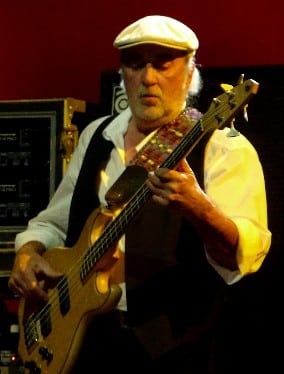
Table of Contents [Click to Expand]
Early Life and Musical Beginnings
John Graham McVie was born on November 26, 1945, in Ealing, London, England.
He grew up in a working-class neighborhood during the post-war recovery period in Britain.
His early exposure to music came through the burgeoning British jazz and blues scene of the late 1950s and early 1960s.
The bass guitar became his instrument of choice during his teenage years, drawn to its rhythmic and foundational role in ensemble playing.
He was particularly influenced by American blues artists whose records were becoming increasingly available in London.
The British blues boom of the early 1960s provided the perfect environment for a young bassist to develop his skills.
John McVie worked as a tax inspector before committing fully to music, a practical job that provided stability while he honed his craft.
His playing style emphasized solid timekeeping and melodic bass lines rather than flashy solos or technical showmanship.
This approach would become his signature throughout his career, prioritizing the needs of the song over individual display.
By his late teens, he was actively playing in London clubs and building a reputation among local musicians.
First Major Band or Breakthrough
McVie’s first significant professional opportunity came when he joined John Mayall & the Bluesbreakers in 1963.
The Bluesbreakers served as a training ground for many British rock legends, including Eric Clapton, Peter Green, and Mick Taylor.
His tenure with Mayall provided invaluable experience playing authentic blues music with some of Britain’s finest musicians.
During this period, he developed the steady, unflashy style that would define his later work.
John McVie appeared on several Bluesbreakers albums, contributing to the band’s reputation as the premier British blues outfit.
His work with Mayall brought him into contact with guitarist Peter Green, who would soon invite him to join a new venture.
When Green left the Bluesbreakers to form his own band in 1967, he specifically wanted McVie as his bassist.
John McVie initially declined the offer, preferring the security of his position with the established Bluesbreakers.
Green’s new band was called Fleetwood Mac, named after drummer Mick Fleetwood and McVie himself, despite his absence.
The name itself was an inducement, and McVie eventually joined the band several months after its formation in 1967.
His arrival solidified the classic early lineup that would achieve significant success on the British blues circuit.
John McVie Peak Era
The peak era for John McVie began when he officially joined Fleetwood Mac in late 1967, completing the lineup that would dominate the British blues scene.
The early incarnation of the band featured Peter Green on guitar, Jeremy Spencer on slide guitar, and Mick Fleetwood on drums.
McVie’s bass playing provided the perfect counterpoint to Green’s fluid, emotional guitar work.
The band’s self-titled debut album in 1968 showcased their blues credentials and featured McVie’s understated but essential bass lines.
Their second album, Mr. Wonderful, further established them as a premier blues act in Britain.
The band achieved their first major hit with the instrumental Albatross, which reached number one in the UK in 1968.
McVie’s melodic bass line on the track demonstrated his ability to create memorable parts that served the song’s atmospheric quality.
The album Then Play On in 1969 marked a creative peak for the Peter Green era of the band.
During this period, keyboardist Christine Perfect joined the band, and she would later marry McVie in 1968.
Christine McVie became an integral part of the band’s sound and songwriting, creating a unique dynamic within the group.
The early 1970s brought significant lineup changes as Peter Green departed, followed by Jeremy Spencer.
John McVie and Fleetwood remained the constant core, navigating through various guitarists and singers.
The band relocated to California in the early 1970s, seeking new opportunities in the American market.
In 1974, the addition of Lindsey Buckingham and Stevie Nicks transformed Fleetwood Mac into a pop-rock powerhouse.
The 1975 self-titled album Fleetwood Mac marked the beginning of their commercial breakthrough in America.
McVie’s bass work on tracks like Rhiannon provided the steady foundation for the band’s new sound.
His playing on Landslide demonstrated his sensitivity to ballad arrangements and emotional dynamics.
The album sold millions of copies and established the band as major stars in North America.
The follow-up album, Rumours, became one of the best-selling albums in history.
Released in 1977, Rumours was recorded during a period of intense personal turmoil within the band.
McVie and Christine were divorcing during the sessions, adding emotional weight to the recording process.
Despite the personal difficulties, McVie delivered some of his finest bass work on the album.
His bass line on Go Your Own Way drives the song with relentless energy and precision.
The track The Chain features one of his most famous bass lines, a thunderous riff that has become iconic in rock music.
His contribution to Dreams showcased his ability to create simple yet effective parts that enhanced the song’s dreamy quality.
Rumours spent 31 weeks at number one on the Billboard 200 and won the Grammy Award for Album of the Year.
The album’s success made all Members of Fleetwood Mac household names and cemented their place in rock history.
McVie’s rhythm section partnership with Fleetwood became one of the most celebrated in rock music.
Their intuitive musical connection provided the backbone for the band’s diverse musical explorations.
The 1979 double album Tusk represented a more experimental direction for the band.
McVie’s bass work on Sara demonstrated his adaptability to longer, more complex song structures.
The title track featured unconventional arrangements, and John McVie navigated the experimental territory with his characteristic steadiness.
While Tusk did not match the commercial success of Rumours, it showcased the band’s artistic ambition.
The 1982 album Mirage returned to a more accessible pop-rock sound.
His bass playing on Gypsy provided a smooth, rolling foundation for the track’s romantic atmosphere.
Mirage topped the Billboard 200 and produced several hit singles, proving the band’s continued commercial viability.
Throughout the 1980s, John McVie continued to tour and record with various configurations of Fleetwood Mac.
The 1987 album Tango in the Night became another major commercial success, selling millions worldwide.
His bass work remained consistent and professional, even as the band navigated changing musical trends.
McVie’s approach to bass playing emphasized serving the song rather than showcasing technical virtuosity.
He rarely took solos, preferring to lock in with Fleetwood’s drums and support the melodic elements.
This musical philosophy made him an ideal bassist for a band focused on songwriting and vocal harmonies.
His tone was warm and round, achieved through his preference for Fender Precision and Jazz basses.
McVie’s equipment choices remained relatively simple and consistent throughout his career.
He favored straightforward signal chains that emphasized the natural sound of his instrument.
His playing technique relied on fingerstyle rather than pick, contributing to his smooth, flowing bass lines.
John McVie Career Challenges and Personal Struggles
The dissolution of his marriage to Christine McVie during the Rumours sessions created significant personal and professional challenges.
Working alongside his ex-wife required professionalism and emotional resilience, particularly during the intense touring schedules.
Despite the divorce, both maintained their commitment to the band and continued to work together for decades.
John McVie struggled with alcohol dependency during various periods of his career, a common challenge among touring musicians.
The constant pressure of maintaining commercial success and the grueling nature of world tours took their toll.
In 2013, he was diagnosed with cancer, forcing him to step away from touring temporarily.
He underwent treatment and successfully recovered, returning to the band for their reunion tours.
The death of Christine McVie in 2022 represented a profound personal loss, ending their decades-long musical partnership.
Throughout these challenges, McVie maintained his reputation as a reliable and professional musician.
Later Career and Revival
The 1997 reunion of the classic Rumours-era lineup brought renewed attention to McVie’s contributions to the band.
The live album The Dance documented this reunion and became a commercial success.
John McVie continued to tour with Fleetwood Mac through various configurations in the 2000s and 2010s.
His recovery from cancer in 2013 allowed him to rejoin the band for extensive touring.
The band’s 2018 tour demonstrated that his playing remained strong and consistent despite his age.
Younger generations discovered Fleetwood Mac through streaming services and viral moments, introducing McVie’s work to new audiences.
His bass lines on classic tracks became subject to analysis and appreciation by modern bassists and music students.
McVie largely avoided solo projects, remaining committed to his role within Fleetwood Mac throughout his career.
He maintained a relatively private personal life, rarely giving interviews or seeking individual attention.
His dedication to the band and his craft earned him respect from fellow musicians and fans alike.
Awards and Recognition
John McVie was inducted into the Rock and Roll Hall of Fame as a member of Fleetwood Mac in 1998.
The band received the Grammy Award for Album of the Year for Rumours in 1978.
Rumours has been certified over 20 times platinum in the United States alone.
The album consistently appears on lists of the greatest albums of all time compiled by music publications.
His contribution to Fleetwood Mac Greatest Hits Songs has influenced countless bassists across multiple generations.
Music educators frequently cite his work as exemplary of tasteful, song-oriented bass playing.
His partnership with Mick Fleetwood is studied as one of rock’s most effective rhythm sections.
Essential Discography
- Fleetwood Mac (1968) – The debut album showcasing the band’s British blues roots with McVie’s solid foundational bass work.
- Then Play On (1969) – The creative peak of the Peter Green era featuring McVie’s melodic bass contributions.
- Fleetwood Mac (1975) – The breakthrough album with the Buckingham-Nicks lineup that launched the band to superstardom.
- Rumours (1977) – The iconic album featuring some of McVie’s most memorable bass lines and one of the best-selling records ever.
- Tusk (1979) – An experimental double album showcasing McVie’s adaptability to complex arrangements and unconventional song structures.
- Mirage (1982) – A return to accessible pop-rock that topped the charts and featured McVie’s smooth, polished bass work.
- Tango in the Night (1987) – A major commercial success demonstrating McVie’s continued relevance in the changing musical landscape of the 1980s.
- The Dance (1997) – A live album documenting the reunion of the classic lineup and proving the enduring power of their musical chemistry.
Frequently Asked Questions About John McVie
What bass guitars does John McVie play?
McVie primarily plays Fender Precision and Jazz basses throughout his career.
He favors the warm, round tone these instruments provide and uses relatively simple amplification setups.
His equipment choices emphasize the natural sound of the bass rather than heavy effects processing.
Is John McVie still performing with Fleetwood Mac?
McVie continued performing with Fleetwood Mac through their tours in the late 2010s.
The death of Christine McVie in 2022 significantly impacted the band’s future touring plans.
As of 2025, the band’s touring status remains uncertain following this loss.
Why is Fleetwood Mac named after John McVie?
Peter Green named the band Fleetwood Mac after drummer Mick Fleetwood and bassist John McVie.
Ironically, McVie had not yet joined the band when Green chose the name.
The name served as both a tribute and an inducement to convince McVie to leave John Mayall’s Bluesbreakers.
What is John McVie’s most famous bass line?
His bass line on The Chain is widely considered his most iconic contribution.
The thunderous riff in the song’s climax has become one of rock’s most recognizable bass parts.
His work on Go Your Own Way and Dreams also ranks among his most celebrated performances.
Did John McVie have any solo albums?
McVie never released a solo album during his career.
He remained dedicated to his role within Fleetwood Mac rather than pursuing individual projects.
His focus stayed consistently on serving the band’s collective sound throughout his decades-long tenure.
John McVie remains a testament to the power of understated musicianship, proving that serving the song with taste and precision can create a legacy as enduring as any virtuoso display.