

📅 Last Updated: February 6, 2026 | ⏱️ 18-minute read
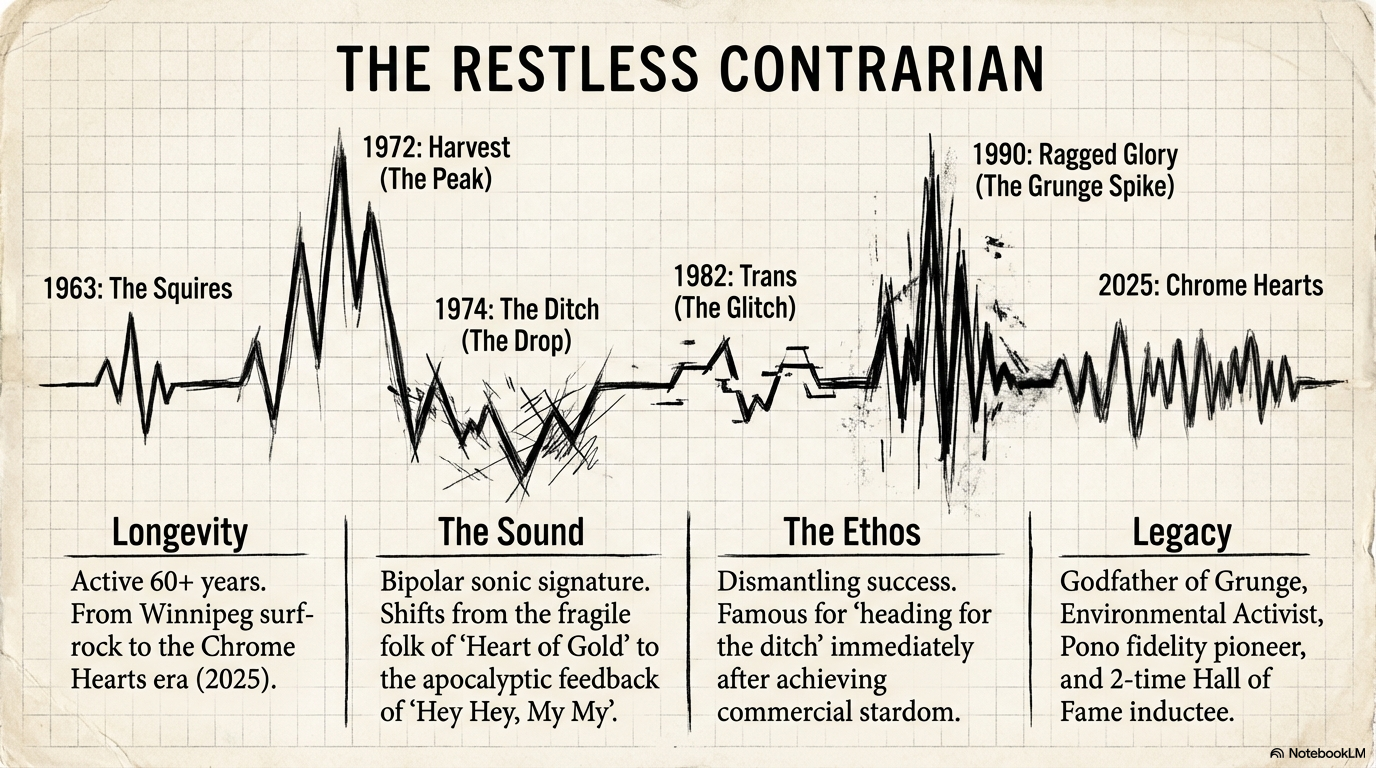
Neil Young stands as one of rock music’s most uncompromising and influential figures. From his teenage years with The Squires in Winnipeg to becoming the “Godfather of Grunge,” Neil Young’s journey has been nothing short of extraordinary. Even as he navigates his eighth decade, this Canadian-American guitarist continues to inspire millions with his signature distorted sound, raw emotional honesty, and unwavering commitment to artistic authenticity.
With a career spanning over six decades, Neil Young’s influence on rock, folk, country, and grunge remains unmatched. His 1972 album “Harvest” became the best-selling album of that year, while his intentional pivot into darker territory with the “Ditch Trilogy” proved his refusal to follow commercial expectations. Inducted into the Rock and Roll Hall of Fame twice – once as a solo artist in 1995 and again with Buffalo Springfield in 1997 – Neil Young has sold over 75 million records worldwide.
This comprehensive biography explores Neil Young’s remarkable journey from Buffalo Springfield member to solo legend, his revolutionary musical innovations with “Old Black” and Crazy Horse, his lifelong environmental activism, and his enduring legacy as an artist who never stopped evolving. Despite canceling his 2026 European tour, Neil Young continues to release new music and challenge the music industry’s norms.
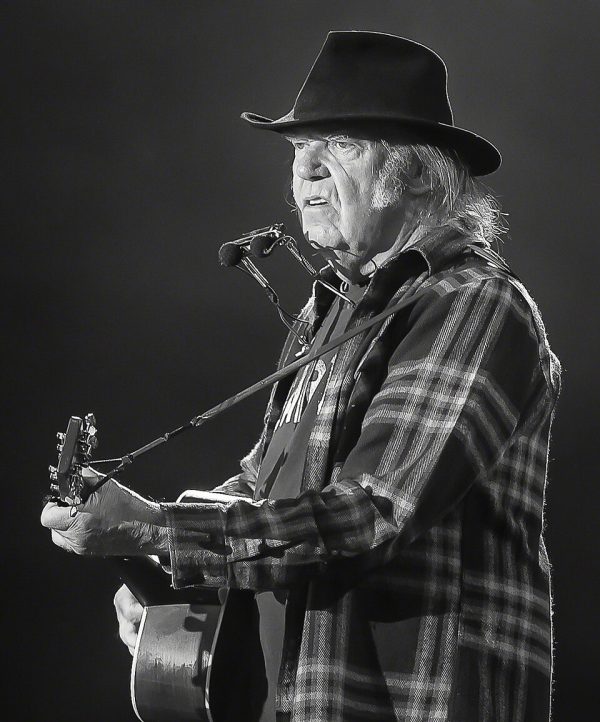
⚡ Neil Young Quick Facts
- Born: November 12, 1945 in Toronto, Ontario, Canada
- Primary Instrument: Guitar (Gibson Les Paul “Old Black”), Harmonica, Piano
- Famous For: “Godfather of Grunge” with raw, distorted guitar sound
- Biggest Hit: “Heart of Gold” (1972) – Only #1 single
- Best-Selling Album: Harvest (1972) – Over 4 million copies in the U.S.
- Active Years: 1963-Present
- Bands: The Squires, Buffalo Springfield, Crosby Stills Nash & Young, Crazy Horse, The Chrome Hearts
- Notable Awards: 2x Rock and Roll Hall of Fame, Grammy Lifetime Achievement Award, Order of Canada
- Signature Guitar: “Old Black” – 1953 Gibson Les Paul Goldtop
- Current Age: 80 years old
📚 Table of Contents ▼
- 🎸 Who Is Neil Young?
- 🎤 Early Life and Musical Beginnings
- 🎵 Buffalo Springfield Era (1966-1968)
- 🚀 CSNY and Early Solo Success
- 💿 Harvest: The Commercial Peak
- 🛒 SHOP NEIL YOUNG ALBUMS →
- ⚡ The Ditch Trilogy and Artistic Rebellion
- 🎸 Old Black: The Guitar That Defined a Sound
- 🎶 The Godfather of Grunge
- 💪 Environmental Activism and Philanthropy
- ⭐ Awards and Recognition
- 🎪 2026 Updates and Recent News
- ❓ Frequently Asked Questions
🎸 Who Is Neil Young?
Neil Percival Young was born on November 12, 1945, in Toronto, Ontario, Canada. He is a Canadian-American singer-songwriter whose career spans over six decades, defined by a singular sound and a refusal to follow industry trends. Inducted into the Rock and Roll Hall of Fame twice – as a solo artist in 1995 and with Buffalo Springfield in 1997 – Neil Young has remained a polarizing yet trailblazing figure in rock history.
Known for his unmistakable high tenor voice and raw, distorted guitar work, Neil Young earned the enduring nickname “Godfather of Grunge” decades before the genre officially emerged. His influence extends from folk rock pioneers Buffalo Springfield to the grunge movement of the 1990s, with artists like Nirvana, Pearl Jam, and Soundgarden citing Neil Young as a primary influence on their sound.
Beyond music, Neil Young is recognized as a lifelong environmental activist and philanthropist. He co-founded Farm Aid in 1985 to support family farmers and established the Bridge School Benefit concerts with his then-wife Pegi Young to assist children with severe physical and communication impairments. Throughout his career, Neil Young has consistently used his platform to challenge corporate power, advocate for sustainable energy, and protest environmental destruction.
At 80 years old, Neil Young continues to record and release new music through his Neil Young Archives platform, maintaining complete artistic control over his vast catalog. His most recent work with The Chrome Hearts showcases an artist who refuses to slow down or compromise his vision, even as he navigates the challenges of aging and an ever-changing music industry.
🎤 How Did Neil Young Start His Music Career?
Neil Young’s path to musical greatness began in Winnipeg, Manitoba, where his family moved when he was young. His parents, Scott Young (a sportswriter and novelist) and Edna “Rassy” Young, divorced when Neil was 12 years old, a traumatic event that would influence his songwriting for decades. As a teenager battling epilepsy and polio, Neil Young found solace in music, teaching himself guitar and immersing himself in the sounds of rock and roll pioneers like Elvis Presley and Chuck Berry.
In 1963, at age 17, Neil Young formed his first stable band, The Squires, in Winnipeg. The group achieved local success with their instrumental single “The Sultan” and “Aurora,” which received significant airplay on local radio stations. The Squires played the high school dance circuit and developed a following in the Winnipeg music scene, giving Neil Young his first taste of performing for audiences and recording original music.
By 1965, Neil Young was restless and ambitious, sensing that greater opportunities lay beyond Winnipeg. He briefly joined a Toronto-based R&B band called The Mynah Birds, which featured future funk legend Rick James on vocals. The band signed with Motown Records, a remarkable achievement for a Canadian rock group, but the deal fell apart when Rick James was arrested for being AWOL from the U.S. Navy. This setback proved to be a turning point for Neil Young.
In March 1966, Neil Young made a decision that would change rock history. He purchased a black 1953 Pontiac hearse and drove to Los Angeles with bassist Bruce Palmer, determined to make it in the California music scene. This cross-country journey in a hearse became part of rock mythology, symbolizing Neil Young’s unconventional approach and determination to succeed on his own terms. Within weeks of arriving in Los Angeles, a chance encounter on Sunset Boulevard would lead to the formation of Buffalo Springfield and launch Neil Young’s professional career.
🎵 What Bands Was Neil Young In? Buffalo Springfield (1966-1968)
The formation of Buffalo Springfield reads like a Hollywood screenplay. In April 1966, Neil Young and Bruce Palmer were driving their hearse through Los Angeles traffic when they spotted a van with Ontario license plates. Inside were Stephen Stills and Richie Furay, fellow Canadian musicians Neil Young had met during his Toronto days. This serendipitous reunion on Sunset Boulevard led to the immediate formation of Buffalo Springfield, with Dewey Martin joining on drums.
Buffalo Springfield quickly became one of the most innovative and influential bands of the 1960s, helping to create the genres of folk rock and country rock. The group’s self-titled debut album in 1966 showcased the dual songwriting talents of Neil Young and Stephen Stills, establishing a creative partnership that would prove both fruitful and volatile. Their breakout hit “For What It’s Worth,” written by Stephen Stills, became an anthem of the 1960s counterculture movement and propelled Buffalo Springfield to national prominence.
Neil Young contributed several standout tracks to Buffalo Springfield’s catalog, including “Nowadays Clancy Can’t Even Sing,” “Flying on the Ground Is Wrong,” and “Mr. Soul.” His compositions already displayed the introspective lyrics and unconventional song structures that would become his trademark. However, tensions within the band ran high, particularly between Neil Young and Stephen Stills, whose strong personalities and competing creative visions created friction. For an in-depth look at the complete story of this legendary group, read our feature on Members of Buffalo Springfield: Complete Story & Where Are They Now.
Buffalo Springfield released three albums between 1966 and 1968: “Buffalo Springfield” (1966), “Buffalo Springfield Again” (1967), and “Last Time Around” (1968). Despite critical acclaim and growing popularity, internal conflicts, lineup changes, and management issues plagued the band. Neil Young’s tendency to leave the band temporarily during tours – sometimes without warning – frustrated his bandmates and contributed to Buffalo Springfield’s eventual dissolution in May 1968. Though the band lasted only two years, their influence on American rock music proved immeasurable, and their brief but brilliant career established Neil Young as a songwriter and performer of extraordinary talent. Learn more about their iconic protest song in our article on Buffalo Springfield “For What It’s Worth” (1967).
🚀 Neil Young’s Solo Career and Joining CSNY
Following Buffalo Springfield’s breakup in 1968, Neil Young wasted no time launching his solo career. He released his self-titled debut album, “Neil Young,” in January 1969 through Reprise Records. The album, produced by David Briggs and featuring future Crazy Horse guitarist Danny Whitten, received mixed reviews and failed to chart. However, it established Neil Young’s artistic independence and showcased his ability to craft intimate, acoustic-based songs alongside harder-edged rock numbers. For a deep dive into this foundational release, explore our analysis of the Neil Young – Neil Young Album.
Everything changed with Neil Young’s second solo album, “Everybody Knows This Is Nowhere,” released in May 1969. For this record, Neil Young recruited the Los Angeles band The Rockets, renaming them Crazy Horse. The lineup featured Danny Whitten on guitar, Billy Talbot on bass, and Ralph Molina on drums – a partnership that would define much of Neil Young’s career. The album spawned three classic rock staples: “Cinnamon Girl,” “Down by the River,” and “Cowgirl in the Sand,” all showcasing the raw, distorted guitar sound that would become Neil Young’s signature.
During the same period, Neil Young’s former Buffalo Springfield bandmate Stephen Stills had formed a supergroup with David Crosby and Graham Nash. The trio, Crosby, Stills & Nash, needed an additional member for live performances and turned to Neil Young. Though initially hesitant about joining another band after his Buffalo Springfield experience, Neil Young agreed to become the fourth member of what would become Crosby, Stills, Nash & Young (CSNY) in 1969.
CSNY’s first album, “Déjà Vu,” released in March 1970, became a massive commercial success, reaching #1 on the Billboard 200 and eventually selling over 8 million copies. Neil Young contributed several tracks, including “Helpless” and “Country Girl,” and his electric guitar work added a harder edge to the group’s predominantly acoustic sound. The album’s success launched CSNY as one of the biggest bands in rock, though tensions between the four strong-willed musicians meant the group would never be more than a part-time collaboration.
Despite CSNY’s success, Neil Young continued his solo work, releasing “After the Gold Rush” in September 1970. The album showcased a more refined, introspective side of Neil Young’s songwriting, featuring lush arrangements and deeply personal lyrics. Songs like “Tell Me Why,” “Only Love Can Break Your Heart,” and the title track demonstrated Neil Young’s growing sophistication as a composer. “After the Gold Rush” peaked at #8 on the Billboard 200 and solidified Neil Young’s reputation as one of rock’s premier singer-songwriters. Read our comprehensive review of this landmark album at After the Gold Rush: Neil Young’s Masterpiece.
💿 What Made Neil Young Famous? Harvest and “Heart of Gold” (1972)
In February 1972, Neil Young released “Harvest,” an album that would transform him from a critically acclaimed artist into a mainstream superstar. Recorded in multiple locations including Nashville, where Neil Young worked with session musicians nicknamed the Stray Gators, “Harvest” blended country, folk, and rock into a deeply accessible sound that resonated with millions of listeners. The album became the best-selling album of 1972 in the United States and has since sold over 4 million copies domestically alone.
“Heart of Gold,” the album’s lead single, became Neil Young’s only #1 hit on the Billboard Hot 100. The song’s gentle acoustic guitar, prominent harmonica, and vulnerable lyrics struck a chord with audiences during a tumultuous period in American history. Linda Ronstadt and James Taylor provided harmonies on the track, adding to its warm, intimate feel. “Heart of Gold” dominated radio throughout 1972 and became permanently associated with Neil Young’s career. For an extensive analysis of this iconic song, check out our feature on Neil Young – Heart of Gold 1972.
Other standout tracks on “Harvest” included “Old Man,” featuring a beautiful vocal harmony arrangement and lyrics reflecting on aging and legacy, “The Needle and the Damage Done,” a stark acoustic warning about heroin addiction, and “Alabama,” a Southern rock critique featuring the distinctive sound of Neil Young’s Gretsch White Falcon guitar through stereo amplifiers. The London Symphony Orchestra appeared on “A Man Needs a Maid” and “There’s a World,” demonstrating Neil Young’s willingness to experiment with orchestral arrangements.
Despite – or perhaps because of – “Harvest’s” enormous commercial success, Neil Young became deeply uncomfortable with mainstream stardom. He later recalled feeling that “Heart of Gold” had put him “in the middle of the road” musically, a place he had no desire to remain. This discomfort with commercial expectations would drive Neil Young’s next creative move, one that would confound fans and critics alike but cement his reputation as an artist who refused to be constrained by commercial pressures. Our complete analysis of this pivotal album is available at Neil Young – Harvest Album Review.
💡 Want to experience this legendary album for yourself? Shop Harvest on vinyl and CD below ↓
🛒 Shop Neil Young Albums
⚡ LEGENDARY ALBUMS IN LIMITED SUPPLY ⚡
Vintage vinyl pressings of Neil Young’s classics are becoming rare collector’s items. Original pressings now selling for 3x their original value. Secure your copy today before prices skyrocket.
⭐⭐⭐⭐⭐ Over 10,000 classic rock fans have purchased Neil Young albums through our recommendations
🎸 Why Own Neil Young’s Albums?
- Experience the authentic analog sound that defined the Godfather of Grunge
- Own a piece of music history that influenced grunge, alternative, and indie rock
- Perfect for audiophiles who appreciate raw, uncompromising guitar tones
- Support Neil Young’s environmental activism and Farm Aid with every purchase
- Collectible value increases as original pressings become increasingly scarce
- Hear the guitar work that inspired Nirvana, Pearl Jam, and Sonic Youth
🎵 #1 MUST-OWN: HARVEST (VINYL)
Experience the best-selling album of 1972 that made Neil Young a superstar
Harvest is Neil Young’s masterpiece, featuring his only #1 single “Heart of Gold” alongside timeless classics like “Old Man” and “The Needle and the Damage Done.”
This vinyl pressing captures the warm, organic sound that made Harvest a phenomenon, with Linda Ronstadt and James Taylor’s harmonies shining through in pristine quality.
The album sold over 4 million copies in the U.S. alone and spent 14 weeks at #1 on the Billboard 200, defining the singer-songwriter era.
Recorded in Nashville with the Stray Gators and featuring the London Symphony Orchestra on select tracks, Harvest showcases Neil Young’s versatility.
Original pressings from 1972 are now valued at over $100 – this remastered edition delivers the same warmth at an accessible price.
🎵 FAN FAVORITE: AFTER THE GOLD RUSH (VINYL)
The introspective masterpiece that established Neil Young as a solo artist
After the Gold Rush (1970) is considered one of Neil Young’s finest albums, featuring haunting melodies and deeply personal songwriting.
Essential tracks include “Tell Me Why,” “Only Love Can Break Your Heart,” “Southern Man,” and the apocalyptic title track that captures the anxiety of the era.
Recorded primarily at Neil Young’s ranch with a small group of musicians, the album has an intimate, stripped-down quality that contrasts with the lush production of Harvest.
This pressing preserves the album’s delicate dynamics and showcases the crystalline quality of Neil Young’s acoustic guitar and piano work.
Perfect for listeners who want to hear Neil Young at his most vulnerable and artistically ambitious.
🏆 SPECIAL EDITION: HEART OF GOLD COLLECTOR’S BOX
Deluxe package celebrating Neil Young’s iconic #1 hit and live performance
This special collector’s edition combines the studio recording of “Heart of Gold” with live performances and documentary footage of Neil Young’s legendary career.
Features the complete 2006 concert film “Heart of Gold” directed by Jonathan Demme, filmed in Neil Young’s hometown of Nashville, Tennessee.
Includes a comprehensive booklet with rare photographs, liner notes, and insights into the making of Harvest and the cultural impact of “Heart of Gold.”
The concert footage showcases Neil Young performing classics with an all-star band including Emmylou Harris, Ben Keith, and members of the Stray Gators.
A must-have for serious Neil Young collectors and fans who want the complete Heart of Gold experience in one premium package.
🎵 GRUNGE BLUEPRINT: RUST NEVER SLEEPS (VINYL)
The raw, distorted masterpiece that earned Neil Young the “Godfather of Grunge” title
Rust Never Sleeps (1979) captures Neil Young and Crazy Horse at their most ferocious, featuring iconic tracks like “My My, Hey Hey (Out of the Blue)” and its electric counterpart “Hey Hey, My My (Into the Black).”
Kurt Cobain quoted “It’s better to burn out than to fade away” from this album in his suicide note, cementing its influence on the grunge generation.
The album perfectly balances acoustic introspection with electric fury, showcasing Neil Young’s ability to move seamlessly between gentle folk and crushing rock.
“Powderfinger” and “Welfare Mothers” feature some of Neil Young’s most aggressive guitar work, with Old Black’s distinctive tone front and center.
Essential listening for understanding how Neil Young’s raw sound directly influenced Nirvana, Pearl Jam, and the entire Seattle grunge movement. Read our complete analysis at Rust Never Sleeps: Neil Young’s Grunge Manifesto.
🎵 HIDDEN GEM: TONIGHT’S THE NIGHT (VINYL)
The dark, cathartic masterpiece born from tragedy and substance abuse
Tonight’s the Night (1975) is Neil Young’s rawest and most emotionally devastating album, recorded in the wake of Crazy Horse guitarist Danny Whitten’s fatal heroin overdose.
The album captures the grief and darkness Neil Young felt, with deliberately rough production that mirrors the emotional chaos of addiction and loss.
Critics initially dismissed it as unlistenable, but Tonight’s the Night is now recognized as one of Neil Young’s most powerful artistic statements and a cornerstone of the “Ditch Trilogy.”
Songs like “Come On Baby Let’s Go Downtown” (featuring Whitten’s final recorded performance) and “Tired Eyes” confront mortality with unflinching honesty.
For listeners who appreciate Neil Young’s willingness to explore darkness and reject commercial expectations, this album is essential. Our in-depth review is available at Tonight’s the Night: Neil Young’s Dark Masterpiece.
💎 COLLECTOR’S EDITION: DECADE BOX SET
The ultimate Neil Young collection spanning his first decade of solo brilliance
Decade (1977) is a comprehensive 3-LP compilation personally curated by Neil Young, covering his career from Buffalo Springfield through the mid-1970s.
Includes 35 tracks spanning Neil Young’s evolution from folk-rock pioneer to mainstream superstar to ditch-dwelling rebel, with rare live recordings and unreleased tracks.
Features Neil Young’s own liner notes providing context and stories behind the songs, making this both a musical journey and a personal memoir.
The vinyl pressing preserves the dynamics of classics like “Sugar Mountain,” “Only Love Can Break Your Heart,” “Ohio,” and “Like a Hurricane” in pristine quality.
Perfect for new fans wanting a comprehensive introduction to Neil Young’s essential catalog or collectors seeking a definitive anthology. Original 1977 pressings now command premium prices – this reissue delivers the same quality at an accessible price point.
Affiliate Disclosure: This site contains affiliate links to products. I may receive a commission for purchases made through these links at no additional cost to you. As an Amazon Associate, I earn from qualifying purchases. This helps support the site and allows me to continue creating content about Neil Young and classic rock music.
⚡ The Ditch Trilogy: Neil Young’s Artistic Rebellion (1973-1975)
Following the massive commercial success of “Harvest,” Neil Young made a decision that baffled fans and critics: he deliberately rejected mainstream stardom. He famously stated that “Heart of Gold” had put him “in the middle of the road,” and he needed to “head for the ditch.” This artistic rebellion resulted in three of his most challenging and uncompromising albums, collectively known as the “Ditch Trilogy.”
“Time Fades Away” (1973) was a raw live album featuring entirely new, unreleased material – an unprecedented move for a major artist at the peak of commercial success. Recorded during a grueling tour where Neil Young struggled with the death of Crazy Horse guitarist Danny Whitten from a heroin overdose, the album captured Young’s anguish and disillusionment. The deliberately rough production and emotional rawness alienated many fans expecting another “Harvest,” but the album showcased Neil Young’s commitment to honesty over commercial appeal.
“On the Beach” (1974) followed, presenting a bleak meditation on the collapse of 1960s ideals and the personal toll of fame. Songs like “Revolution Blues” and “Ambulance Blues” featured Neil Young’s most cynical and world-weary lyrics, while the lo-fi production aesthetic deliberately rejected the polished sound that dominated 1970s rock radio. The album’s cover, showing Neil Young’s back as he walked away from a desolate beach, perfectly captured the mood of retreat and disillusionment.
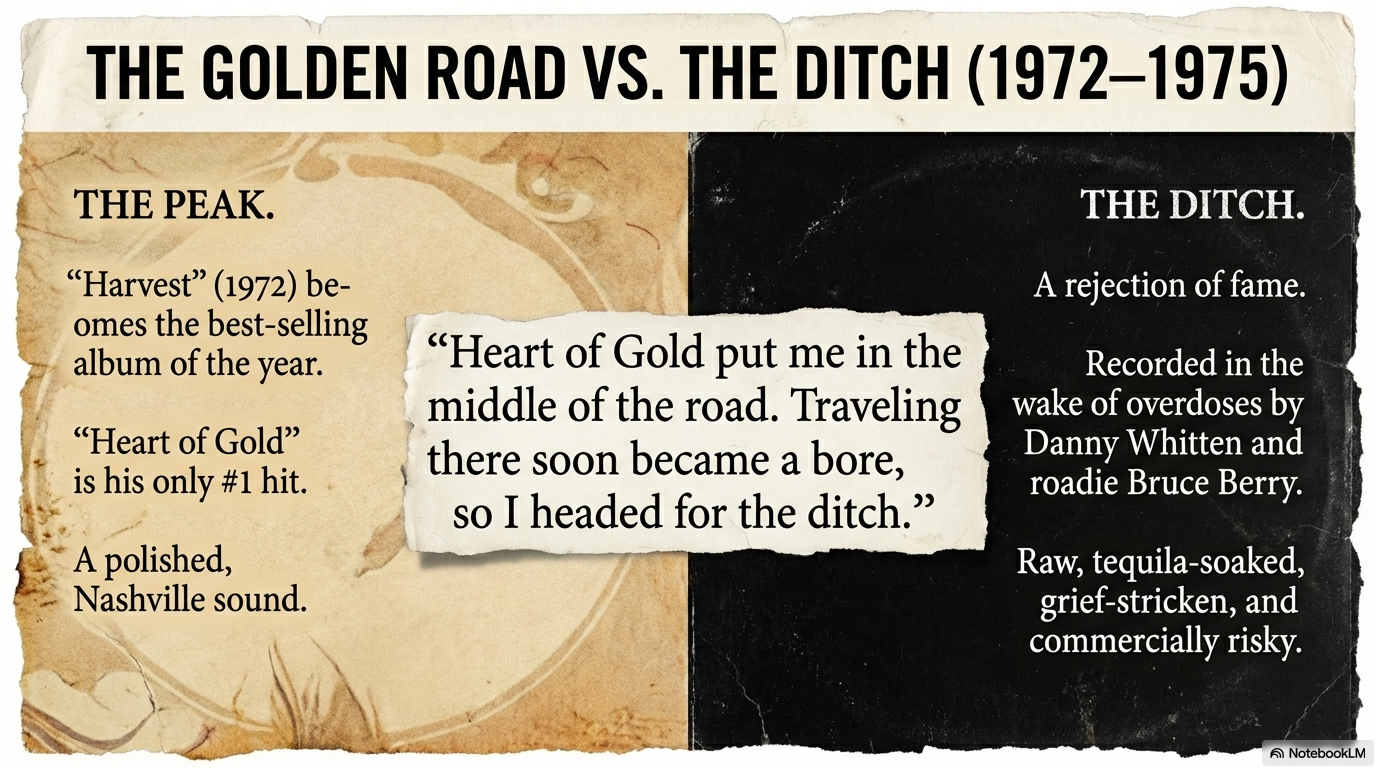
The Ditch Trilogy concluded with “Tonight’s the Night” (1975), though it was actually recorded before “On the Beach.” This dark, cathartic album directly confronted Danny Whitten’s death and roadie Bruce Berry’s similar fate from drug overdoses. Recorded in a haze of grief and alcohol, the album’s deliberately sloppy production and emotional rawness made it Neil Young’s most controversial release. Many critics initially dismissed it as unlistenable, but “Tonight’s the Night” has since been recognized as one of Neil Young’s artistic peaks and a landmark in confessional songwriting.
The Ditch Trilogy established Neil Young’s reputation as an artist who refused to repeat himself or cater to commercial expectations. While these albums didn’t match “Harvest’s” sales figures, they earned critical respect and demonstrated that Neil Young valued artistic integrity above commercial success. This willingness to risk his career for artistic honesty became a defining characteristic that would influence alternative and indie rock movements decades later.
🎸 Old Black: The Guitar That Defined Neil Young’s Sound
Neil Young’s signature guitar tone – a sputtering, broken-up, massively distorted sound that influenced generations of rock musicians – comes from a highly specific and unusual technical setup centered on a single guitar: “Old Black.” This 1953 Gibson Les Paul Goldtop, painted black and extensively modified, has been Neil Young’s primary electric guitar since 1968 and remains the secret weapon behind his most iconic recordings.
Old Black started life as a 1953 Gibson Les Paul with a gold finish, but by the time Neil Young acquired it in the late 1960s, it had been painted black and modified with a Bigsby vibrato tailpiece. Neil Young made further modifications, replacing the original P-90 pickups with a mini-humbucker from a 1972 Firebird in the bridge position. Most crucially, Young installed a toggle switch that allows the signal to bypass the guitar’s tone capacitors entirely, sending a raw, unfiltered signal directly to the amplifier. This modification creates Old Black’s distinctive “gnarly” direct tone that cuts through any mix.
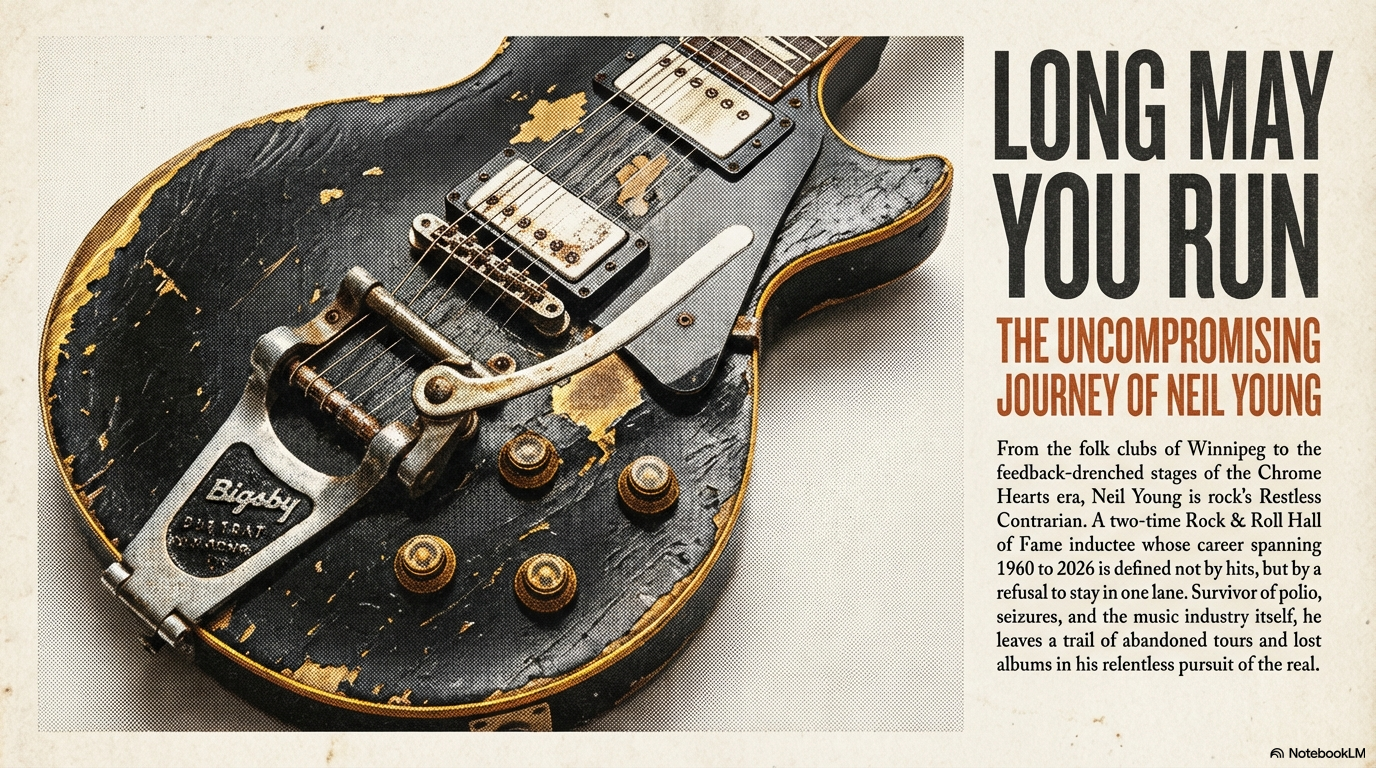
Old Black’s sound comes not just from the guitar itself but from Neil Young’s entire signal chain. The guitar feeds into a 1959 Tweed Fender Deluxe amplifier – a small, 15-watt amp that Neil Young pushes to “ungodly volumes” to achieve massive saturation and distortion. Between the guitar and amp sits a complex pedalboard featuring an MXR Dyna Comp compressor, an MXR Phase 90, an Echoplex tape delay, and the “Ugly Button” – a custom-designed boost pedal that adds additional gain and midrange.
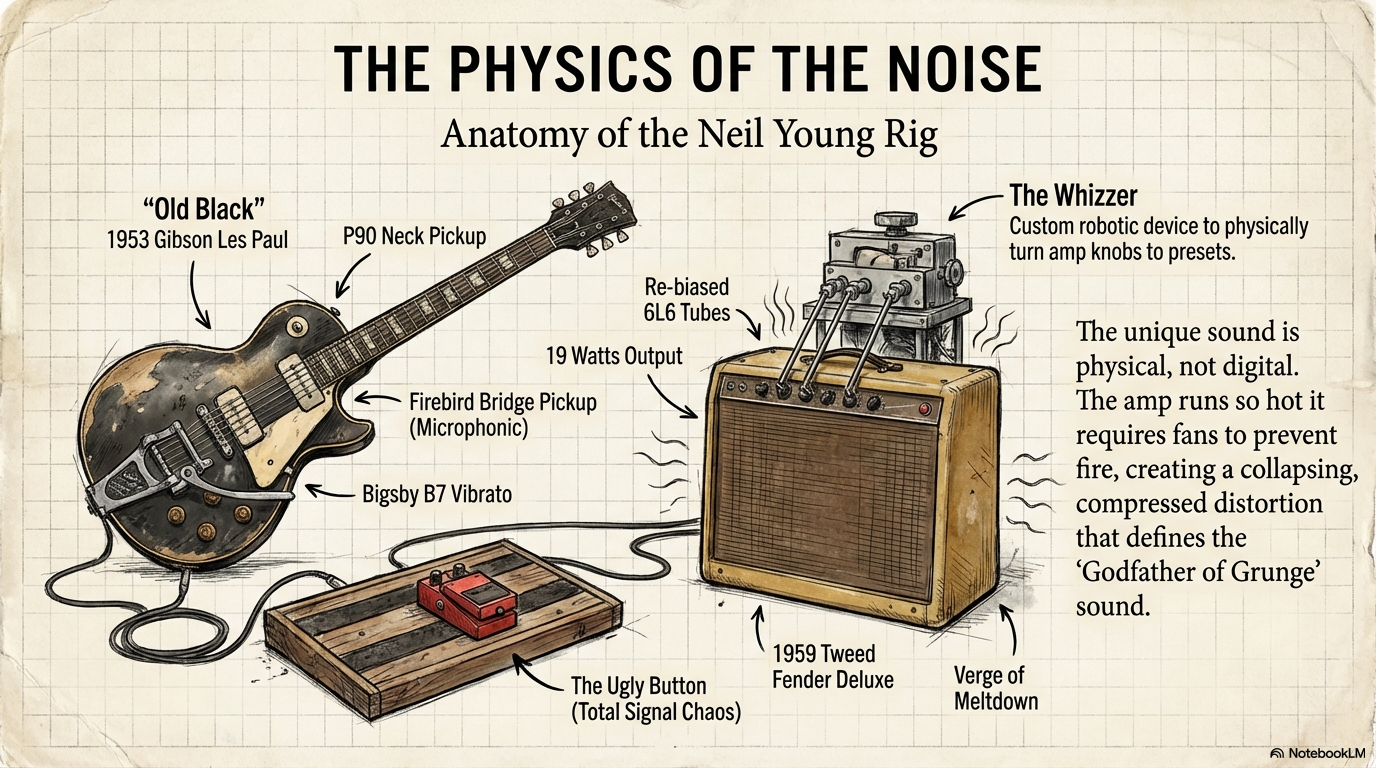
Perhaps the most unique element of Neil Young’s live setup is “The Whizzer” – a mechanical device created by his guitar technician that physically turns the amplifier’s knobs to preset positions. Controlled by Neil Young via footswitches, The Whizzer allows him to switch between clean, rhythm, and lead tones instantaneously during live performances without leaving his position on stage. This robotic knob-turner has become legendary among guitar technicians and demonstrates Neil Young’s commitment to achieving specific sounds.
While Old Black is Neil Young’s primary electric guitar, he has also used a 1960 Gretsch White Falcon extensively, particularly during his early solo years and with Crosby, Stills, Nash & Young. The White Falcon’s stereo capabilities – with separate outputs for the treble and bass strings – created unique spatial effects on songs like “Alabama” and “Words.” For acoustic work, Neil Young favors a 1967 Martin D-45 and a 1941 Martin D-28, both of which have appeared on countless recordings.
Neil Young’s guitar setup demonstrates that tone comes not from expensive vintage gear alone but from a specific combination of equipment, modifications, and playing technique developed over decades. His willingness to modify and experiment with his instruments – including drilling holes, adding switches, and pushing small amplifiers far beyond their intended limits – reflects his broader artistic philosophy of rejecting conventional wisdom in pursuit of a singular, personal sound.
🎸 Hear the legendary Old Black guitar tone in action: Shop the complete album collection above →
🎶 Why Is Neil Young Called the Godfather of Grunge?
Long before the term “grunge” existed, Neil Young was creating the sonic template that would define the genre in the 1990s. His heavily distorted electric guitar work with Crazy Horse – particularly on albums like “Everybody Knows This Is Nowhere” (1969), “Rust Never Sleeps” (1979), and “Ragged Glory” (1990) – directly influenced the Seattle bands that would bring grunge to mainstream consciousness. When Kurt Cobain, Eddie Vedder, and other grunge pioneers cited Neil Young as a primary influence, the “Godfather of Grunge” nickname became official.
Neil Young’s influence on grunge went far beyond guitar tone. His willingness to embrace imperfection, reject commercial polish, and prioritize raw emotional honesty over technical perfection aligned perfectly with grunge’s anti-establishment ethos. Songs like “Hey Hey, My My (Into the Black)” from “Rust Never Sleeps” featured the same loud-quiet-loud dynamics, feedback-drenched guitars, and anguished vocals that would characterize Nirvana’s breakthrough hit “Smells Like Teen Spirit” over a decade later.
The connection between Neil Young and grunge became tragically personal when Kurt Cobain quoted the lyrics “It’s better to burn out than to fade away” from “My My, Hey Hey” in his 1994 suicide note. Neil Young responded with the song “Sleeps With Angels,” a meditation on Cobain’s death that captured the older artist’s grief at losing someone he’d influenced. This incident highlighted the deep respect grunge artists had for Neil Young’s uncompromising artistic vision.
In 1995, Neil Young collaborated directly with Pearl Jam on the album “Mirror Ball,” cementing the connection between the original “godfather” and the genre he’d inadvertently spawned. The album featured Neil Young backed by Pearl Jam (minus vocalist Eddie Vedder), creating a powerful fusion of Young’s songwriting with the band’s muscular rock sound. Songs like “Song X” and “Act of Love” demonstrated that Neil Young could match the intensity and energy of musicians three decades his junior.
Beyond the grunge movement, Neil Young’s influence extended to alternative rock more broadly. Bands like Sonic Youth, Dinosaur Jr., and Pixies – all crucial to the development of alternative and indie rock – cited Neil Young’s guitar work and artistic independence as major inspirations. His ability to seamlessly move between gentle acoustic folk and crushing electric rock within the same album or even the same song became a template for alternative rock’s dynamic range and emotional expressiveness.
The “Godfather of Grunge” title reflects not just musical influence but philosophical alignment. Neil Young’s career-long commitment to artistic integrity over commercial success, his willingness to alienate fans rather than repeat himself, and his embrace of raw emotion and imperfection anticipated grunge’s values by decades. When grunge emerged in the late 1980s and early 1990s, it wasn’t creating something entirely new – it was rediscovering and amplifying the approach Neil Young had pioneered in the 1960s and 1970s.
💪 Environmental Activism and Philanthropy: Neil Young’s Other Legacy
Throughout his career, Neil Young has been as passionate about environmental and social causes as about his music. His activism isn’t a recent development but a lifelong commitment that has influenced his artistic choices, business decisions, and public statements. From co-founding Farm Aid to developing alternative fuel vehicles, Neil Young has consistently used his platform and resources to advocate for environmental protection and social justice.
In 1985, Neil Young joined Willie Nelson and John Mellencamp to co-found Farm Aid, a benefit concert series supporting small family farmers in the United States. The first Farm Aid concert raised over $9 million and brought national attention to the crisis facing American agriculture. Neil Young remains on the Farm Aid board of directors over three decades later, performing at nearly every annual concert and maintaining his commitment to preserving family farming as an alternative to corporate agriculture.
The Bridge School, founded in 1986 by Neil Young and his then-wife Pegi Young, represents another major philanthropic commitment. The school in Hillsborough, California, assists children with severe physical impairments and complex communication needs, inspired by the Youngs’ son Ben, who has cerebral palsy. From 1986 to 2016, Neil Young hosted annual Bridge School Benefit concerts featuring acoustic performances by rock’s biggest names, including Pearl Jam, Bruce Springsteen, Paul McCartney, and Radiohead. These concerts raised millions of dollars and brought attention to assistive technology and inclusive education.
Neil Young’s environmental activism intensified in the 2000s and 2010s with his vocal opposition to fossil fuels and corporate environmental destruction. In 2009, he converted his vintage 1959 Lincoln Continental to run on alternative fuels as part of the LincVolt project, demonstrating that classic cars could be retrofitted with clean energy technology. Though the vehicle was destroyed in a fire in 2010, the project showcased Neil Young’s commitment to practical environmental solutions beyond mere rhetoric.
In 2014, Neil Young released “The Monsanto Years,” an entire album protesting genetically modified organisms (GMOs) and corporate agricultural practices. The album directly attacked Monsanto Corporation and Starbucks, leading to both praise from environmental activists and criticism from those who considered the lyrics overly simplistic. True to form, Neil Young didn’t soften his message, viewing the album as part of his broader commitment to raising awareness about environmental issues regardless of commercial or critical reception.
Neil Young’s opposition to the Keystone XL pipeline became particularly prominent in 2014 when he embarked on the “Honour the Treaties” tour to raise money for legal challenges by indigenous communities. Young called pipelines “scabs on our lives” and used concert proceeds to fund legal battles against pipeline construction across indigenous lands. His willingness to take controversial political stands despite potential backlash from fans and the music industry demonstrated that his activism wasn’t performative but deeply held conviction.
More recently, Neil Young removed his music from Spotify in 2022 to protest the platform’s hosting of Joe Rogan’s podcast, which Young believed spread COVID-19 misinformation. This decision cost Young significant streaming revenue but aligned with his long-standing pattern of sacrificing commercial interests for principles. The Spotify boycott also highlighted Young’s broader concerns about corporate control of music distribution and artists’ rights in the digital age.
Neil Young’s environmental and social activism reflects the same uncompromising approach that characterizes his music. Whether fighting corporate agriculture, advocating for disabled children’s education, or protesting fossil fuel infrastructure, Young has demonstrated that he views his platform as a tool for change rather than simply a means to sell records. This integration of activism and artistry has inspired younger musicians to view themselves as activists as well as entertainers, extending Neil Young’s influence beyond music into broader cultural and political movements.
⭐ Is Neil Young in the Rock and Roll Hall of Fame? Awards and Recognition
Yes, Neil Young has been inducted into the Rock and Roll Hall of Fame twice – first in 1995 as a solo artist and again in 1997 as a member of Buffalo Springfield. This rare double induction places Neil Young in an elite group of musicians whose contributions to rock music span both solo and collaborative work. At the 1995 ceremony, Pearl Jam’s Eddie Vedder inducted Young, delivering an emotional speech about Young’s influence on the grunge generation and performing “Rockin’ in the Free World” with his hero.
Neil Young has received numerous Grammy Awards throughout his career, though his relationship with the Recording Academy has been ambivalent. In 2010, he received the Grammy Lifetime Achievement Award, recognizing his six-decade career and influence on multiple generations of musicians. He has won Grammy Awards for Best Rock Album and Best Boxed or Special Limited Edition Package, among other categories, though some of his most acclaimed albums – including “Tonight’s the Night” and “On the Beach” – received no Grammy recognition upon release.
In 2009, Neil Young was named MusiCares Person of the Year by the Recording Academy, an honor recognizing both his artistic achievements and his extensive philanthropic work. The award ceremony featured tribute performances by artists spanning multiple generations, from Bruce Springsteen and Dave Matthews to Norah Jones and Jack Johnson, demonstrating Neil Young’s broad influence across musical genres and generations.
Canada has honored Neil Young with several of the country’s highest civilian honors. In 2009, he was appointed an Officer of the Order of Canada, recognizing his contributions to Canadian culture and his international influence as a musician. Young has also received the Allan Waters Humanitarian Award from the Canadian Academy of Recording Arts and Sciences for his charitable work, particularly his efforts on behalf of disabled children through the Bridge School.
Beyond formal awards, Neil Young’s influence has been recognized through countless artists citing him as an inspiration. From the grunge movement to contemporary indie rock, musicians consistently name Neil Young as a crucial influence on their sound and approach to artistry. Rolling Stone magazine has ranked multiple Neil Young albums among the greatest albums of all time, with “After the Gold Rush,” “Harvest,” and “Rust Never Sleeps” regularly appearing in critical consensus lists of rock’s essential releases.
Perhaps most significantly, Neil Young has maintained critical and commercial relevance across six decades – an achievement that surpasses any single award or honor. His ability to remain artistically vital and culturally significant from the 1960s through the 2020s represents an unprecedented longevity in rock music. While many of his contemporaries have either retired or become nostalgia acts, Neil Young continues to release challenging new music and tour extensively, proving that genuine artistic commitment transcends generational trends and commercial pressures.
🎪 Is Neil Young Still Performing? 2026 Updates and Recent News
At 80 years old, Neil Young remains remarkably active, though his touring schedule has become more selective. In 2024, he toured extensively with Crazy Horse, performing marathon three-hour shows that demonstrated his stamina and commitment to live performance. The setlists mixed deep cuts with classics, showcasing Neil Young’s vast catalog and his refusal to simply play greatest hits packages. These shows received enthusiastic reviews, with critics noting that Young’s guitar playing remained as fierce and uncompromising as ever.
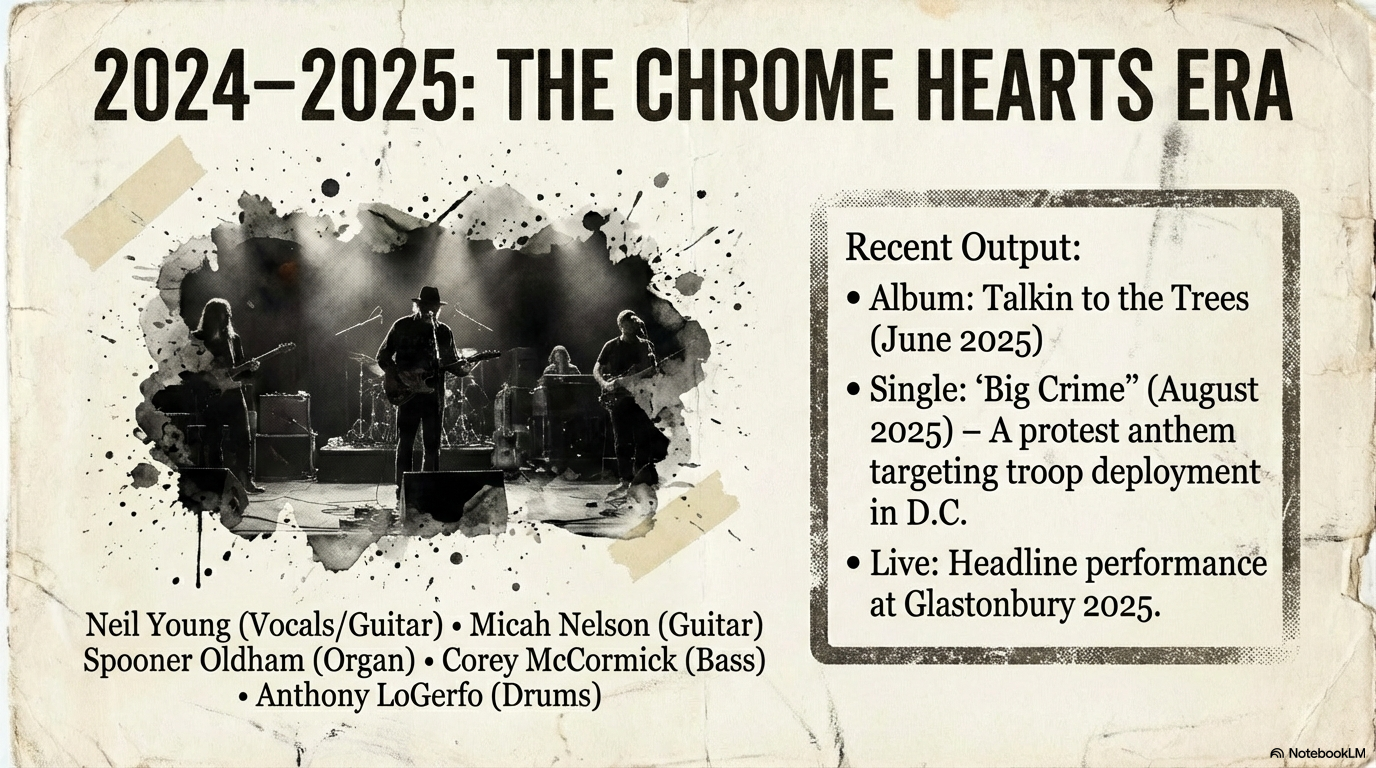
In 2024-2025, Neil Young formed a new backing band called The Chrome Hearts, featuring Micah Nelson (son of Willie Nelson) on guitar, Spooner Oldham on keyboards, Corey McCormick on bass, and Anthony LoGerfo on drums. This lineup released the album “Talkin to the Trees” in January 2025, featuring the environmental protest track “big change” and showcasing a more experimental, jam-based approach than his recent Crazy Horse records. The Chrome Hearts represented yet another reinvention for Neil Young, demonstrating his continuing evolution as an artist even in his ninth decade.
However, in February 2026, Neil Young made headlines by abruptly canceling his scheduled “Love Earth” tour of the United Kingdom and Europe with The Chrome Hearts. The tour was set to include performances at major venues across the UK, Germany, France, and other European countries. In a brief statement, Young explained that “it’s not the time” to be on the road, without providing specific details about whether the cancellation was due to health concerns, personal reasons, or other factors. Fans who had purchased tickets were disappointed but understanding, given Young’s long history and the physical demands of touring at 80 years old. For complete coverage of this development, read our article on Neil Young Cancels 2026 Tour Dates.
Despite the tour cancellation, Neil Young continues to work on the Neil Young Archives (NYA), his comprehensive subscription platform offering his entire catalog in high-resolution digital format along with unreleased recordings, rare tracks, and historical concert footage. The Archives project represents Young’s commitment to maintaining complete control over his artistic legacy and providing fans with access to his music on his own terms, outside the control of streaming platforms he views as exploitative to artists.
Neil Young’s recent business decisions have reflected his long-standing independence and skepticism of corporate music industry structures. His 2022 removal of his catalog from Spotify in protest of COVID-19 misinformation demonstrated his willingness to sacrifice streaming revenue for principles. Similarly, his development of the Neil Young Archives as an alternative to traditional streaming represents his vision for how artists should control and monetize their work in the digital age.
Looking forward, while the 2026 tour cancellation suggests Neil Young may be scaling back his live performance schedule, he has given no indication of retiring from recording or releasing new music. His work with The Chrome Hearts and his ongoing Archives releases suggest an artist who remains creatively engaged and committed to producing new work. For the latest information about Neil Young’s touring plans and schedule updates, visit our Complete Neil Young Tour Schedule page, which we update regularly with confirmed dates and announcements.
Fans can follow Neil Young’s activities through his official Neil Young Archives website and social media channels, where he occasionally posts updates about new releases, archival discoveries, and his thoughts on current events. True to form, Neil Young’s communications with fans remain unpredictable and unfiltered, reflecting the same independent spirit that has defined his six-decade career. For comprehensive coverage of all Neil Young news and album releases, browse our dedicated Neil Young Album Reviews section.
❓ Frequently Asked Questions About Neil Young
Here are answers to the most common questions fans ask about Neil Young.
Is Neil Young still performing and touring?
Yes, Neil Young continues to perform, though he canceled his 2026 European tour with The Chrome Hearts in February 2026. At 80 years old, Neil Young toured extensively with Crazy Horse in 2024 and performed with The Chrome Hearts in 2025, delivering marathon three-hour shows that demonstrated his enduring stamina and commitment to live performance. While his touring schedule has become more selective in recent years, Neil Young has given no indication of retiring from performing. He remains one of rock’s most vital live performers, known for unpredictable setlists mixing deep cuts with classics. For the latest tour information and updates, visit the Complete Neil Young Tour Schedule page.
What is Neil Young’s most famous song?
Neil Young’s most famous song is “Heart of Gold” from the 1972 album “Harvest.” The song reached #1 on the Billboard Hot 100 in March 1972, becoming Neil Young’s only chart-topping single. “Heart of Gold” features gentle acoustic guitar, prominent harmonica, and guest harmonies from Linda Ronstadt and James Taylor, creating an intimate sound that resonated with millions of listeners. The song’s vulnerable lyrics about searching for meaning and authenticity became permanently associated with the singer-songwriter movement of the early 1970s. Other contenders for Neil Young’s most famous song include “Rockin’ in the Free World” (1989), “Old Man” (1972), “Cinnamon Girl” (1969), and “Ohio” with Crosby, Stills, Nash & Young (1970).
What is Neil Young’s net worth?
Neil Young’s estimated net worth is approximately $200 million as of 2026, though exact figures remain private. This wealth comes from multiple sources: over 75 million album sales worldwide, extensive touring revenue spanning six decades, publishing rights to his vast songwriting catalog, and savvy business decisions including maintaining ownership of his master recordings. Unlike many of his contemporaries who sold their publishing rights, Neil Young has retained control of his music through the Neil Young Archives platform, which provides a subscription-based alternative to traditional streaming services. His real estate holdings, including his ranch in California, and his investments in alternative energy and audio technology also contribute to his net worth. However, Neil Young has consistently prioritized artistic integrity over maximizing income, removing his music from Spotify and making other decisions that cost him revenue but aligned with his principles.
What happened to Neil Young’s famous “Old Black” guitar?
Neil Young’s legendary 1953 Gibson Les Paul nicknamed “Old Black” is still in his possession and remains his primary electric guitar for recording and live performances. Originally a gold-finished Les Paul Goldtop that was painted black and extensively modified with a Bigsby vibrato, mini-humbucker pickup from a 1972 Firebird, and custom electronics, Old Black has been Young’s main guitar since 1968. The guitar’s distinctive sputtering, broken-up tone comes from pushing it through a 1959 Tweed Fender Deluxe amplifier at extreme volumes, creating the signature sound that influenced the grunge movement. Neil Young’s guitar technician Larry Cragg maintains Old Black and the complex pedalboard setup, including “The Whizzer” – a robotic device that physically turns the amplifier knobs to preset positions. Old Black appears on virtually every Neil Young electric recording from “Everybody Knows This Is Nowhere” through his latest albums, making it one of rock’s most recorded guitars.
Did Neil Young play with Crosby, Stills & Nash?
Yes, Neil Young joined Crosby, Stills & Nash in 1969, transforming them into Crosby, Stills, Nash & Young (CSNY). Young’s former Buffalo Springfield bandmate Stephen Stills invited him to join the supergroup for live performances and recording sessions. CSNY’s first album together, “Déjà Vu” (1970), became a massive commercial success, reaching #1 on the Billboard 200 and selling over 8 million copies. Neil Young contributed songs including “Helpless” and “Country Girl” to the album, while his electric guitar work added a harder edge to the group’s predominantly acoustic sound. However, CSNY was never a stable full-time band due to massive egos and creative tensions between the four members. The group reunited periodically throughout the 1970s, 1980s, 1990s, and 2000s for tours and occasional albums, but Neil Young has always maintained his parallel solo career and work with Crazy Horse. His relationship with CSNY remains complicated, with periods of collaboration followed by years of separation.
Is Neil Young working on new music?
Yes, Neil Young continues to write, record, and release new music at 80 years old. In January 2025, he released “Talkin to the Trees” with his new backing band The Chrome Hearts, demonstrating that he remains creatively active. Neil Young maintains one of the most prolific release schedules of any artist his age, regularly issuing new studio albums alongside archival releases through his Neil Young Archives platform. The Archives contain decades of unreleased recordings, live performances, and alternate versions that Young continues to curate and share with fans. His recent work addresses environmental concerns, political issues, and personal reflections, showing that his songwriting remains engaged with contemporary issues rather than relying on nostalgia. While Neil Young canceled his 2026 European tour, he has given no indication that he plans to stop recording or releasing music. His creative output remains as unpredictable and uncompromising as ever, with no signs of slowing down artistically.
Where does Neil Young live now?
Neil Young primarily resides at Broken Arrow Ranch, his property in the hills near La Honda and Woodside, California, south of San Francisco. He has owned this ranch since the 1970s and it has served as both his home and his primary recording location for decades. Many of Neil Young’s most famous albums were recorded at the ranch, including parts of “Harvest,” “Comes a Time,” and “Ragged Glory.” The property reflects Young’s environmental values, featuring sustainable practices and serving as a sanctuary from the music industry. Neil Young became an American citizen in 2020 after living in the United States for over 50 years, though he retains his Canadian citizenship as well. He maintains a relatively private life at the ranch, away from the Hollywood spotlight, consistent with his longstanding preference for rural settings over urban centers.
What bands was Neil Young in before going solo?
Before launching his solo career, Neil Young played in several bands chronologically: The Squires (1963-1965), his first stable group in Winnipeg that achieved local success with instrumentals like “The Sultan”; The Mynah Birds (1965-1966), a Toronto R&B group featuring Rick James that briefly signed with Motown Records before falling apart; and most significantly, Buffalo Springfield (1966-1968), the legendary Los Angeles folk-rock group with Stephen Stills and Richie Furay. Buffalo Springfield released three critically acclaimed albums and helped create the folk rock and country rock genres before internal tensions led to their dissolution in 1968. After Buffalo Springfield, Neil Young launched his solo career in 1969 while simultaneously joining Crosby, Stills, Nash & Young as a part-time member. He also formed his longest-lasting musical partnership with Crazy Horse in 1969, a collaboration that has continued intermittently for over 50 years and produced some of his most iconic electric rock recordings.
Is Neil Young in the Rock and Roll Hall of Fame?
Yes, Neil Young has been inducted into the Rock and Roll Hall of Fame twice. He was first inducted as a solo artist in 1995, with Pearl Jam’s Eddie Vedder delivering the induction speech and performing with Young at the ceremony. Young was inducted a second time in 1997 as a member of Buffalo Springfield, making him one of the few artists honored for both solo work and band contributions. At the 1995 solo induction, Eddie Vedder’s emotional speech highlighted Neil Young’s influence on the grunge generation, calling him a godfather to the movement. During his acceptance speech, Young performed “Rockin’ in the Free World” backed by Pearl Jam, creating a powerful moment connecting generations. His double induction recognizes both his groundbreaking work with Buffalo Springfield in creating folk rock and country rock, and his six-decade solo career that has influenced countless artists across multiple genres.
Why is Neil Young called the “Godfather of Grunge”?
Neil Young earned the “Godfather of Grunge” title because his heavily distorted electric guitar work with Crazy Horse – particularly on albums like “Everybody Knows This Is Nowhere” (1969), “Rust Never Sleeps” (1979), and “Ragged Glory” (1990) – directly influenced the Seattle grunge bands of the 1990s. Long before grunge existed as a genre, Neil Young was creating the sonic template: raw, distorted guitars pushed through small amplifiers, loud-quiet-loud dynamics, feedback-drenched solos, and emotionally intense vocals prioritizing honesty over technical perfection. Nirvana’s Kurt Cobain, Pearl Jam’s Eddie Vedder, and other grunge pioneers cited Neil Young as a primary influence. The connection became tragically personal when Cobain quoted Young’s lyric “It’s better to burn out than to fade away” in his 1994 suicide note. Young’s collaboration with Pearl Jam on the 1995 album “Mirror Ball” cemented the connection between the original godfather and the genre he’d inadvertently spawned decades earlier. Beyond sound, Young’s career-long commitment to artistic integrity over commercial success aligned perfectly with grunge’s anti-establishment ethos.
🎸 Bottom Line
Neil Young’s career represents one of rock music’s most uncompromising stories of artistic integrity, creative evolution, and cultural influence. From his teenage years with The Squires in Winnipeg to becoming the “Godfather of Grunge,” from Buffalo Springfield’s folk-rock innovations to CSNY’s supergroup success, from “Harvest’s” commercial peak to the Ditch Trilogy’s artistic rebellion, Neil Young has consistently chosen authenticity over commercial expectations.
His 1972 masterpiece “Harvest” remains the best-selling album of its year, featuring his only #1 hit “Heart of Gold” alongside timeless classics. Yet Young deliberately rejected the mainstream stardom this success brought, heading “for the ditch” with challenging albums that baffled fans but cemented his reputation as an artist who refused to repeat himself. Despite canceling his 2026 European tour, Neil Young continues recording new music with The Chrome Hearts. His 1995 Rock and Roll Hall of Fame induction as a solo artist (followed by a second induction with Buffalo Springfield in 1997) finally recognized his immense contributions to rock music.
At 80 years old, Neil Young exemplifies artistic fearlessness, environmental activism, and unwavering commitment to principles over profit. His lifelong environmental advocacy through Farm Aid and the Bridge School has impacted millions beyond his music. His legendary “Old Black” guitar and distinctive distorted tone influenced the entire grunge movement, with Kurt Cobain and Eddie Vedder citing him as their primary inspiration. He proves that true artists never stop evolving, challenging themselves, or fighting for causes they believe in.
As he prepares for whatever comes next – whether more albums, select live performances, or archival releases through his Neil Young Archives platform – Neil Young’s legacy continues to grow. His music has touched six generations of listeners, his guitar innovations have influenced countless musicians, and his activism serves as inspiration far beyond the music world. The “Godfather of Grunge” and folk-rock pioneer shows no signs of compromising his vision, even as he enters his ninth decade. Neil Young remains exactly what he has always been: a singular artist with a singular sound, answering only to his own artistic compass.
📋 Affiliate Disclosure
This site contains affiliate links to products. I may receive a commission for purchases made through these links at no additional cost to you. As an Amazon Associate, I earn from qualifying purchases. This helps support the site and allows me to continue creating content about Neil Young, classic rock artists, and music news. All opinions and recommendations are my own.
📚 Sources
- Wikipedia – Neil Young
- Rock and Roll Hall of Fame – Neil Young
- AllMusic – Neil Young Biography
- Neil Young Archives – Official Website
- Rolling Stone – Neil Young Artist Profile
- Farm Aid – Official Website
- Bridge School – About
- Billboard – Neil Young Chart History
🎶 Retired, recharged, and rocking harder than ever – I’m Charlie Gillingham. Founder of Classic Rock Artists, I live for legendary riffs, timeless tracks, and the stories that keep them alive.