

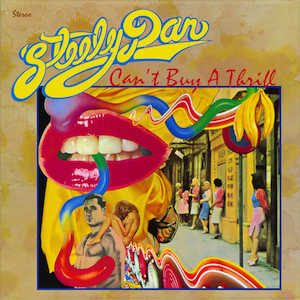
Reelin’ In the Years by Steely Dan arrived in 1972 as one of the sharpest guitar-driven singles of the decade, appearing on the duo’s debut album Can’t Buy a Thrill and immediately establishing the band as a distinct voice in American rock.
Written by Donald Fagen and Walter Becker, the track pairs biting, retrospective lyrics with a guitar solo by Elliott Randall that many consider among the finest in rock history.
Few debut singles from that era matched the musical depth and lyrical precision that made Reelin’ In the Years a permanent fixture on classic rock radio more than fifty years after its release.
Affiliate Disclosure: I am an Amazon affiliate and if you purchase through any amazon links on this site i may earn a small commission at no extra charge to you.
| Song Title | Reelin’ In the Years |
| Artist | Steely Dan |
| Album | Can’t Buy a Thrill (1972) |
| Release Year | 1972 |
| Written By | Donald Fagen, Walter Becker |
| Producer | Gary Katz |
| Label | ABC Records |
| Chart Peak | #11 US Billboard Hot 100 |
Background and Meaning
Thia song was produced by Gary Katz, who became a long-time collaborator of Steely Dan throughout the 1970s.
The song’s lyrics are written from the perspective of a speaker looking back at a failed romantic relationship with a mixture of bitterness, sarcasm, and resigned regret.
The chorus — “Are you reelin’ in the years, stowin’ away the time?” — poses a rhetorical question about wasted youth and the false permanence people assign to relationships that are already falling apart.
Fagen’s delivery is deliberately detached, giving the words a sardonic edge that became a hallmark of Steely Dan’s songwriting throughout the decade.
Randall’s guitar solo was recorded in a single take, and Jimmy Page of Led Zeppelin reportedly named it his favorite guitar solo of all time.
Despite its studio precision, this tune carries a live energy that has kept the track sounding immediate across decades of radio airplay.
Notable Lyrics
“Your everlasting summer, you can see it fading fast / So you grab a piece of something that you think is gonna last.”
These lines capture the central tension of Reelin’ In the Years — the instinct to cling to something beautiful even as it slips away.
“Are you reelin’ in the years? Stowin’ away the time?”
The chorus operates on two levels: as a question directed at a former partner and as a broader meditation on how people spend the years of their lives without noticing them pass.
Cultural Impact
This tune reached #11 on the Billboard Hot 100 in 1973, becoming one of Steely Dan’s highest-charting singles and confirming the band as a commercial force alongside their critical reputation.
Randall’s solo drew immediate praise from guitarists and critics, cementing the track as a touchstone for lead guitar playing in rock music of the 1970s.
The song helped define the sophisticated sound that Steely Dan would develop across albums like Pretzel Logic, Katy Lied, and Aja, setting the band apart from both arena rock and the singer-songwriter movements of the era.
Reelin’ has appeared in films, television shows, and commercials over the decades, maintaining a cultural visibility that few tracks from 1972 can match.
Fun Facts
Randall was a New York session guitarist, not a permanent member of Steely Dan, and he laid down the entire solo in one take during the original recording session.
Steely Dan rarely performed Reelin’ In the Years in concert during their active years, preferring the more harmonically complex material from their later records.
Despite that, the song remained their most-played track on classic rock radio through the 1980s and 1990s, sustaining the band’s profile during a long period of inactivity.
Why It Still Resonates
Reelin’ In the Years holds up because its core themes — wasted time, failed relationships, and the impossibility of holding onto youth — are universal and age-proof.
The production, handled by Katz with the clean studio clarity that defined early ABC Records releases, has aged remarkably well compared to many of its contemporaries.
As one of the defining tracks from Steely Dan’s debut, the song remains both a gateway for new listeners discovering the band’s catalog and a touchstone for those who have followed them since the beginning.