

The Boys of Dungeon Lane is the album Paul McCartney has been building toward for more than fifty years, a record that only a man of 83 with nothing left to prove and everything left to say could have made.
Affiliate Disclosure: I am an Amazon affiliate and if you purchase through any amazon links on this site I may earn a small commission at no extra charge to you. This helps support classicrockartists.com and allows me to keep providing deep-dive content on the legends of rock. Thank you for your support!
Quick Navigation
- What Is Dungeon Lane and Why Did McCartney Name the Album After It?
- The George Harrison School Bus Connection
- How The Boys of Dungeon Lane Came Together
- Andrew Watt: The Producer Who Connected McCartney and the Stones
- Days We Left Behind: The Lead Single
- Home to Us: The First McCartney-Ringo Vocal Duet
- The Studer Four-Track Easter Egg on We Two
- Full Tracklist and Track-by-Track Highlights
- Is The Boys of Dungeon Lane McCartney’s Best Solo Album?
- UK Chart History and Commercial Success
- A Broader McCartney Cultural Moment
- The Google Street View Campaign and Album Artwork
- Critical Reception
- You Might Also Like
What Is Dungeon Lane and Why Did McCartney Name the Album After It?
Dungeon Lane is a real road in Speke, Liverpool, running from the council estates down to Oglet Shore on the River Mersey.
McCartney grew up in Speke, and that lane was part of the geography of his boyhood.
He used to walk it with his Observer’s Book of Birds, watching the birdlife that gathered along the Mersey shore.
The lane runs through what was, and in many ways still is, a working-class corner of south Liverpool.
The album title comes from a lyric in a 1991 demo McCartney wrote called “In Liverpool,” recorded during sessions for the Off the Ground album.
That demo sat unreleased for decades, but the phrase stayed with him.
There is also a more specific memory attached to the lane.
McCartney was robbed on Dungeon Lane as a teenager, two boys taking his watch.
Those two boys became the album’s title.
The phrase carries no bitterness, only the texture of a remembered life, rough edges included.
On social media, McCartney teased the album announcement using only bird emojis, a quiet nod to those childhood walks along the Mersey with his bird book.
Very few reviewers caught that connection.
The George Harrison School Bus Connection
Dungeon Lane was not just McCartney’s street.
It was also where George Harrison caught the school bus every morning.
Both boys lived in Speke and both boarded the same bus on routes that passed through that part of Liverpool.
On that bus, they talked about guitars and rock and roll.
Before The Beatles, before the Cavern Club, before anything, there were two boys on a bus on Dungeon Lane.
The album title is a tribute to that moment, to the specific geography where one of music history’s most important partnerships first took shape.
Most album reviews mention the lane.
Almost none of them mention George Harrison getting on that bus.
McCartney knows.
How The Boys of Dungeon Lane Came Together
The Boys of Dungeon Lane is Paul McCartney’s 20th solo studio album, his first since McCartney III in December 2020.
Sessions began in 2021 when McCartney and producer Andrew Watt met for tea and started talking about making a record.
Their first session yielded “As You Lie There” after McCartney discovered an unfamiliar chord sequence at the piano.
From that starting point, the project expanded over five years with no label deadlines and no pressure to deliver.
Recording took place at McCartney’s own Hogg Hill Mill studio in East Sussex and at facilities in Los Angeles.
Work continued between legs of McCartney’s Got Back tour, fitting sessions around one of the most demanding touring schedules in rock.
McCartney played the majority of instruments himself: electric guitar, acoustic guitar, bass, drums, piano, Moog, harpsichord, Mellotron, Rhodes, Wurlitzer, synthesizer, and percussion throughout.
The album contains 14 tracks and runs 47 minutes and 7 seconds.
The concept is a musical scrapbook: Liverpool childhood memories, post-war family life, early adventures with Harrison and John Lennon, and new love songs woven through the whole.
Released May 29, 2026, on Capitol Records through MPL Communications, the album arrived to immediate acclaim.
Andrew Watt: The Producer Who Connected McCartney and the Stones
Choosing Andrew Watt as co-producer was not a random decision.
Watt had already worked with Ozzy Osbourne and Elton John before McCartney came calling.
One detail almost no review has mentioned: McCartney introduced Watt to the Rolling Stones.
That introduction led directly to Watt producing Hackney Diamonds, the Stones’ 2023 comeback album.
So the same production partnership that built The Boys of Dungeon Lane also built one of the most celebrated rock albums of recent years.
That context matters when you listen to the album’s more aggressive moments, the snarling guitars on “As You Lie There,” the arena swagger of “Come Inside.”
Watt understands rock at a physical level and he brought that to McCartney’s sessions without softening the edges.
The result is an album that sounds alive in a way McCartney’s studio work has not consistently managed since his 1980s peak.
Days We Left Behind: The Lead Single
The campaign for The Boys of Dungeon Lane began on March 26, 2026, with the release of “Days We Left Behind.”
The single premiered on BBC Radio Merseyside, a deliberate homecoming gesture.
The lyric video, made by Trunk Animation, featured McCartney’s handwritten lyrics alongside childhood photographs.
The song references Forthlin Road, the McCartney family home where he and Lennon wrote early songs together in the front room.
It also evokes the Mersey shore and the skylarks that would have been common in post-war Liverpool.
McCartney performed the song on Saturday Night Live, bringing it to an American audience before the album arrived.
Read our full breakdown of “Days We Left Behind” for the complete story behind the lyric.
Home to Us: The First McCartney-Ringo Vocal Duet
The second single, “Home to Us,” was released May 8, 2026, and it is the most historically significant track on the album.
It is the first full vocal duet Paul McCartney and Ringo Starr have ever recorded, across more than sixty years of friendship and music-making.
The song began not with a melody or a lyric but with a drum performance.
In 2024, Starr visited Watt’s Diamond Dust studio in Los Angeles for an informal jam session.
He sat at the kit and played, with no song in mind.
Watt recorded it.
McCartney heard that recording and built the entire song around Ringo’s drums.
He sent a demo to Starr expecting a full vocal collaboration across the track.
Ringo thought McCartney only wanted him on the chorus and sent back a minimal take.
McCartney called him: he wanted Ringo’s voice throughout the whole song.
Starr returned, recorded a full vocal performance, and the two men split the lead lines one by one, trading back and forth across the entire track.
Chrissie Hynde and Sharleen Spiteri contribute backing vocals.
McCartney explained the choice: “I had the idea it would be nice to hear girls.”
Read the complete story at our “Home to Us” feature.
The Studer Four-Track Easter Egg on We Two
“We Two” is one of the quieter tracks on The Boys of Dungeon Lane, but it carries an extraordinary piece of equipment history.
The song was recorded on the same Studer four-track tape machine The Beatles used to record “A Day in the Life” in 1967.
That machine still works.
McCartney still has access to it.
He chose to use it for this track, and the warmth of that old tape format is audible if you know what you’re listening for.
Only a handful of outlets noticed this detail.
It is the kind of thing a casual listener would never catch, but it says everything about McCartney’s relationship with his own history.
He is not trying to escape the past on this album.
He is making it part of the fabric of something new.
Full Tracklist and Track-by-Track Highlights
The album opens with “As You Lie There,” nearly five minutes long, a song about a Liverpool neighborhood crush.
It begins acoustic and fingerpicked, then detonates with drums and snarling guitars at the 55-second mark, one of the most startling pivots McCartney has put on record in decades.
“Lost Horizon” and “Ripples in a Pond” carry the album’s more reflective mood before “Mountain Top” arrives with a trippy, psychedelic force that belongs squarely in the Sgt. Pepper lineage.
“Mountain Top” references “magic mushrooms peeping through,” deploys cosmic harpsichord, a reversed guitar solo, and wordless vocals.
“Down South” is McCartney recalling a hitchhiking trip with George Harrison during the early Beatles years, before fame consumed everything around them.
“Come Inside” swaggers like a lost Wings arena track, and “Life Can Be Hard” channels early 20th-century pop standards.
Watt reportedly referenced the drums from “Rocky Raccoon” (1968) when building the production for that track.
“Salesman Saint” is a brass-laden waltz tribute to McCartney’s parents’ resilience in post-war Britain, co-arranged by Ben Foster and Giles Martin, son of George Martin.
“Momma Gets By” closes the record with swooning orchestral pop, also co-arranged by Foster and Martin.
Full tracklist:
- As You Lie There (4:45)
- Lost Horizon (3:03)
- Days We Left Behind (3:18)
- Ripples in a Pond (2:43)
- Mountain Top (3:39)
- Down South (2:23)
- We Two (3:01)
- Come Inside (3:13)
- Never Know (4:15)
- Home to Us feat. Ringo Starr (3:11)
- Life Can Be Hard (3:15)
- First Star of the Night (2:57)
- Salesman Saint (3:20)
- Momma Gets By (4:05)
Is The Boys of Dungeon Lane McCartney’s Best Solo Album?
The honest answer is: it is the most creatively invested McCartney solo album in at least thirty years, and by most critical measures it belongs in the same conversation as Band on the Run (1973) and Ram (1971).
The Telegraph gave it five stars, calling it “as good as anything he has given us in the last 50 years.”
The Guardian’s Alexis Petridis, rarely given to superlatives, also awarded five stars, writing that “at 83, his gift for melody still astounds.”
Metacritic scored it 86/100, marking “universal acclaim” from 14 critics.
Paste Magazine noted “two Paul McCartneys battling for space,” the nostalgist and the wild experimentalist, and concluded that tension was the source of the album’s power.
Band on the Run and Ram were made by a younger man with something to prove after the Beatles dissolved.
This is made by an older man with everything to remember and a sharper ear for what matters.
Whether it surpasses those earlier records is a matter of personal taste.
That it belongs beside them is not seriously in dispute.
For a broader look at his post-Beatles output, see our full McCartney and Wings album reviews archive.
UK Chart History and Commercial Success
The Boys of Dungeon Lane debuted at number one on the UK Albums Chart with approximately 24,209 first-week sales, 22,440 of them physical.
It is McCartney’s 24th UK number one album overall: 15 with The Beatles, 2 with Wings, 1 with Linda McCartney for Ram, and 6 solo.
That tally extends his record as the most successful albums act in UK chart history.
His chart-topping career began 63 years ago with Please Please Me in 1963.
The previous solo number one was McCartney III at Christmas 2020, another album that surprised critics with its directness and invention.
The high physical sales figure, 22,440 out of 24,209, reflects a fanbase that still buys vinyl and CD, and an album campaign designed to reward that loyalty.
A Broader McCartney Cultural Moment
The Boys of Dungeon Lane does not arrive in isolation.
In February 2026, the Morgan Neville-directed Wings documentary Man on the Run gave audiences a deep look at the most undervalued chapter of McCartney’s post-Beatles career.
For context on that era, our Venus and Mars, Wings at the Speed of Sound, and Red Rose Speedway reviews cover that period in full.
Simultaneously, filming continues on Sam Mendes’ four-part Beatles biopics, with Paul Mescal cast as McCartney and a release date of 2028.
Saoirse Ronan has been announced in the Linda McCartney role, as covered in our dedicated feature.
McCartney is simultaneously subject of a major documentary, a four-part cinematic biography in production, and now an album receiving the strongest reviews of his solo career.
No other living rock artist is operating at this level of cultural presence at 83.
For deeper Beatles-era context, our Beatles Anthology Paley Museum screening feature and the Lennon’s secret envy story are worth reading alongside this album.
Browse all our coverage at the artists archive and the album reviews section.
The Google Street View Campaign and Album Artwork
The promotional campaign for The Boys of Dungeon Lane included one genuinely unusual move: Google Street View imagery of Dungeon Lane itself was updated as part of the rollout.
Anyone who searched for the lane during the campaign period found fresh imagery tied to the album’s visual identity.
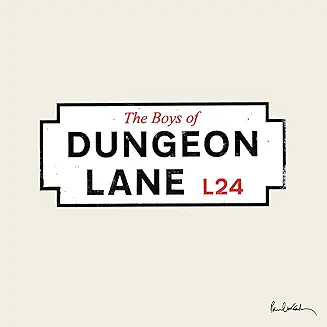
The album artwork was designed by McCartney’s nephew Josh, son of his brother Mike McCartney, who announced the design credit on social media.
The artwork takes its visual cues from Liverpool street signs and features the Speke postcode L24.
It is a family project in the most literal sense: a record about growing up in Speke, designed by a Speke family member, named after a Speke street.
Before the official announcement, McCartney posted only bird emojis on his channels, a nod to those childhood walks on Dungeon Lane with his Observer’s Book of Birds.
Listening parties were held for 30 fans at Watt’s Diamond Dust studio in Los Angeles on April 16, followed by an Abbey Road event on May 5, and a first public listening at The Jacaranda in Liverpool on May 22, the bar long associated with McCartney’s earliest days as a musician.
For more news and updates, visit our Classic Rock News and Tour Updates sections, or browse by era at our 60s, 70s, 80s, and 90s iconic hits and stories archives.
Critical Reception
The Boys of Dungeon Lane has earned some of the strongest notices of McCartney’s solo career.
Neil McCormick at The Telegraph awarded five stars: “as good as anything he has given us in the last 50 years.”
Alexis Petridis at The Guardian gave five stars: “at 83, his gift for melody still astounds.”
Rolling Stone praised it as a late-career highlight.
NME praised its freshness and McCartney’s range from acoustic balladry to arena rock to orchestral pop, calling it one of his most complete solo statements.
Variety added to the chorus of praise.
AnyDecentMusic aggregated a score of 7.7/10.
The Metacritic score of 86/100 puts it in the “universal acclaim” category.
Full album details are available at McCartney’s official site and the Wikipedia entry.
See the full Members Of archive for related band history features on this site.
You Might Also Like


The Boys of Dungeon Lane is available now on Capitol Records. It is the sound of Paul McCartney at 83, fully present, fully alive, and still making music that demands to be heard on its own terms, not as nostalgia, but as evidence that The Boys of Dungeon Lane produced one of rock’s greatest careers, and that career is not finished yet.