

Tony Iommi is the guitar architect of Black Sabbath, the man who built the sound of heavy metal from a factory floor accident and never stopped building.
Quick Navigation (click to open)
Who Is Tony Iommi?
Tony Iommi is the founding guitarist, primary composer, and creative core of Black Sabbath, the band that invented heavy metal in Birmingham, England in 1968.
His full name is Frank Anthony Iommi, and he was born on February 19, 1948, in Aston, Birmingham.
Wikipedia describes him as “the father of heavy metal,” a title that holds up under any scrutiny.
No other guitarist in rock history adapted to physical adversity, reshaped an entire sound from necessity, and then watched that sound become the foundation of a genre followed by hundreds of millions of people.
He is 78 years old as of 2026, lives in Birmingham with his wife Maria Sjoholm, and he is still writing music.
Tony Iommi’s Early Life in Aston, Birmingham
Aston in the 1950s was a working-class district of Birmingham, scarred by post-war poverty and industrial grime.
It was exactly the kind of place that produces music fueled by real weight.
Tony Iommi grew up there, the son of Italian immigrant parents who ran a local grocery shop.
He discovered music early, gravitating toward the guitar and the sounds coming out of America and from acts like The Beatles and The Shadows.
By his mid-teens, Tony Iommi was playing in local bands around Birmingham, honing a natural talent for riffs and heavy melody that set him apart from most teenagers picking up a guitar at the time.
He left school and took factory work, as young men in Aston did, because that was the next practical step.
What happened in that factory would change the course of music history.
The Factory Accident That Almost Ended Tony Iommi’s Career
On his very last day working at a Birmingham sheet metal factory, at the age of 17, a press slammed down on his right hand.
It severed the tips of the middle and ring fingers on his fretting hand, because Tony Iommi plays left-handed.
He was devastated and initially gave up playing guitar completely.
Then his foreman played him a record by Django Reinhardt, the Belgian-born Romani jazz guitarist who overcame two paralyzed fingers on his fretting hand to become one of the most revered musicians of the twentieth century.
Reinhardt’s example changed everything.
Tony Iommi fashioned prosthetic fingertip caps from melted-down plastic bottles, creating homemade thimbles that would sit over the damaged fingertips and allow him to press the strings.
Then he made a decision that would alter the course of music: he detuned his guitar strings to reduce tension, making it easier to bend notes and play without the full force that standard tuning requires.
That downtuning created a darker, heavier tone than anything recorded before it.
The physical solution to a painful injury became the sonic origin of heavy metal guitar.
Did You Know?
Tony Iommi briefly joined Jethro Tull in 1968.
He appeared in The Rolling Stones Rock and Roll Circus TV special alongside The Who and The Dirty Mac, performing as Jethro Tull’s guitarist, before leaving the band within days to return to his Birmingham friends. That decision led directly to Black Sabbath as the world knows it. The full story is told in his autobiography, Iron Man: My Journey Through Heaven and Hell with Black Sabbath.
Tony Iommi and the Formation of Black Sabbath (1968)
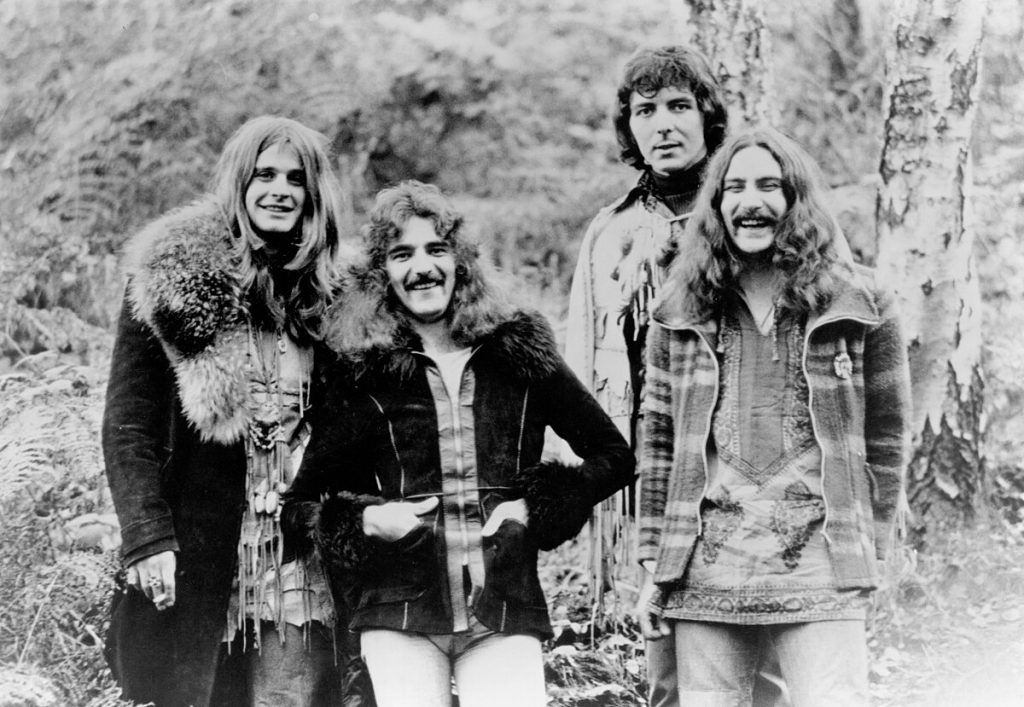
Tony Iommi had known Ozzy Osbourne, Geezer Butler, and Bill Ward from the streets and music scene of Birmingham for years.
In 1968, they formed together under the name Earth before settling on Black Sabbath, a name inspired by a Boris Karloff horror film playing at a cinema across the street from their rehearsal space.
The sound they developed was unlike anything recorded at the time.
Tony Iommi’s downtuned, prosthetic-aided guitar collided with Butler’s melodic bass, Ward’s swinging heavy drumming, and Osbourne’s wailing vocal style to produce something genuinely new.
Their 1970 debut, Black Sabbath, opened with rain, a single bell toll, and one of the most ominous guitar riffs ever written.
The tritone interval at the heart of that riff had been called “diabolus in musica” (the devil in music) by medieval theorists who considered it forbidden.
Tony Iommi used it as his opening statement.
That same year, Paranoid arrived and delivered “Iron Man,” “War Pigs,” and the title track in a single album, confirming that Black Sabbath had not stumbled onto something by accident.
Tony Iommi’s Guitar Style: The Science Behind Heavy Metal
The way Tony Iommi plays guitar is inseparable from the physical reality of his hands.
His prosthetic fingertip caps mean he grips and frets differently from any other player, producing a tone and attack that cannot be reproduced by someone with standard fingertips.
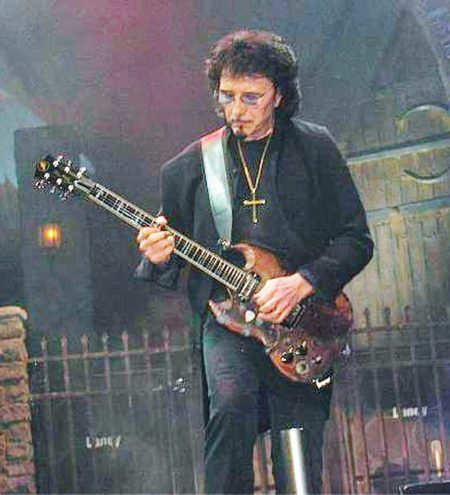
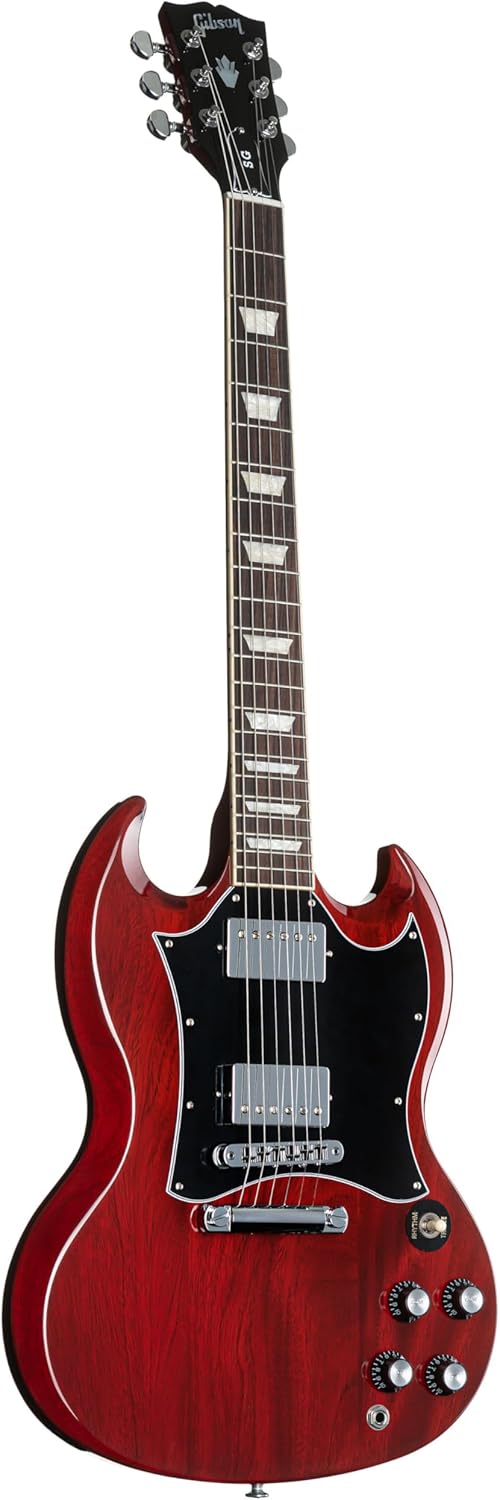
His primary guitar is a Gibson SG Custom with distinctive cross inlays on the fretboard, a signature model that has become one of the most recognized instruments in rock history.
He has also played Jaydee guitars built specifically to his specifications, as well as various custom instruments across the decades.
The downtuning Tony Iommi introduced, dropping his strings below standard pitch to ease tension on his injured fingers, became the default approach for virtually every heavy metal and hard rock guitarist who followed him.
His riff vocabulary draws heavily on the tritone, the pentatonic scale, and chromatic runs, creating a sound that carries genuine menace while remaining melodically coherent and memorable.
Key riffs attributed to Tony Iommi include “Black Sabbath,” “Iron Man,” “Paranoid,” “War Pigs,” “Children of the Grave,” “Heaven and Hell,” “Mob Rules,” and “Sign of the Southern Cross,” each one a complete musical idea in itself.
He was the primary musical composer for Black Sabbath, writing virtually all the band’s riffs and arrangements across every era and lineup change.
Did You Know?
Rolling Stone ranked Tony Iommi among the 100 Greatest Guitarists of All Time.
He earned a place on both the 2003 and 2011 versions of that definitive list. His ranking was driven not just by technique but by his singular influence on an entire genre. No other guitarist on that list can claim to have literally invented the sound of a new category of music. His downtuned, tritone-driven approach is the genetic code every metal guitarist since has inherited. You can hear exactly how that influence sounds on Fused, his 2005 collaboration with Glenn Hughes.
Tony Iommi Through Every Black Sabbath Era
Tony Iommi is the only member of Black Sabbath to appear on all 19 of the band’s studio albums, making him the indisputable creative constant across more than five decades.
The Ozzy era produced the core catalog: Black Sabbath (1970), Paranoid (1970), Master of Reality (1971), Vol. 4 (1972), Sabbath Bloody Sabbath (1973), Sabotage (1975), Technical Ecstasy (1976), and Never Say Die! (1978).
When Ozzy departed, Ronnie James Dio stepped in and Tony Iommi delivered some of his finest compositional work, including Heaven and Hell (1980) and Mob Rules (1981).
Vinny Appice joined the band during this period, and the rhythm section around Tony Iommi shifted while his guitar remained the constant anchor.
Ian Gillan of Deep Purple took the vocal chair for Born Again (1983), followed by Glenn Hughes, Ray Gillen, and Tony Martin across albums through the 1980s and 1990s, including Seventh Star (1986).
Through every lineup change, Tony Iommi remained the creative force, adapting his riff writing to each vocalist’s range while never losing the signature heaviness that defined the band.
The original lineup reunited in 1997 and produced the reunion album 13 in 2013, which debuted at number one in multiple countries.
Tony Iommi’s Battle With Lymphoma
In January 2012, Tony Iommi was diagnosed with non-Hodgkin lymphoma in its early stages.
The diagnosis came as the original Black Sabbath lineup was preparing to record the reunion album 13, and it forced the band to restructure touring plans around his treatment schedule.
Treatment took place in Melbourne, Australia, requiring Tony Iommi to step away from the road repeatedly across the following years.
He did not stop writing or recording.
In interviews during that period, he said: “I can’t stop. I have to carry on. I enjoy what I do.”
That attitude, mirroring the same stubbornness that drove him back to the guitar after losing his fingertips at 17, defines how Tony Iommi meets every obstacle in his path.
He has been in remission since 2016.
The cancer battle never stopped him from performing, composing, or planning new projects.
Tony Iommi’s Solo Career
Tony Iommi’s first solo album, simply titled Iommi, arrived in 2000 and stands as one of the most ambitious guest-vocalist albums in rock history.
The record featured contributions from Henry Rollins, Dave Grohl, Ozzy Osbourne, Billy Corgan, Serj Tankian, and Phil Anselmo, each lending their voice to riffs written entirely by Tony Iommi.
In 2005, he released Fused, a full collaborative record with former Deep Purple vocalist Glenn Hughes, which showcased a bluesy, melodic dimension of his writing that the Black Sabbath context rarely allowed to fully surface.
In 2012, he partnered with Ian Gillan on WhoCares, a charity project whose proceeds went to relief efforts for victims of a 1988 Armenian earthquake.
Each of these projects confirmed that Tony Iommi’s creative voice extends well beyond the Black Sabbath framework, adapting naturally to whatever vocalist he works alongside.
Tony Iommi and the Black Sabbath Ballet
In 2025, Birmingham Royal Ballet artistic director Carlos Acosta conceived and staged a full ballet production set to Black Sabbath music, titled “Black Sabbath: The Ballet.”
The production ran twice, first in London and then in Birmingham, selling out both runs completely.
Tony Iommi performed live on stage alongside the dancers, playing guitar in real time as the ballet unfolded around him.
The production drew attention far outside the usual rock audience, introducing the Black Sabbath catalog to an entirely new generation and demographic of music lovers.
It stands as one of the more unexpected chapters in his career, and by all accounts it worked completely.
Tony Iommi’s 2026 Solo Album
On New Year’s Eve 2025, Tony Iommi confirmed on camera that his third full solo studio album is “definitely, definitely” arriving in 2026.
Details remain closely held as of May 2026, but he has confirmed the album features a Swedish vocalist whose identity has not yet been publicly announced.
In May 2025, he contributed a guitar solo to Robbie Williams‘s single “Rocket,” released to considerable attention and demonstrating that his playing at 78 carries exactly the same authority it always has.
In August 2025, Brian May of Queen gifted Tony Iommi a left-handed replica of his famous Red Special guitar, a gesture from one guitar legend to another that spoke to the mutual respect between them.
A Gibson documentary focused on Tony Iommi is also confirmed for release in 2026, adding another major platform for his story to reach new listeners.
Tony Iommi confirms his solo album arrives in 2026.
Did You Know?
Gibson released a Tony Iommi signature pickup in August 2025.
The pickup was engineered to recreate the specific tonal characteristics of Tony Iommi’s personal instruments, capturing the warm, mid-forward attack that defines his sound across decades of recording. It is available for any player who wants to dial closer to the original heavy metal tone, and pairs naturally with a Gibson SG Standard, the body style most closely associated with his playing throughout his career.
Tony Iommi’s Legacy and Influence
The guitarists who cite Tony Iommi as a primary influence include some of the most celebrated players in heavy music: James Hetfield of Metallica, Brent Hinds of Mastodon, Tom Morello, Zakk Wylde, and Kirk Hammett all point directly to his playing as a formative force.
That influence is not confined to metal alone.
The downtuned, riff-centered approach Tony Iommi established has shaped hard rock, grunge, doom metal, stoner rock, and virtually every genre that sits between traditional rock and extreme metal.
He said it plainly himself: “I love to create music. That’s what started me off and that’s what will finish me off, probably.”
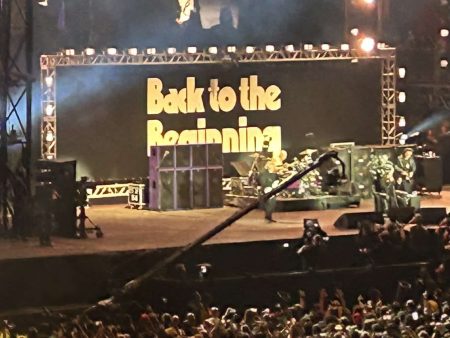
The Back to the Beginning farewell concert at Villa Park on July 5, 2025, which Tony Iommi organized and headlined, drew 42,000 fans to Birmingham and 3 million livestream viewers worldwide.
It was the final time the original Black Sabbath lineup performed together, and Tony Iommi made it happen.
Tony Iommi performs Iron Man at the final Black Sabbath concert, July 2025.
Where Is Tony Iommi Now?
Tony Iommi remains in Birmingham, the city that forged him, living with his wife Maria Sjoholm.
In July 2025, he was named a Freeman of the City of Birmingham, one of the city’s highest honors, recognizing his contribution to music and to Birmingham’s cultural identity.
He organized a charity guitar raffle that raised 53,000 pounds for the cancer unit at Heartlands Hospital, the same hospital that treated patients like himself during his lymphoma battle.
Weeks after the Back to the Beginning concert, Ozzy Osbourne passed away.
Tony Iommi’s tribute was direct and devastating: “My dear dear friend Ozzy has passed away only weeks after our show at Villa Park. It’s just such heartbreaking news. There won’t ever be another like him.”
He added: “Geezer, Bill and myself have lost our brother.”
He carries that loss, as he has carried every injury and setback of his life, by continuing to create.
The 2026 solo album is in progress, the Gibson documentary is coming, and Tony Iommi at 78 shows no sign of slowing down.
Frequently Asked Questions About Tony Iommi
What happened to Tony Iommi’s fingers?
At age 17, on his last day at a Birmingham sheet metal factory, a press severed the tips of the middle and ring fingers on his right hand, which is his fretting hand because he plays left-handed. He overcame this by fashioning plastic prosthetic fingertip caps and detuning his guitar strings to reduce tension.
What guitar does Tony Iommi play?
His primary instrument is a Gibson SG Custom with distinctive cross inlays on the fretboard. Gibson has produced a signature Tony Iommi SG model. He has also played Jaydee guitars built to his personal specifications, and in 2025 Brian May gifted him a left-handed replica of the famous Red Special guitar.
Is Tony Iommi still in Black Sabbath?
Black Sabbath played their farewell concert at Villa Park in Birmingham on July 5, 2025, marking the end of the band’s performing career. Tony Iommi is now focused on his solo work, with a new solo album confirmed for 2026.
Did Tony Iommi have cancer?
Yes. Tony Iommi was diagnosed with non-Hodgkin lymphoma in January 2012. He underwent treatment in Melbourne, Australia, and has been in remission since 2016.
Who influenced Tony Iommi?
The most documented influence is Django Reinhardt, the jazz guitarist whose recording his factory foreman played after the accident. Tony Iommi has also cited Hank Marvin of The Shadows, Muddy Waters, and early rock and roll guitar playing as formative influences.
What is Tony Iommi doing in 2026?
Tony Iommi is completing his third solo studio album, confirmed for 2026, featuring a Swedish vocalist. A Gibson documentary about him is also scheduled for release in 2026. He received the Freeman of the City of Birmingham honor in July 2025.
Tony Iommi Albums and Book on Amazon


You Might Also Like

At 78 years old, with a new album in progress and a legacy that spans every corner of rock and metal music, Tony Iommi remains exactly what he has always been: the man who invented heavy metal, still playing, still building, and still impossible to replace.