

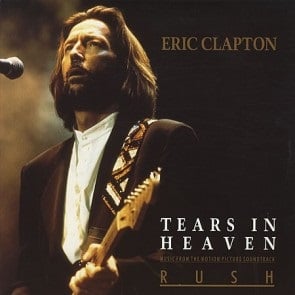
Tears in Heaven by Eric Clapton became one of the most emotionally significant recordings of the 1990s, a song written in the aftermath of profound personal loss that reached number two on the US Billboard Hot 100 and won three Grammy Awards at the 1993 ceremony.
Written with lyricist Will Jennings following the death of Clapton’s four-year-old son Conor in March 1991, the track transformed a private grief into a universally understood experience that listeners across multiple generations have found resonant.
Affiliate Disclosure: As an Amazon Associate I earn from qualifying purchases. This helps support the site at no extra cost to you.
| Song | Tears in Heaven |
| Artist | Eric Clapton |
| Album | Unplugged (1992) |
| Written by | Eric Clapton, Will Jennings |
| Produced by | Russ Titelman |
| Released | 1992 |
| Genre | Soft Rock, Blues Rock |
| Record Label | Duck / Reprise Records |
| Chart Peak | #2 US Billboard Hot 100 |
Table of Contents
Background and History
Eric Clapton had established himself across three decades as one of the most celebrated guitarists and songwriters in rock history, moving from his early work with The Yardbirds and Cream through a solo career that produced some of the most enduring recordings in the classic rock canon.
On March 20, 1991, his son Conor Clapton, aged four, died after falling from a window of a New York City apartment building, a loss so devastating that Clapton retreated from public life for a period before channeling his grief into the songwriting process.
Will Jennings, who had previously collaborated with Steve Winwood on Higher Love, brought the same gift for framing profound emotion in universally accessible language to the collaboration, helping Clapton shape his private experience into a song that spoke to anyone who had faced loss.
Tears in Heaven was first recorded for the soundtrack to the 1991 film Rush before being re-recorded for Clapton’s landmark Unplugged album, the version that reached the widest audience and has since become the definitive recording.
The decision to perform the song acoustically for the MTV Unplugged concert proved essential to its emotional impact, the stripped-down arrangement leaving nowhere for the lyric to hide and giving Clapton’s voice a directness and vulnerability that the original full-band recording did not achieve to the same degree.
Musical Composition of Tears in Heaven
The production of Tears in Heaven by Russ Titelman is built around acoustic guitar, Nathan East’s understated bass, and the simplest possible rhythmic support, a deliberate restraint that keeps the focus on Clapton’s voice and the lyric’s emotional content throughout.
Clapton’s guitar playing, characteristically melodic and expressive even in this restrained context, functions as both accompaniment and commentary, the instrument answering and extending the vocal phrases in the way that defines his most personal work.
The lyric addresses the theological uncertainty that accompanies grief with a directness that is neither sentimental nor detached, asking questions about recognition and identity that frame the loss without claiming to resolve it.
That combination of musical economy and lyrical honesty gives the track a weight that more elaborate productions rarely achieve, the simplicity of the arrangement creating space for the listener’s own emotional response rather than prescribing one.
Will Jennings’s contribution to the lyric structure ensured that the song’s private origin translated into a public experience, following the same approach he had used with other artists to find the universal within the personal.
Chart Success and Impact
Tears in Heaven reached number two on the US Billboard Hot 100 in early 1992 and topped charts in multiple other countries, making it one of the most commercially successful singles of Clapton’s long career.
The Unplugged album reached number one in the United States and multiple other territories, was certified ten times platinum in the US alone, and won the Grammy Award for Album of the Year at the 1993 ceremony.
At the same ceremony, the song won the Grammy Award for Record of the Year, the Grammy for Song of the Year, and the Grammy for Best Male Pop Vocal Performance, three of the most prominent individual recognitions the Recording Academy could award.
The commercial performance confirmed that the MTV Unplugged format, previously viewed as a promotional vehicle rather than a definitive artistic statement, could produce recordings that stood entirely on their own terms as complete and lasting works.
The album’s success also revitalized interest in acoustic performance across mainstream rock, demonstrating to a generation of artists that stripping back the production did not diminish commercial appeal but could in fact strengthen the emotional connection between performer and listener.
Lasting Legacy of Tears in Heaven
Tears in Heaven has become one of the most recognized expressions of grief in popular music, a song that transcends its personal origin to function as a shared language for loss in general, accessible to anyone who has faced the death of someone they loved.
In 2004, Clapton publicly stated that he could no longer perform the song because the grief that had given it its power had finally receded enough that he felt he could no longer deliver it with the authenticity it required, a statement that paradoxically reinforced the song’s reputation as a work of genuine emotional testimony.
He has periodically returned to performing it since, but the context of that statement has shaped how audiences receive the track, understanding it as a document of a specific and irreplaceable emotional experience rather than simply a very good pop song.
Classic rock, adult contemporary, and pop radio formats have all maintained it in rotation for three decades, a cross-format presence that reflects how thoroughly it transcends the genre categories that typically limit a song’s audience.
Among the many honors it has received, the three Grammy wins remain the most concrete recognition of what made the track so exceptional, rewarding the craft and honesty that turned private grief into one of the 1990s’ most enduring recordings.
Watch the Official Video
Frequently Asked Questions
FAQ
- What inspired Tears in Heaven?
Eric Clapton wrote it following the death of his four-year-old son Conor in March 1991, working with lyricist Will Jennings to transform a private grief into a song that could speak to universal experiences of loss.
- How many Grammys did Tears in Heaven win?
It won three Grammy Awards at the 1993 ceremony: Record of the Year, Song of the Year, and Best Male Pop Vocal Performance, while the parent album Unplugged also won Album of the Year at the same ceremony.
- What is the Unplugged album?
It is an acoustic live album recorded for MTV’s Unplugged series in 1992, produced by Russ Titelman, that reached number one in the United States and was certified ten times platinum, becoming one of Clapton’s most successful releases.
- Why did Clapton stop performing the song?
In 2004 he stated that the grief that had inspired it had receded enough that he felt he could no longer perform it with the authenticity it required, though he has returned to it periodically since that statement.
- Who co-wrote the lyrics?
Will Jennings co-wrote the lyrics, a professional lyricist who had previously collaborated on Grammy-winning material with Steve Winwood and who brought a gift for translating private experience into universally resonant language.
You Might Also Like

Written from the deepest possible source of personal loss and performed with the stripped acoustic honesty that only comes from having nothing left to prove, Tears in Heaven by Eric Clapton stands as one of the most quietly devastating songs in the classic rock catalog.