

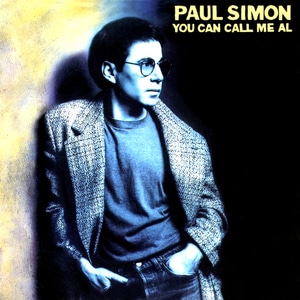
You Can Call Me Al by Paul Simon became one of the most widely recognized singles of 1986, propelled by a memorable music video and a sound unlike almost anything else on pop radio at the time.
Drawing on South African township music, the track brought the rhythms and textures of mbaqanga to a global audience and helped make the Graceland album one of the decade’s most celebrated recordings.
Affiliate Disclosure: As an Amazon Associate I earn from qualifying purchases. This helps support the site at no extra cost to you.
| Song | You Can Call Me Al |
| Artist | Paul Simon |
| Album | Graceland (1986) |
| Written by | Paul Simon |
| Produced by | Paul Simon, Roy Halee |
| Released | 1986 |
| Genre | Pop Rock, World Music |
| Record Label | Warner Bros. Records |
| Chart Peak | #23 US Billboard Hot 100, #4 UK |
Table of Contents
Background and Meaning
Paul Simon had built his reputation as half of Simon and Garfunkel before establishing a distinguished solo career through the 1970s that established him as one of American popular music’s most literate songwriters.
The inspiration for Graceland came from a cassette tape of South African township music that Simon received in 1984, which led him to travel to Johannesburg and record with local musicians in a project that proved both creatively and politically controversial.
You Can Call Me Al takes its title from a real incident in which composer Pierre Boulez mistakenly called Simon “Al” at a party, and the lyric grew from that moment into a meditation on middle-aged disorientation and the search for meaning.
The stream-of-consciousness verses describe a man feeling spiritually adrift, and the chorus offers a sudden, unexpected moment of human connection as the answer to that emptiness.
Simon’s decision to root the song in South African rhythms gave You Can Call Me Al a kinetic joy that cuts against the lyric’s underlying anxiety, creating the productive tension that makes the track so memorable.
Musical Composition of You Can Call Me Al
The track’s bass line, played by Bakithi Kumalo, is one of the most propulsive and distinctive in 1980s pop, a fretless figure that drives the song forward with a forward-leaning energy that no synthesized bass could replicate.
The horn arrangements and percussion patterns draw directly from the South African musicians Simon recorded with, giving You Can Call Me Al a rhythmic density that sets it apart from everything else in the decade’s pop landscape.
The production by Simon and Roy Halee preserves the live energy of the South African session recordings while shaping them into a format that could reach the broadest possible pop audience.
The result is a song that functions simultaneously as a pop hit, a world music exploration, and a piece of personal confession, with none of those three dimensions undermining the others.
The famous penny whistle solo near the end of the track lands as a moment of pure delight, a musical detail that captures the spirit of the Johannesburg sessions better than any production note could describe.
Chart Success and Impact
The single reached number twenty-three on the US Billboard Hot 100 and number four on the UK Singles Chart, performing better in Britain than in the United States on its initial release.
The music video, directed by Gary Weis, featured Chevy Chase lip-syncing the lead vocal while Simon played the instruments in the background, a comic reversal that became one of the most discussed video concepts of 1986.
The Graceland album won the Grammy Award for Album of the Year in 1987, with the critical and commercial response confirming that Simon had produced one of the decade’s defining records.
The You Can Call Me Al video’s extensive MTV rotation was crucial to breaking the album in the American market, where the song’s South African influences might otherwise have limited its commercial reach.
The album’s success sparked a broader interest in world music among Western pop audiences, with Graceland serving as the gateway record that introduced millions of listeners to sounds they would not otherwise have encountered.
Lasting Legacy of You Can Call Me Al
The track remains one of the most immediately recognizable singles of the 1980s and the song most commonly cited when Paul Simon’s solo career is discussed outside his Simon and Garfunkel years.
Its fusion of pop songwriting with South African musical traditions influenced a generation of producers and artists who followed Simon’s lead in looking beyond Western pop conventions for rhythmic and melodic inspiration.
Classic rock and pop radio formats have maintained You Can Call Me Al in regular rotation for four decades, and it surfaces consistently on best-of lists for both the decade and Simon’s catalog.
The Chevy Chase video remains one of the most watched music videos from the pre-internet era, a production whose comic simplicity and genuine musical performance have kept it entertaining across multiple generations of viewers.
Four decades after its release, You Can Call Me Al by Paul Simon stands as the moment when one of popular music’s most thoughtful songwriters found the perfect vehicle for his concerns: a song that dances while it worries, and worries while it dances.
Watch the Official Video
Frequently Asked Questions
FAQ
- Who wrote You Can Call Me Al?
Paul Simon wrote it himself, with the title taken from a real incident in which composer Pierre Boulez mistakenly called him Al at a party.
- What album is it from?
It is from Graceland, released in 1986 on Warner Bros. Records, the album that won the Grammy Award for Album of the Year in 1987.
- Why did Paul Simon record in South Africa?
Simon received a cassette of South African township music in 1984 and was drawn to its rhythmic energy, leading him to travel to Johannesburg to record with local musicians including bassist Bakithi Kumalo.
- Who appeared in the You Can Call Me Al video?
Chevy Chase lip-synced the lead vocal while Simon played instruments in the background, a comic reversal that became one of the most talked-about video concepts of 1986.
- Did Graceland cause controversy?
Yes. Simon recorded in apartheid South Africa at a time when a cultural boycott was in effect, and his decision was criticized by some activists while others argued the collaboration gave South African musicians global exposure.
You Might Also Like
Rhythmically joyful, lyrically restless, and built on a musical fusion unlike anything else on 1980s radio, You Can Call Me Al by Paul Simon stands as proof that the most adventurous pop records are often also the most lasting ones.