

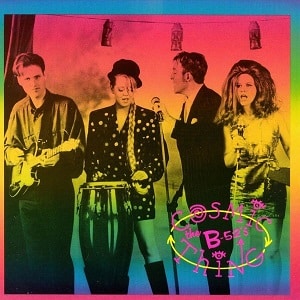
Love Shack by The B-52s reached number three on the US Billboard Hot 100 in 1989, becoming the band’s biggest commercial hit and a joyful declaration that the Athens, Georgia new wave group had returned from a difficult period with more energy than ever.
Built on call-and-response vocals, a driving rhythm, and an infectious invitation to abandon inhibition, the track became one of the most played party songs of the decade and has maintained that reputation ever since.
Affiliate Disclosure: As an Amazon Associate I earn from qualifying purchases. This helps support the site at no extra cost to you.
| Song | Love Shack |
| Artist | The B-52s |
| Album | Cosmic Thing (1989) |
| Written by | Kate Pierson, Fred Schneider, Keith Strickland, Cindy Wilson |
| Produced by | Don Was, Nile Rodgers |
| Released | 1989 |
| Genre | New Wave, Dance Rock |
| Record Label | Reprise Records |
| Chart Peak | #3 US Billboard Hot 100 |
Table of Contents
Background and Meaning
The B-52s formed in Athens, Georgia in 1976, taking their name from a beehive hairstyle worn by original members Kate Pierson and Cindy Wilson that resembled the nose cone of a B-52 bomber.
The band’s commercial and creative momentum was interrupted when guitarist Ricky Wilson, Cindy’s brother and the architect of the band’s distinctive guitar sound, died from AIDS-related illness in October 1985.
The Cosmic Thing album and Love Shack represented the band’s return after that loss, a comeback built around the remaining members’ decision to keep making music as a tribute to Wilson’s energy and spirit.
The title refers to a real location near Athens, Georgia, a small rural house where members of the band had gathered for parties, and the lyric transforms that specific place into a universal invitation.
Producers Don Was and Nile Rodgers gave the recording a groove-driven clarity that amplified the song’s infectious energy without overproducing it into something that lost the band’s essential scrappiness.
Musical Composition of Love Shack
The track opens with a spare guitar figure before the drums and bass establish the driving groove that carries the song from beginning to end without breaking its celebratory momentum.
Fred Schneider’s talk-sung vocal delivery contrasts with Kate Pierson’s soaring melodic lines in a call-and-response arrangement that captures the communal, inclusive spirit the lyrics are reaching for.
The arrangement is deceptively simple: Love Shack achieves its energy through rhythm and repetition rather than through harmonic complexity or production density.
Cindy Wilson’s vocal contributions and the underlying guitar work connect the track to the band’s earlier sound while the production gives it a commercial sheen that suited the late-1980s radio landscape.
The “tin roof, rusted” moment in the final section, delivered by Pierson with barely controlled delight, has become one of the most quoted lines in new wave history, a spontaneous-sounding detail that perfectly captures the song’s anarchic spirit.
Chart Success and Impact
The single peaked at number three on the Billboard Hot 100, the highest position the band had ever reached, and the Cosmic Thing album reached number four on the Billboard 200.
Both the album and single were certified multiplatinum in the United States, confirming that the B-52s had not just survived the loss of Ricky Wilson but had found a new commercial peak beyond anything in their previous catalog.
MTV gave the Love Shack video heavy rotation, and its colorful, high-energy visual presentation reinforced the song’s identity as one of the most joyful records of the decade.
The song became a staple at parties, sporting events, wedding receptions, and broadcast programming almost immediately after its release, establishing a cultural function it has never surrendered.
The success revitalized the band’s career at a moment when many of their contemporaries from the late-1970s new wave scene had already faded from mainstream commercial relevance.
Lasting Legacy of Love Shack
Few rock songs of any era have maintained as consistent a presence at celebrations and communal events as this one, which has been a party playlist fixture for more than thirty-five years.
The track appears in countless films, television episodes, commercials, and live event soundtracks, valued for its ability to generate an immediate, inclusive atmosphere wherever it plays.
The B-52s have performed Love Shack at every major concert appearance since 1989, and the audience response has never noticeably diminished, which is a rare achievement for any single.
Its combination of dance-floor functionality, emotional openness, and unmistakable sonic personality has placed it in a category shared by very few records: songs that work at virtually any gathering regardless of the audience’s age, background, or musical preferences.
Thirty-five years after it first hit the airwaves, Love Shack by The B-52s stands as one of the most purely joyful rock singles ever made, a record that has never needed a revival because it has never stopped being played.
Watch the Official Video
Frequently Asked Questions
FAQ
- Who wrote Love Shack?
- Kate Pierson, Fred Schneider, Keith Strickland, and Cindy Wilson wrote it together, with the title referencing a real rural house near Athens, Georgia where the band used to gather for parties.
- What album is it from?
- It is from Cosmic Thing, released by The B-52s in 1989 on Reprise Records, produced by Don Was and Nile Rodgers, and the band’s most commercially successful album.
- Why did the B-52s take a break before Cosmic Thing?
- Guitarist Ricky Wilson, Cindy Wilson’s brother, died from AIDS-related illness in October 1985. The band took time before returning to recording, and Cosmic Thing was their first full studio album since his death.
- How high did it chart?
- It reached number three on the US Billboard Hot 100 in 1989, the highest chart position the B-52s had ever reached, and helped drive Cosmic Thing to number four on the Billboard 200.
- What does ‘tin roof, rusted’ mean?
- The phrase, delivered by Kate Pierson, is generally understood as a playful euphemism within the song’s broader celebration of romantic freedom, though the band has given deliberately vague answers about its meaning over the years.
You Might Also Like

Joyful, rhythm-driven, and built for the specific purpose of making any gathering more alive, Love Shack by The B-52s is one of the handful of rock singles that has never needed a revival because it has simply never stopped playing.