

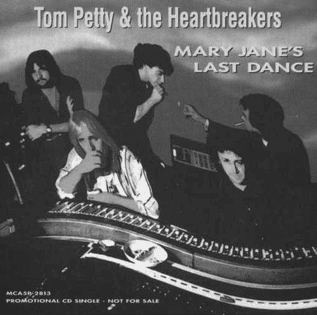
Mary Jane’s Last Dance by Tom Petty and the Heartbreakers was recorded as a new track for the band’s 1993 Greatest Hits compilation and became one of the most distinctive songs in their catalog, a slow-burning blues-inflected rock track that reached number fourteen on the US Billboard Hot 100.
The song stood apart from much of Petty’s earlier catalog in its feel, drawing on a darker and more deliberate rhythmic approach that gave it a cinematic quality reinforced by one of the most striking music videos the band had ever produced.
Affiliate Disclosure: As an Amazon Associate I earn from qualifying purchases. This helps support the site at no extra cost to you.
| Song | Mary Jane’s Last Dance |
| Artist | Tom Petty and the Heartbreakers |
| Album | Greatest Hits (1993) |
| Written by | Tom Petty |
| Produced by | Rick Rubin |
| Released | 1993 |
| Genre | Classic Rock, Blues Rock |
| Record Label | MCA Records |
| Chart Peak | #14 US Billboard Hot 100 |
Table of Contents
Background and History
Tom Petty and the Heartbreakers had been one of American rock’s most consistently reliable bands since their debut in 1976, producing a steady run of albums and singles that demonstrated Petty’s gift for direct, melodically strong songwriting rooted in the classic American rock tradition.
By 1993 the band was assembling a Greatest Hits compilation for MCA Records, and rather than simply package existing material, Petty agreed to record several new songs for the collection, treating the project as an opportunity for fresh work rather than an archive release.
Producer Rick Rubin, who had built a reputation for stripping productions back to their essential elements across multiple genres, was brought in to record the new tracks, and his instinct for space and rhythm proved well suited to the blues-influenced approach Petty was exploring.
Mary Jane’s Last Dance was the most notable of the new recordings, a song whose slower tempo and deliberate groove marked a departure from the urgent, upbeat energy that characterized many of the band’s most familiar hits.
The title and lyric draw on a set of imagery that is deliberately ambiguous, the “last dance” suggesting both a farewell and a finality that operates on multiple levels simultaneously, giving the song a resonance that its surface simplicity does not immediately suggest.
The Story Behind Mary Jane’s Last Dance
Mary Jane’s Last Dance has been interpreted variously as a song about marijuana, a romantic farewell, or simply a meditation on the end of something unnamed, with Petty himself declining to provide a definitive reading and allowing the ambiguity to remain part of the song’s appeal.
That deliberate openness is characteristic of Petty’s best lyric writing, which tends to establish a vivid scene and emotional situation without resolving it into a single clear meaning, leaving the listener’s imagination to complete what the words begin.
The “Indiana girl” referenced in an earlier working version of the song suggests a specific geographic and cultural setting that gives the track its particular quality of American rootedness, connecting it to the regional specificity that runs through much of Petty’s most distinctive work.
The bluesy, slow groove that Rick Rubin helped shape gives the lyric’s ambiguity a physical correlative, the music’s deliberate unhurriedness suggesting a resigned acceptance of whatever ending the song describes.
That combination of lyric ambiguity and musical directness placed it alongside contemporaries like Tears in Heaven by Eric Clapton as a 1993 rock song that achieved mainstream success through emotional restraint rather than melodramatic statement.
Mary Jane’s Last Dance Musical Composition
The track opens with Mike Campbell’s guitar riff, a slow, slightly compressed phrase that establishes the song’s deliberate pace and bluesy character before the rhythm section enters and locks the groove into place.
Petty’s vocal sits in the lower part of his range for most of the song, a choice that suits both the lyric’s resigned quality and the track’s slower tempo, creating a performance that feels measured rather than urgent.
Rubin’s production is notably spare, prioritizing the interaction between the guitar, bass, and drums over any textural decoration, a restraint that makes each element more audible and gives the track its stripped-down power.
The organ that surfaces in the arrangement adds a subtle gospel quality to the sound without pushing it overtly in that direction, providing harmonic warmth that complements the blues-derived guitar work without competing with it.
The structural patience of the arrangement, its willingness to sit in the groove rather than moving urgently toward a resolution, is one of the production choices that most clearly distinguishes the track from the more conventional rock material on the Greatest Hits collection it accompanies.
Mary Jane’s Last Dance and Chart Success
Mary Jane’s Last Dance reached number fourteen on the US Billboard Hot 100 and topped the Mainstream Rock chart, performing commercially well enough to become one of the most-heard tracks from the Greatest Hits package.
The music video, directed by Keir McFarlane, starred Kim Basinger in a surreal scenario involving a morgue, a bridal gown, and a late-night drive, creating a visual narrative as deliberately ambiguous as the song’s lyric.
The video’s Gothic imagery and Basinger’s performance gave the track a visual identity distinct from anything in the Heartbreakers’ previous catalog, making it immediately recognizable and contributing to its extended MTV presence.
The Greatest Hits compilation was certified multiplatinum and became one of the best-selling packages in the band’s catalog, with the new recordings including this track adding commercial and artistic value that a purely archival collection would not have generated.
The song’s mainstream rock chart performance confirmed that Petty’s sonic range extended further than his most commercially familiar work suggested, reaching audiences who responded to the blues-inflected approach as enthusiastically as those who valued his more melodically direct rock songs.
Watch the Official Video
Frequently Asked Questions
FAQ
- What is Mary Jane’s Last Dance about?
Tom Petty left the meaning deliberately open, but the song has been interpreted as addressing farewell, loss, or a romantic ending, with an ambiguity that is central to its appeal and that Petty himself declined to resolve with a definitive explanation.
- Who produced Mary Jane’s Last Dance?
Rick Rubin produced it, bringing his characteristic instinct for spare, rhythm-focused production to the track, a working relationship that proved well suited to the blues-inflected, deliberately paced approach Petty was exploring.
- What album is it from?
It was recorded as a new track for the Greatest Hits compilation released by Tom Petty and the Heartbreakers on MCA Records in 1993, rather than being drawn from an existing studio album.
- Who is in the music video?
Kim Basinger stars in the video, which features surreal Gothic imagery including a morgue setting and a bridal gown, creating a visual narrative as deliberately ambiguous as the song’s lyric.
- Did the song reach number one?
It peaked at number fourteen on the US Billboard Hot 100 and topped the Mainstream Rock chart, generating strong MTV rotation and becoming one of the most recognized tracks from the Greatest Hits collection.
You Might Also Like

Slow, bluesy, and anchored by a lyric that refuses to explain itself, Mary Jane’s Last Dance by Tom Petty and the Heartbreakers stands as one of the most distinctive departures in the band’s catalog, a track that proved their range extended well beyond the bright, driving rock they were most famous for.