

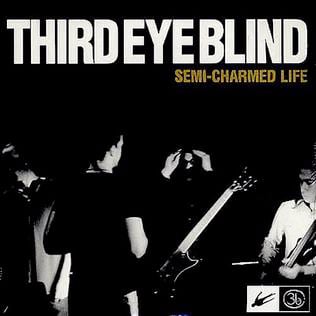
Semi-Charmed Life by Third Eye Blind reached number four on the US Billboard Hot 100 in 1997 and became one of the most deceptively packaged singles of the decade, presenting a lyric about crystal methamphetamine addiction inside one of the most immediately catchy guitar pop arrangements of the late 1990s.
Written by vocalist Stephan Jenkins and produced by Eric Valentine, the song drove the band’s self-titled debut album to six times platinum certification in the United States and established Third Eye Blind as one of the most commercially successful San Francisco rock acts of the period.
Affiliate Disclosure: As an Amazon Associate I earn from qualifying purchases. This helps support the site at no extra cost to you.
| Song | Semi-Charmed Life |
| Artist | Third Eye Blind |
| Album | Third Eye Blind (1997) |
| Written by | Stephan Jenkins |
| Produced by | Eric Valentine |
| Released | 1997 |
| Genre | Alternative Rock, Pop Rock |
| Chart Peak | #4 US Billboard Hot 100, #1 US Mainstream Rock |
Table of Contents
Background and History
Third Eye Blind formed in San Francisco in 1993, built around vocalist and songwriter Stephan Jenkins alongside guitarist Kevin Cadogan, bassist Arion Salazar, and drummer Brad Hargreaves.
The band spent several years building a San Francisco following before signing with Elektra Records and recording their self-titled debut with producer Eric Valentine.
Valentine had experience in both rock and pop production and brought a clarity to the arrangements that made the album’s melodic content immediately accessible to radio formats across alternative, mainstream rock, and pop.
Semi-Charmed Life was released as the debut single in May 1997 and received immediate radio support, entering the charts quickly and climbing to a level that the band’s label had not necessarily anticipated for a debut release.
Semi-Charmed Life and the Hidden Lyric
The contrast between Semi-Charmed Life‘s guitar pop arrangement and its actual lyrical content became the most discussed aspect of the song in music journalism and cultural commentary.
Jenkins wrote the song from direct observation of the crystal methamphetamine experience, describing the cycle of craving, use, and deterioration in specific physical and emotional terms that are legible on close listening but easy to miss in the song’s upbeat context.
Radio edits removed the most explicit references, but the full lyric contains lines about crystal meth by name and descriptions of the physical experience that leave no ambiguity about the subject matter.
The song became a case study in how sonic presentation can override lyrical content in listener perception, with the vast majority of the song’s commercial audience experiencing it as a feel-good pop song while the lyric described something quite different.
Jenkins has said the deceptive quality was not entirely unintentional, arguing that the upbeat arrangement accurately reflected the seductive initial experience of the substance while the lyric’s trajectory described what followed.
The same contrast between surface appeal and dark subject matter that Green Day’s Basket Case had used for anxiety in 1994 was deployed here for addiction, with an even wider gap between the sonic packaging and the lyrical content.
Semi-Charmed Life and the Recording Story
Semi-Charmed Life opens with one of the most recognizable guitar figures of its era, a three-note descending pattern that establishes the song’s melodic framework in the first bar.
Eric Valentine’s production layers the arrangement with a fullness that made the track immediately at home on top forty radio despite the alternative rock orientation that had defined the band’s San Francisco club shows.
The “doo doo doo” vocal hook that opens and recurs throughout the song gave radio listeners an entry point that did not require engaging with the lyric, which partly explains how the song’s actual subject matter remained peripheral to its commercial reception.
Cadogan’s guitar work throughout the track provides both the melodic foundation and the harmonic context that Jenkins’s vocal moves against, creating a layered arrangement that rewards attention without requiring it for the hook to function.
The recording placed the band in the same late-1990s pop-rock territory as Matchbox Twenty and Foo Fighters while carrying a lyrical specificity that distinguished Jenkins’s writing from the more generalized emotional content of comparable commercial rock.
Semi-Charmed Life and the Charts
Semi-Charmed Life reached number four on the US Billboard Hot 100 and number one on the US Mainstream Rock Tracks chart, a commercial performance that confirmed the song’s crossover reach across multiple radio formats.
The song held the Hot 100 Airplay chart at number one for an extended period and was among the most played songs on American radio in the summer and fall of 1997.
The self-titled debut album was certified six times platinum in the United States and produced four additional singles, establishing Third Eye Blind as a sustained commercial presence rather than a one-hit act.
The chart performance placed the band firmly in the mainstream commercial landscape of 1997, a year when The Verve and Blur were reaching American audiences from the British side of the same alternative rock market.
Lasting Legacy of Semi-Charmed Life
Semi-Charmed Life remains Third Eye Blind’s most recognized recording and the song that most clearly defines their position in the landscape of late 1990s American alternative pop-rock.
Its status as a song whose subject matter is broadly unknown to the majority of its commercial audience has given it a secondary life in media criticism and cultural commentary about the relationship between sound and lyric in pop music.
The song has been used extensively in film and television, consistently placed in settings that treat it as the upbeat summer pop song its arrangement suggests rather than the addiction narrative its lyric describes.
Third Eye Blind have continued recording and touring with consistent commercial success, releasing new albums into the 2020s, and Semi-Charmed Life remains the anchor of their live sets and the song most immediately associated with their name.
More than twenty-five years after its release, Semi-Charmed Life stands as one of the defining examples of how melody and arrangement can determine a song’s commercial identity far more completely than lyrical content, and the recording that established Third Eye Blind as a band capable of reaching a mainstream audience well beyond the San Francisco scene that produced them.
Watch the Official Video
Frequently Asked Questions
FAQ
- What is Semi-Charmed Life actually about?
- Stephan Jenkins wrote the song about crystal methamphetamine addiction, describing the cycle of craving, use, and deterioration in specific physical and emotional terms. Radio edits removed the most explicit references, but the full lyric describes the meth experience directly, including naming the substance. The song’s upbeat arrangement meant that the vast majority of its commercial audience encountered it as a pop song without engaging with the subject matter.
- Who produced Semi-Charmed Life?
- Eric Valentine produced both the single and the self-titled debut album. Valentine brought a production approach that made the band’s melodic content immediately accessible across alternative, mainstream rock, and pop radio formats simultaneously, which was central to the song’s crossover commercial performance.
- What chart did Semi-Charmed Life reach?
- The song reached number four on the US Billboard Hot 100 and number one on the US Mainstream Rock Tracks chart, a commercial performance that reflected the song’s crossover reach across multiple radio formats. It was among the most played songs on American radio in the summer and fall of 1997.
- Where is Third Eye Blind from?
- Third Eye Blind formed in San Francisco in 1993. The band’s Bay Area origins placed them in a city with a rich rock history but outside the Pacific Northwest grunge scene and the Los Angeles industry center, giving them a distinct starting point that Jenkins drew on in the song’s local references and lyrical specificity.
- Did the band have other hits?
- Yes. The self-titled debut album was certified six times platinum in the United States and produced four additional charting singles including “Jumper,” “How’s It Going to Be,” and “Narcolepsy.” The band continued releasing albums and touring through the 2010s and 2020s, maintaining a consistent touring audience built on the debut’s commercial foundation.
You Might Also Like
A song about crystal meth packaged as a summer pop anthem and played on radio stations for months without most listeners realizing what they were singing along to, Semi-Charmed Life stands as the most successful piece of sonic misdirection in 1990s rock and the recording that built Third Eye Blind’s commercial foundation on a misunderstanding that turned out to work perfectly.