

Bitter Sweet Symphony by The Verve reached number two on the UK Singles Chart in 1997 and became the defining song of the British rock moment that followed Britpop, built on an orchestral sample that led to one of the most disputed songwriting credit cases in rock history.
Richard Ashcroft wrote the melody and lyrics over a sample from the Andrew Loog Oldham Orchestra’s orchestral version of “The Last Time” by The Rolling Stones, a decision that ultimately stripped Ashcroft of all publishing royalties for over twenty years.
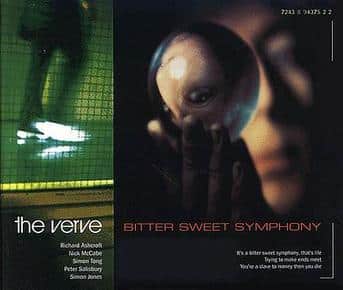
Affiliate Disclosure: As an Amazon Associate I earn from qualifying purchases. This helps support the site at no extra cost to you.
| Song | Bitter Sweet Symphony |
| Artist | The Verve |
| Album | Urban Hymns (1997) |
| Written by | Richard Ashcroft (melody/lyrics); Mick Jagger & Keith Richards (credited sample) |
| Produced by | Youth, The Verve |
| Released | 1997 |
| Genre | Alternative Rock, Britpop |
| Chart Peak | #2 UK Singles Chart, #12 US Billboard Hot 100 |
Table of Contents
Background and History
The Verve formed in Wigan, England in 1990, led by vocalist and songwriter Richard Ashcroft alongside guitarist Nick McCabe, bassist Simon Jones, and drummer Peter Salisbury.
The band released two albums in the early 1990s, building a cult following in the UK but struggling to maintain commercial momentum and a stable lineup through internal tensions and record label disputes.
They dissolved in 1995 before reconvening in 1996 with a clearer creative direction, recording Urban Hymns with producer Youth and with contributions from additional guitarist Simon Tong.
Ashcroft built Bitter Sweet Symphony around a sample from the Andrew Loog Oldham Orchestra’s 1965 orchestral arrangement of “The Last Time,” a Rolling Stones song that Oldham had rerecorded with a full string section.
The Verve obtained a license from ABKCO Records, the label controlling the Stones’ catalog, before recording the track, but the amount of the original recording used in the final version exceeded what the license permitted.
Bitter Sweet Symphony and the Sample Dispute
After the single was released and began climbing the UK chart, ABKCO and the Rolling Stones’ representatives determined that The Verve had used a larger portion of the Oldham Orchestra recording than the negotiated license allowed.
The resulting legal settlement required that all songwriting royalties be assigned to Mick Jagger and Keith Richards, leaving Ashcroft with no financial benefit from the song he had written and which his vocal and lyric entirely defined.
Jagger and Richards received full songwriting credit and all associated publishing income from one of the most commercially successful British singles of the late 1990s for over two decades.
The case became the most widely cited example in music journalism of sample clearance gone wrong, discussed repeatedly in industry coverage whenever sampling disputes arose in subsequent years.
In 2019, Jagger and Richards agreed to return the songwriting credits and royalties to Ashcroft, a reversal that came after the song had generated decades of income for the Rolling Stones camp that had not written it.
Bitter Sweet Symphony and the Recording Story
The orchestral string loop from the Oldham recording provides the harmonic and rhythmic foundation of the entire track, repeating throughout without variation while Ashcroft’s melody moves above it.
Youth’s production adds additional layers of percussion and texture while keeping the string loop at the center, giving the arrangement a cinematic scale that suited both the lyric’s philosophical ambition and the band’s desire for a recording that sounded genuinely large.
Ashcroft’s lyric addresses the experience of being driven by forces beyond conscious control, the “bitter sweet symphony” of a life shaped by circumstance rather than entirely by choice.
The vocal performance is direct and unironic, which gave the song a sincerity that connected with listeners across the British alternative audience that had grown through the Britpop era alongside more established rock voices.
The music video, directed by Walter Stern, shows Ashcroft walking a straight line down a London pavement while colliding with pedestrians who refuse to move out of his path, an image so closely associated with the song that it functions almost as a second lyric.
Bitter Sweet Symphony and the Charts
Bitter Sweet Symphony reached number two on the UK Singles Chart in June 1997, the highest chart position The Verve had achieved in their career to that point.
It peaked at number twelve on the US Billboard Hot 100 and performed strongly across European markets, giving the band their first genuine international commercial footprint.
Urban Hymns reached number one on the UK Albums Chart and was certified five times platinum in the UK, driven by the single’s success and sustained by the album’s depth as a collection.
The album sold over ten million copies worldwide and is consistently cited as one of the defining British rock albums of the 1990s, alongside records from Oasis, Radiohead, and Blur.
The Grammy nomination for Best Rock Song in 1999 added American institutional recognition to the commercial performance, though the disputed songwriting credit meant the Grammy would have gone to Jagger and Richards rather than Ashcroft.
Lasting Legacy of Bitter Sweet Symphony
Bitter Sweet Symphony is The Verve’s most recognized recording and one of the most discussed songs of the 1990s in terms of both its cultural impact and its legal history.
The sample dispute became a foundational case study in music copyright education, cited regularly in discussions of how artists should approach clearances before recording rather than after.
The return of rights to Ashcroft in 2019 was reported widely as a correction of a long-standing injustice, though it came more than two decades after the damage had been done to Ashcroft’s financial position and creative recognition.
The walking video remained one of the most imitated and referenced visual concepts in British music for years after its release, and the shot of Ashcroft shouldering through London crowds became an image shorthand for a certain kind of uncompromising forward motion.
More than twenty-five years on, Bitter Sweet Symphony endures as both a great song and a cautionary case about the mechanics of sampling, its reputation defined equally by the music and the legal aftermath that surrounded it.
Watch the Official Video
Frequently Asked Questions
FAQ
- What is the sample in Bitter Sweet Symphony?
- The song samples a five-note string loop from the Andrew Loog Oldham Orchestra’s 1965 orchestral recording of “The Last Time,” a Rolling Stones song that Oldham had re-recorded with a full string arrangement. The Verve licensed the sample before recording but used more of the original than the license permitted.
- Why did Mick Jagger and Keith Richards get the songwriting credit?
- After the single charted, ABKCO Records determined that The Verve had exceeded the bounds of the sample license. The resulting legal settlement required that all songwriting credits and royalties be transferred to Jagger and Richards, leaving Ashcroft with no financial benefit from the song despite having written its melody and lyrics entirely.
- Were the rights ever returned to Richard Ashcroft?
- Yes. In 2019, Mick Jagger and Keith Richards agreed to return both the songwriting credits and the associated royalties to Ashcroft. The reversal came more than twenty years after the original settlement, following years of public discussion about the fairness of the original outcome.
- What album is it from?
- The song appears on Urban Hymns, The Verve’s third studio album, produced by Youth and released in September 1997. The album reached number one on the UK Albums Chart and sold over ten million copies worldwide.
- Who directed the famous music video?
- Walter Stern directed the video, shot on a single London street with Ashcroft walking in a straight line and colliding with pedestrians who refuse to move aside. The image of Ashcroft’s determined walk became so closely associated with the song that it functions almost as a visual equivalent of the lyric itself.
You Might Also Like
Built on a sample that cost Richard Ashcroft every penny it earned for over two decades, Bitter Sweet Symphony remains one of the defining rock recordings of the 1990s and the most vivid example in music history of a song that its writer owned in every sense except the legal one that matters most.