
Nikki Sixx: The Bassist Who Built Mötley Crüe
Nikki Sixx co-founded Mötley Crüe in 1981 and spent the next four decades writing, performing, and surviving in ways that most rock musicians only read about.
He is the architect of the band’s sound and the author of its biggest songs.
He is also one of the most honest chroniclers of what it actually costs to live at the center of hard rock’s most excessive era.
This is the full story of who Nikki Sixx is, where he came from, and what he built.
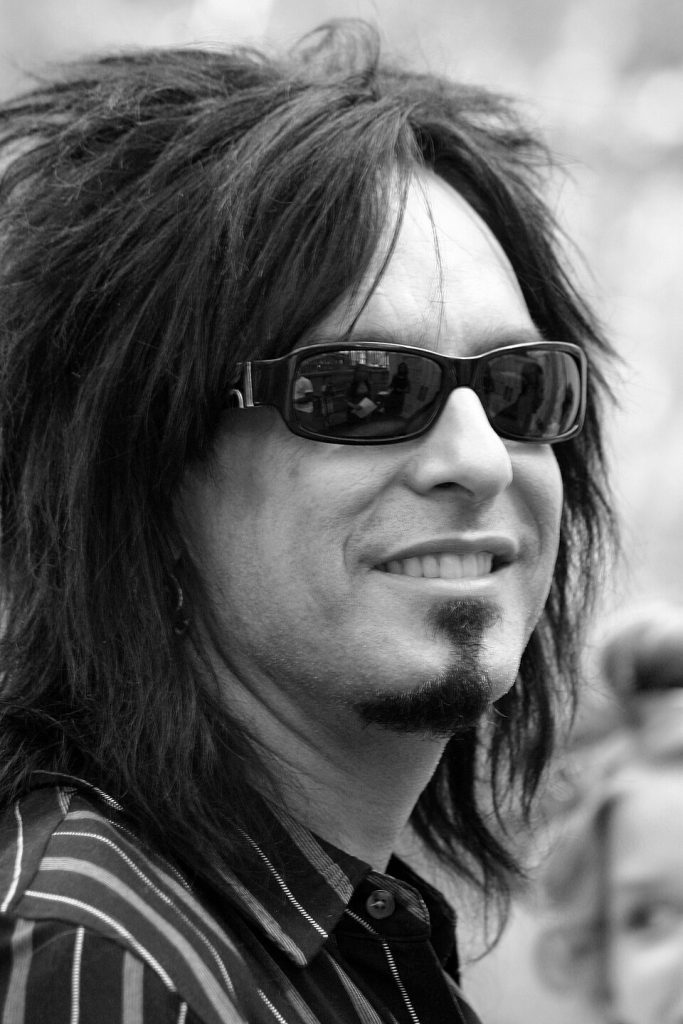
Photo: Wikimedia Commons
Quick Navigation
- Nikki Sixx: The Man Who Built Mötley Crüe
- From Frank Feranna to Nikki Sixx: The Early Years
- The Formation of Mötley Crüe
- Too Fast for Love and the Sunset Strip Years
- Nikki Sixx and the Albums That Defined a Decade
- The Night Nikki Sixx Died and Came Back
- Kickstart My Heart: Writing Through Survival
- The 1990s: Change, Comeback, and Reinvention
- The Heroin Diaries and Nikki Sixx as an Author
- Sixx:A.M. and a New Creative Chapter
- The Final Tour and the 2026 Comeback
- Nikki Sixx on Stage: Power and Presence
- The Legacy of Nikki Sixx
Nikki Sixx: The Man Who Built Mötley Crüe
Nikki Sixx is the creative engine that has driven Mötley Crüe since the day the band was formed.
He wrote or co-wrote the vast majority of the band’s catalog, including their biggest hits and their darkest deep cuts.
He designed the image, built the sound, and held the band together through personnel changes, addiction, near-death, and a music industry that turned over multiple times during his career.
The complete story of the band he built is covered at Mötley Crüe Members: The Complete Story.
What makes Nikki Sixx unusual among rock bass players is not just his musicianship, though that is considerable.
It is the fact that he is simultaneously the band’s primary songwriter, its visual architect, and its most public voice.
Most bands have one of those roles filled by a single person.
Mötley Crüe has had all three concentrated in the same person for over forty years.
DID YOU KNOW?
Before founding Mötley Crüe, Nikki Sixx played in a Los Angeles band called London alongside musicians who would go on to other notable careers in hard rock. His decision to leave London in 1981 and start his own group with a different creative vision was the pivotal choice that created Mötley Crüe. The full story of those early years is captured in the band’s autobiography The Dirt, available on Amazon.
From Frank Feranna to Nikki Sixx: The Early Years
Nikki Sixx was born Frank Carlton Serafino Feranna Jr. on December 11, 1958, in San Jose, California.
His father abandoned the family when Nikki was young, and he was largely raised by his grandparents in various parts of the American West, spending significant time in Idaho.
Those early years of instability, of moving between relatives and finding himself on the outside of conventional family structures, shaped the hunger that would later drive everything he built.
He was drawn to music early.
The sounds he gravitated toward were not soft or polite.
He wanted music that felt like power, that told the world it was being refused rather than accepted.
That impulse led him to rock and roll, and eventually to the decision to leave everything behind and head to Los Angeles.
He arrived in Los Angeles in the late 1970s with almost nothing, slept on floors, worked menial jobs, and spent every available moment trying to build a band and a career.
The name Nikki Sixx was not a random invention.
It was part of a deliberate reinvention, a rejection of the name and the circumstances of a childhood that had not given him what he needed.
He has spoken about this transformation openly, and his Wikipedia biography documents the full progression from Frank Feranna to the person the world would know.
The Formation of Mötley Crüe
Mötley Crüe came together in Los Angeles in January 1981.
Nikki Sixx had been working toward this for years, assembling the right combination of players, style, and attitude.
He connected with drummer Tommy Lee first, and the two began building around a concept that was heavier and more theatrical than most of what was happening on the Sunset Strip at that moment.
Guitarist Mick Mars, who had placed a classified ad describing himself as a loud, rude, and aggressive guitarist, was exactly what Nikki Sixx was looking for.
Vocalist Vince Neil completed the lineup.
The four of them clicked immediately in a way that had nothing to do with temperamental compatibility and everything to do with musical instinct.
They were four people who wanted the same thing: to be the loudest, most dangerous-looking band in Los Angeles.
Nikki Sixx supplied the songs that gave that ambition a concrete form.
Too Fast for Love and the Sunset Strip Years
Mötley Crüe self-released their debut album Too Fast for Love in November 1981 on their own Leatherrecords label before Elektra Records picked it up for a wider release.
The album established the sonic template that Nikki Sixx would spend the next decade refining: heavy riffs, melodic choruses, image-forward presentation, and lyrics that made no apologies for the world they came from.
The Sunset Strip was the laboratory, and Mötley Crüe ran it like they owned it.
Their live shows were events, chaotic and deliberate at the same time, with pyrotechnics, costumes, and a physical energy that made them impossible to dismiss or ignore.
Nikki Sixx was the producer of that experience as much as the performer in it.
He understood from early on that a band’s image was as much a creative product as its music, and he treated both with equal seriousness.
The Sunset Strip noticed, and then the rest of the country did too.
Nikki Sixx and the Albums That Defined a Decade
Nikki Sixx was the primary songwriter across Mötley Crüe’s most commercially and critically successful run of albums in the 1980s.
Shout at the Devil (1983) broke the band nationally, reaching number 17 on the Billboard 200 and going four times platinum.
It was heavier and more deliberately provocative than Too Fast for Love, with production from Tom Werman that gave the songs a sharper commercial edge.
Theatre of Pain followed in 1985 and reached number six on the Billboard 200.
It included the band’s cover of Smokin’ in the Boys Room, their first top-40 pop single, which introduced Mötley Crüe to a mainstream radio audience that had previously only known them by reputation.
Girls, Girls, Girls (1987) debuted at number two on the Billboard 200 and became the band’s first number one in several international markets.
Every one of those records bore Nikki Sixx’s fingerprints as a songwriter in songs that had real hooks beneath all the noise and attitude.
He understood the difference between sounding dangerous and writing music that people would actually want to listen to repeatedly, and he managed both at the same time.
DID YOU KNOW?
In 2011, Nikki Sixx published a photography book titled “This Is Gonna Hurt: Music, Photography and Life Through the Distorted Lens of Nikki Sixx.” The book, which accompanied the Sixx:A.M. album of the same name, featured his photographs of people living outside society’s mainstream, including homeless individuals, tattoo artists, and outsider communities. Photography had become a serious artistic pursuit for Nikki alongside his music, and the book is available on Amazon.
The Night Nikki Sixx Died and Came Back
On December 23, 1987, Nikki Sixx overdosed on heroin and was, by all clinical accounts, dead for approximately two minutes.
He was revived with adrenaline shots and taken to hospital.
The incident did not stop his drug use immediately, but it planted something in him that would eventually grow into the most honest work of his career.
He left the hospital against medical advice and went directly to a party.
That detail, more than almost any other in his biography, captures something essential about where he was in his life at that moment: the near-death had registered, but the part of him that could act on it had not yet caught up.
What he did do was begin writing.
He kept a diary during that year, and those entries, raw and unsparing, would eventually become the foundation for The Heroin Diaries.
The experience of clinical death, of flatline and revival, also became the direct inspiration for the song that would define Mötley Crüe’s commercial peak.
The paramedic who helped revive Nikki Sixx reportedly told him he would never survive if he kept using.
Nikki Sixx turned that encounter into one of the biggest rock songs of 1989.
Kickstart My Heart: Writing Through Survival
Nikki Sixx wrote Kickstart My Heart as a direct response to his overdose and clinical death.
The song appeared on the Dr. Feelgood album, released in September 1989, and became one of the defining rock tracks of the decade.
Dr. Feelgood debuted at number one on the Billboard 200 and went six times platinum in the United States.
Kickstart My Heart reached number 27 on the Billboard Hot 100 and became an enduring rock radio staple that has never really left heavy rotation in the decades since.
The song is a perfect encapsulation of what Nikki Sixx does best as a songwriter: it takes a genuinely dark and personal experience and channels it into something that feels like pure adrenaline from the opening riff.
There is no self-pity in the song.
There is no cautionary messaging.
There is just the electric shock of survival set to a tempo that refuses to slow down.
That is Nikki Sixx’s songwriting voice at its most refined and most effective.
The 1990s: Change, Comeback, and Reinvention
The 1990s brought significant upheaval to Mötley Crüe.
Vince Neil was dismissed from the band in 1992 and replaced by vocalist John Corabi, a change that resulted in a critically respected but commercially underperforming self-titled album in 1994.
Nikki Sixx remained the band’s anchor through that period, continuing to write and hold the creative direction together even when the lineup changed and the commercial landscape shifted dramatically under them.
The grunge movement had fundamentally altered what rock radio wanted, and glam metal found itself excluded from a landscape it had dominated just three years earlier.
Nikki Sixx adapted without abandoning what Mötley Crüe was.
Vince Neil returned in 1997, and the band released Generation Swine the same year, an album that reflected a harder, less polished sound than their 1980s work.
New Tattoo followed in 2000, and the band continued touring through a decade that treated them as legacy artists rather than active commercial forces.
That status did not diminish what they delivered on stage.
It simply changed the context in which they delivered it.
The Heroin Diaries and Nikki Sixx as an Author
In 2007, Nikki Sixx published The Heroin Diaries: A Year in the Life of a Shattered Rock Star, a memoir built from the actual diary entries he had kept during his worst year of addiction in 1987.
The book was a commercial and critical success, reaching the New York Times bestseller list and introducing Nikki Sixx to an audience that extended well beyond Mötley Crüe’s traditional fanbase.
It was brutally honest in a way that rock memoirs rarely are.
He did not clean up the story or position himself as a survivor who had learned a tidy lesson.
He presented the reality of what addiction looked like from the inside of it, including the delusion, the selfishness, and the genuine terror of a person who cannot stop even when they can see what stopping them actually is.
The book established Nikki Sixx as a writer with real literary instincts, not just a rock musician with a story to tell.
It also inspired the music of Sixx:A.M., with The Heroin Diaries Soundtrack album released alongside the book.
A tenth-anniversary edition of the book was released in 2017 with additional entries, commentary, and reflection on the decade since its initial publication.
Sixx:A.M. and a New Creative Chapter
Sixx:A.M. was formed in 2007 as a creative partnership between Nikki Sixx, guitarist DJ Ashba, and vocalist and producer James Michael.
The band began as the musical component of The Heroin Diaries project but quickly evolved into a genuine ongoing creative entity with its own identity and audience.
Their debut single “Life Is Beautiful” became a rock radio staple, reaching the top ten on the Billboard Mainstream Rock Tracks chart.
Subsequent Sixx:A.M. albums, including This Is Gonna Hurt (2011), Modern Vintage (2014), and the two-volume Prayers for the Damned (2016), demonstrated that Nikki Sixx had creative energy that went beyond what Mötley Crüe required of him.
Sixx:A.M. gave him a space to write melodically in ways that the Mötley Crüe context did not always allow.
The band has been on indefinite hiatus since 2017, but its catalog represents a significant and often underappreciated body of work from one of rock’s most prolific songwriters.
DID YOU KNOW?
Nikki Sixx hosted a nationally syndicated rock radio show called “Sixx Sense with Nikki Sixx” that aired across more than 100 stations in the United States and Canada. The show featured interviews with major rock artists, music discussion, and Nikki’s unfiltered commentary on the state of rock and roll. It ran for several years during the 2010s, making him one of the most widely heard voices in rock radio during that period. Explore his Sixx:A.M. work, including their debut album, on Amazon here.
The Final Tour and the 2026 Comeback
Mötley Crüe announced what they called their Final Tour in 2014, a massive global farewell run that concluded in 2015.
The band signed a cessation agreement at the time, a legally binding contract that committed each member to never touring as Mötley Crüe again.
They broke that agreement in 2019, announcing a reunion with Def Leppard, Poison, and Joan Jett for what became The Stadium Tour.
That tour, delayed by the pandemic, finally ran in 2022 and played to sold-out stadiums across North America.
Then came a complication: guitarist Mick Mars announced he was stepping back from touring due to his long-documented health issues with ankylosing spondylitis.
What followed was a public and legal dispute that Nikki Sixx addressed directly in the press.
The story of that dispute is covered at Mick Mars Mötley Crüe Feud: Why Nikki Sixx Calls It Betrayal.
Despite the turmoil, the band continued forward with new guitarist John 5.
Vince Neil also dealt with health challenges during this period, covered at Vince Neil’s Stroke and Vegas Comeback.
The band’s 2026 Carnival of Sins tour, detailed at Mötley Crüe’s 2026 Tour: Return of Carnival of Sins, demonstrated that the band was not finished.
Setlist developments for that run are tracked at Mötley Crüe’s Setlist Changes for the 2026 Tour.
The band also made a high-profile appearance on American Idol, an event that generated significant attention and reaction covered at Mötley Crüe American Idol Reaction.
Nikki Sixx on Stage: Power and Presence
Nikki Sixx has always been a physically commanding stage presence.
He is not a bassist who stands still and plays correctly.
He moves across the stage like someone who believes that every person in the venue paid to see him specifically, and his job is to make sure they feel that was worth it.
His bass playing is not technically showy, but it is effective in exactly the way the songs require.
The low end he provides on a Mötley Crüe record, and replicates live, is the kind that you feel in your chest before you consciously register it as music.
His stage wardrobe and visual presence have been part of the Mötley Crüe experience since the beginning, and he has never allowed that dimension to become complacent or routine.
Even in the band’s later years, the stage show that surrounds a Mötley Crüe performance reflects the deliberate design sensibility that Nikki Sixx has always brought to everything the band does in public.
The video below captures his direct perspective on rock musicians and authenticity, and it illustrates the kind of unfiltered thinking that has made him one of the most compelling voices in the genre for four decades:
The Legacy of Nikki Sixx
Nikki Sixx has now been writing songs, playing bass, and shaping one of rock’s most durable bands for over forty years.
The catalog he has built with Mötley Crüe alone represents one of the most commercially successful bodies of work in the history of hard rock.
The band has sold an estimated 100 million albums worldwide.
The Mötley Crüe biography The Dirt, which Nikki Sixx co-wrote with the other members and author Neil Strauss, became a bestseller in 2001 and was adapted into a Netflix film in 2019.
Nikki Sixx is active across multiple platforms.
You can follow him on Instagram, where he shares photography and commentary with millions of followers.
His Facebook page maintains an active connection with his long-term fanbase.
His X (Twitter) account is characteristically direct and unfiltered.
His official home on the web is at nikkisixxofficial.com, where his current projects and announcements are centralized.
What makes Nikki Sixx genuinely unusual among rock musicians of his generation is the range of creative work he has pursued without losing the thread back to what made him important in the first place.
He has written books, hosted radio programs, built a second band, and continued as the creative anchor of one of rock’s most recognizable acts.
All of it connects back to the same person who arrived in Los Angeles in the late 1970s with nothing but ambition and the absolute certainty that he was going to build something that mattered.
He was right, and four decades later, Nikki Sixx is still building.
Affiliate Disclosure: As an Amazon Associate, I earn from qualifying purchases. If you click a link on this site and make a purchase, I may receive a small commission at no extra cost to you. This helps support classicrockartists.com and keeps the content coming. Thank you for your support.
Shop Mötley Crüe Albums and Vinyl on Amazon