
Mike Starr: Original Bassist Who Built Alice in Chains
Mike Starr was the first bass player in Alice in Chains and one of the four founding members who built the band from nothing into one of the most powerful acts in the history of American rock.
He played on the records that defined a sound and a generation.
He stood at the center of a band whose music still resonates thirty-five years later.
And he paid a price for those years that no amount of success could offset.

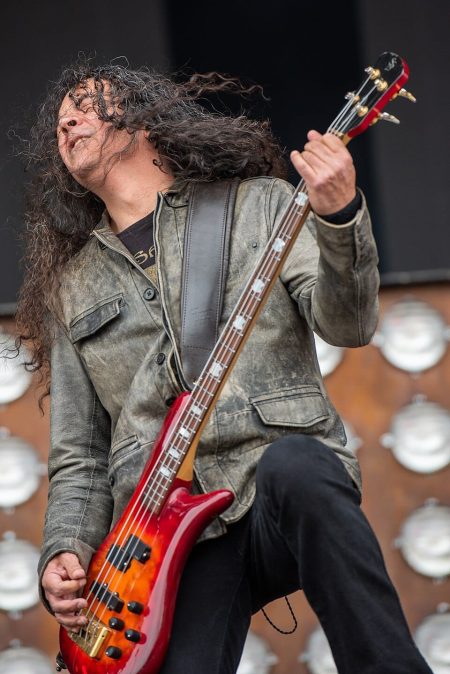
Photo: Wikimedia Commons
Quick Navigation
- Mike Starr: The Original Bass Voice
- Early Life and the Roots of a Bassist
- How Alice in Chains Came Together
- Mike Starr and the Facelift Sessions
- Dirt: The Record That Defined an Era
- The SAP EP and the Acoustic Side
- Mike Starr Leaves the Band
- The Years After Alice in Chains
- Celebrity Rehab and the Public Eye
- Mike Starr and Layne Staley: Brothers in Pain
- The Sound He Left Behind
- Mike Starr on Stage: Power and Presence
- The Legacy of Mike Starr
Mike Starr: The Original Bass Voice
Mike Starr was not simply the first bassist to sit in the chair.
He was part of the creative partnership that gave Alice in Chains its early identity.
He was in the room when Jerry Cantrell was working out the guitar language that would make the band unlike anything else in rock.
He stood alongside Sean Kinney every night, locking in a rhythm section that made those early records feel like they were pulling the foundation out from under you.
His bass on Facelift and Dirt sits beneath two of the most important rock albums of the 1990s.
Pull it out of those recordings and you feel the absence immediately.
Mike Starr understood exactly what those songs needed, and he delivered it every single time.
DID YOU KNOW?
Mike Starr’s younger brother, Matt Starr, went on to become a professional rock drummer in his own right, performing with Ace Frehley of KISS, Mr. Big, and Accept. Music was embedded in the Starr family, and Matt built a serious career while Mike was making history with Alice in Chains. You can explore Ace Frehley’s catalog, which Matt contributed to, on Amazon here.
Early Life and the Roots of a Bassist
Michael Christopher Starr was born on April 4, 1966, in Honolulu, Hawaii.
His family eventually settled in the Pacific Northwest, moving to the Kent, Washington area outside Seattle.
Growing up in the suburbs south of the city in the late 1970s and early 1980s, he absorbed the hard rock coming through the radio and cassette decks of his generation.
He picked up the bass in his teens, not because it was glamorous, but because he was drawn to the physicality of it.
He wanted to feel music as much as hear it.
He was not a technical showoff.
He was a feel player, someone who understood that the bass is the ground beneath everything else.
That philosophy, built quietly in the suburbs of Seattle, would shape everything he played when the opportunity finally came to do it in front of the world.
How Alice in Chains Came Together
Alice in Chains formed in Seattle in the late 1980s.
The original lineup that would record the band’s first albums brought together Jerry Cantrell on guitar, Layne Staley on vocals, Mike Starr on bass, and Sean Kinney on drums.
The full story of how each of those members came together and what they built is documented at Alice in Chains: The Complete Member Story.
What matters about the formation of that lineup is how quickly they found a common musical language.
Mike Starr belonged in that band from the first rehearsal.
His bass was heavy without being overpowering, melodic without being soft.
It sat beneath Cantrell’s guitar the way a good foundation sits beneath a building.
The band signed with Columbia Records and prepared to introduce themselves to a world that had no idea what was coming.
Mike Starr and the Facelift Sessions
In 1990, Mike Starr recorded Facelift with Alice in Chains, and the album arrived with a force that very few debut records have ever matched.
It introduced the world to Man in the Box, a song whose riff, vocal performance, and bass line converged into something that sounded like nothing else on rock radio.
Starr’s bass on Facelift is direct and anchored.
It does not compete with the guitars or the vocals for space.
Instead it makes every song feel heavier and more deliberate than it would be without it.
Facelift reached platinum and pushed Alice in Chains into the front ranks of what was emerging in Seattle.
Mike Starr had earned his place not through image or hype, but through the quality of what he played every day in that studio.
DID YOU KNOW?
Before Facelift was commercially released, Alice in Chains distributed “We Die Young” as a free promotional single to American troops stationed in the Gulf War in 1990. It was an early and unusually direct military-channel promotional strategy for a rock band. The exposure built awareness of Alice in Chains weeks before the wider album campaign began. Facelift, featuring Mike Starr’s bass on every track, is available on vinyl and CD on Amazon.
Dirt: The Record That Defined an Era
In September 1992, Alice in Chains released Dirt, and Mike Starr played on every track.
That album confronts addiction, pain, and self-destruction with a directness that mainstream rock music had almost never attempted before.
Starr’s bass holds the record together across some of its most emotionally devastating moments.
Rooster is a song about war and survival, and the bass line underneath it moves with the slow, deliberate weight of something that will not be rushed.
Them Bones opens in an odd time signature and hits like a wall.
Down in a Hole is heavy with grief, moving slowly and deliberately, and the bass is part of what gives it that sinking quality.
Angry Chair is one of Staley’s most personal songs, and the low end underneath it is thick enough to feel like pressure on your chest.
Dirt reached number six on the Billboard 200 and eventually went four times platinum.
Every note on that record carries Mike Starr’s contribution in its foundation.
The SAP EP and the Acoustic Side
Released in February 1992 between Facelift and Dirt, the SAP EP revealed a quieter, more fragile side of Alice in Chains.
Mike Starr played on those sessions, and his bass on the EP shows a different dimension of his playing.
Acoustic settings demand more from a bassist in some ways, not less.
When the electric amplification is stripped away, the bass lines are exposed completely.
They either serve the song or they sink it.
Starr served every song on that EP with precision and restraint.
SAP also features guest vocals from Ann Wilson of Heart and Mark Lanegan of Screaming Trees, making it one of the most genuinely collaborative recordings from the Seattle scene.
It remains a small but essential document of what Mike Starr could do when the music asked something different of him.
Mike Starr Leaves the Band
Mike Starr departed Alice in Chains in 1993.
The circumstances were complex, reflecting the mounting pressures that surrounded the band during those years.
He was replaced by Mike Inez, a bassist who had been touring with Ozzy Osbourne, and who you can follow on his official Facebook page.
Inez went on to record four more studio albums with the band and toured with them for decades.
But the songs from Facelift and Dirt, the songs Mike Starr helped build, never left the live set.
His contributions to those recordings could not be replaced or erased.
Every night those songs were played, they carried his fingerprints in their foundation.
Mike Starr was gone from the band, but the music he had made with them was permanent.
The Years After Alice in Chains
Life after Alice in Chains was hard for Mike Starr.
He did not pursue a high-profile solo career or immediately find another major band to join.
He stayed connected to music during the mid-to-late 1990s, playing sessions and collaborating with other musicians, but the sustained momentum that being in a band of Alice in Chains’ stature had provided was gone.
During those same years, Alice in Chains itself was falling silent.
The band’s 1995 self-titled album would be the last studio record made with Layne Staley, and the years that followed saw the group cease to function as a working unit.
For Mike Starr, watching the band he had co-founded go quiet while its lead singer retreated from the world carried a particular weight.
He had been close to Staley.
The distance from the music and from his friend was not something that got easier over time.
Celebrity Rehab and the Public Eye
In 2010, Mike Starr appeared on the fourth season of Celebrity Rehab with Dr. Drew, the VH1 documentary series that followed celebrities through addiction treatment.
His appearance brought renewed public attention to a man who had stayed largely out of the spotlight since leaving Alice in Chains nearly two decades earlier.
He spoke with openness about his struggles, about the losses he had experienced, and about what he was trying to rebuild in his life.
The show confronted viewers with something the rock press rarely covers honestly: what happens to the people in great bands after the albums and tours are over.
Mike Starr came across as someone still fighting with everything he had.
Fans who had grown up with Facelift and Dirt were confronted with the full human cost of the years between those records and that moment.
His appearance on Celebrity Rehab remains one of the most unguarded public moments in the extended Alice in Chains story.
DID YOU KNOW?
The Dirt album, which features Mike Starr’s bass throughout, was produced by Dave Jerden, who had already worked with Alice in Chains on Facelift. Jerden was known for recording bands in a way that preserved the physical weight of a live performance, capturing low-end tone on tape rather than manufacturing it in post-production. That approach is audible in every groove Mike Starr plays on Dirt. The album remains available in multiple formats, including deluxe editions, on Amazon.
Mike Starr and Layne Staley: Brothers in Pain
Of all the relationships in Alice in Chains’ history, the bond between Mike Starr and Layne Staley was among the most complex.
The two men shared similar struggles.
They had stood in the same band during the same formative years and had absorbed the same pressures, the same losses, and the same aftermath of the Seattle scene’s rise and collapse.
When Staley withdrew from public life in the mid-to-late 1990s, the band that had connected him and Mike Starr already belonged to the past.
Layne Staley died on April 5, 2002, at 35 years old.
The loss devastated every person connected to Alice in Chains.
For Mike Starr, who had been part of the world that produced those songs and that friendship, it was a loss he carried differently than anyone else could.
He had been there from the beginning.
He had been part of what made those records possible.
Losing the voice that had given them their emotional center was something that did not diminish.
The Sound He Left Behind
Mike Starr’s playing is audible in some of the most celebrated rock recordings of the 1990s.
The bass on Would is massive and melodic simultaneously, a line that serves the song’s emotional arc without ever stepping outside of it.
The bass on Rain When I Die is relentless, a grinding low-end engine that makes an already aggressive song feel physically heavier.
These were not the sounds of a player filling in the gaps.
They were the sounds of a bassist who understood the emotional content of the music and calibrated his playing to match it exactly.
Other bands had heavy guitars in the early 1990s.
Other bands had powerful vocalists.
But the specific combination of elements that Alice in Chains assembled on those early records was its own thing entirely.
Mike Starr’s bass was a structural part of that identity, not an afterthought.
Mike Starr on Stage: Power and Presence
Mike Starr was a physical player on stage.
He was not a performer who worked the crowd with rehearsed moves or audience interaction.
He was a musician who stood in the music and played hard every single night.
The early Alice in Chains shows, built around the Facelift material and then the Dirt material, were intense, confrontational performances that demanded absolute commitment from the rhythm section.
Mike Starr gave that commitment without reservation.
Those shows contrasted the crushing weight of the band’s sound with Staley’s soaring, anguished vocals in a way that had no real equivalent in rock at the time.
Mike Starr was part of the engine that made those shows feel like something physical rather than simply sonic.
Anyone in those rooms during the Facelift and early Dirt tours witnessed a band at the very start of something that could not be planned or repeated.
Mike Starr was in the center of it, holding the low end together every night.
The Legacy of Mike Starr
Mike Starr died on March 8, 2011, in Salt Lake City, Utah.
He was 44 years old.
The cause was an accidental prescription drug overdose.
He had been fighting for years.
He left behind a body of recorded work that will not diminish with time.
The bass lines on Facelift, on SAP, and on Dirt are the permanent mark he made on rock music.
Alice in Chains continued after Mike Starr, making records with Mike Inez on bass that stand alongside the best rock music of the past thirty years, including Black Gives Way to Blue and the work of William DuVall.
The band did not stop, and their continued work is a tribute to the foundation that the original lineup built.
That foundation included Mike Starr at its center.
You can find his full profile and discography at Wikipedia.
A memorial page maintained by fans can be found on Facebook, where his memory and his music continue to be celebrated by the people whose lives he changed.
The music on those records, the weight he contributed, the foundation he poured under two of the greatest heavy rock albums ever made, ensures that Mike Starr is remembered exactly as he should be: as one of the people who built something that mattered.
Affiliate Disclosure: As an Amazon Associate, I earn from qualifying purchases. If you click a link on this site and make a purchase, I may receive a small commission at no extra cost to you. This helps support classicrockartists.com and keeps the content coming. Thank you for your support.
Shop Alice in Chains Dirt on Amazon: Vinyl, CD and More