

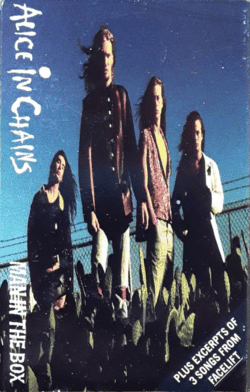
Man in the Box by Alice in Chains reached number one on the US Mainstream Rock chart in 1991 and became the song that introduced the Seattle band’s heavily downtuned sound to mainstream rock audiences, establishing them as one of the defining forces of grunge alongside Nirvana and Soundgarden.
Written by vocalist Layne Staley and guitarist Jerry Cantrell, it combined Cantrell’s wah-heavy guitar riff with Staley’s multi-layered vocals to create a sound that felt immediately distinct from anything else on rock radio.
Affiliate Disclosure: As an Amazon Associate I earn from qualifying purchases. This helps support the site at no extra cost to you.
| Song | Man in the Box |
| Artist | Alice in Chains |
| Album | Facelift (1990) |
| Written by | Layne Staley (lyrics), Jerry Cantrell (music) |
| Produced by | Dave Jerden |
| Released | 1991 |
| Genre | Grunge, Heavy Metal |
| Chart Peak | #1 US Mainstream Rock |
Table of Contents
Background and History
Alice in Chains formed in Seattle in 1987 and built a live following in the Pacific Northwest before signing to Columbia Records and recording their debut album Facelift with producer Dave Jerden in 1989 and 1990.
The band’s lineup of Layne Staley on vocals, Jerry Cantrell on guitar, Mike Starr on bass, and Sean Kinney on drums created a particularly dense sound that leaned harder into metal than most of the Seattle acts that surrounded them.
Staley wrote the lyrics to Man in the Box after watching a television segment on animal cruelty, specifically the conditions in which veal calves were kept confined in crates.
The image of a living creature silenced, confined, and prevented from natural movement became the central metaphor for the song’s critique of censorship and societal control.
Cantrell composed the guitar music separately, and the combination of his downtuned, wah-saturated riff with Staley’s imagery produced a track that both the band and their label recognized immediately as something capable of breaking through on rock radio.
Man in the Box and the Recording Story
Man in the Box is built around Jerry Cantrell’s guitar riff, which uses a wah pedal to create a talking, almost human quality that anchors the track’s theme of suppressed voices.
Layne Staley’s vocal performance layers harmonies over the lead melody, a technique the band used extensively on Facelift and which became one of the most imitated approaches in grunge-era rock.
Producer Dave Jerden captured the guitar tone with a directness that suited the song’s aggression, and the rhythm section of Kinney and Starr provides a locked-in heaviness that keeps the track from tipping into pure metal.
The music video features imagery of Staley with sewn-shut eyes, a visual representation of blind authority and enforced silence that extended the song’s central metaphor into a format that MTV could broadcast widely.
The visual and sonic combination landed the song in heavy rotation and placed Alice in Chains directly alongside Nirvana and Soundgarden as the three bands most responsible for defining the Seattle sound’s commercial moment.
The song also marked Temple of the Dog‘s wider moment, as the collaborative project featuring members of both Soundgarden and Pearl Jam was recording at the same time in Seattle, giving the city an extraordinary concentration of musical talent in a single period.
Man in the Box and the Charts
Man in the Box reached number one on the US Mainstream Rock chart, making it Alice in Chains’ first chart-topping single and one of the earliest grunge tracks to break through on that format.
The song’s success on rock radio preceded the broader mainstream explosion of grunge by several months, positioning the band ahead of the cultural wave that followed Nirvana’s Nevermind later that year.
The Facelift album was eventually certified double platinum in the United States, with this track driving much of its continued sales after the initial release.
The combination of the song’s chart performance and music video presence established a commercial template that Alice in Chains used across their subsequent releases, each of which built on the foundation this track laid.
Its impact on rock radio programming was significant enough that program directors began actively seeking similar-sounding tracks from Seattle and from other heavy alternative acts, accelerating the shift in mainstream rock that defined the early 1990s.
Lasting Legacy of Man in the Box
Man in the Box appears on virtually every list of the most important grunge songs and is consistently cited alongside Smells Like Teen Spirit and Black Hole Sun as a track that defined what the Seattle scene achieved at its peak.
The song’s central guitar riff is among the most recognized in heavy rock of the 1990s, a quality it shares with very few tracks from the era.
Layne Staley’s vocal approach on the track, particularly the harmony layering, influenced a generation of rock singers who adopted the technique across the decade that followed.
Alice in Chains has continued to perform the song with vocalist William DuVall, who joined the band after Staley’s death in 2002, maintaining its place in their live set as the track that best represents the original band’s defining sound.
The critique of censorship and societal control embedded in the lyrics proved elastic enough to resonate across different cultural moments, giving the song a durability that purely sonic choices alone could not have produced.
Three decades after its release, Man in the Box remains the song most associated with Alice in Chains and the clearest statement of what the band accomplished on their first attempt at breaking into rock radio.
Watch the Official Video
Frequently Asked Questions
FAQ
- Who wrote Man in the Box?
- Layne Staley wrote the lyrics after watching a television segment about animal cruelty and veal calf confinement. Jerry Cantrell composed the music, creating the wah-heavy guitar riff that anchors the track.
- What album is Man in the Box from?
- The song is the second single from Facelift, Alice in Chains’ debut studio album recorded in 1989 and 1990 and produced by Dave Jerden, released by Columbia Records in 1990.
- What does “man in the box” mean?
- Staley used the imagery of a veal calf confined in a crate as a metaphor for censorship and societal control, the idea of a living being silenced and prevented from expressing itself by external forces.
- Did it reach number one?
- The song topped the US Mainstream Rock chart, making it Alice in Chains’ first number one single and one of the earliest grunge tracks to reach the top of that chart.
- How is it used in live performances today?
- Alice in Chains continues to perform the song with vocalist William DuVall, who joined after Layne Staley’s death in 2002, and it remains a regular part of their live set as the track most associated with the original band.
You Might Also Like

Built on Jerry Cantrell’s wah-saturated riff and Layne Staley’s layered harmonics, Man in the Box remains Alice in Chains’ most recognized track and one of the defining songs of the grunge era, a record whose combination of heaviness and melody proved that the Seattle sound could succeed on the widest possible commercial scale.