

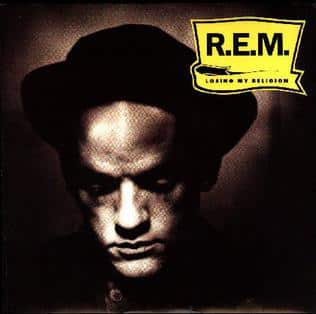
Losing My Religion by R.E.M. reached number four on the US Billboard Hot 100 in 1991 and became the song that lifted the Athens, Georgia band from college radio to global commercial success in a matter of months.
Written by all four members and anchored by Peter Buck‘s mandolin figure, the track arrived as the lead single from Out of Time and won two Grammy Awards the following year, including Best Pop Performance by a Duo or Group with Vocal.
Affiliate Disclosure: As an Amazon Associate I earn from qualifying purchases. This helps support the site at no extra cost to you.
| Song | Losing My Religion |
| Artist | R.E.M. |
| Album | Out of Time (1991) |
| Written by | Bill Berry, Peter Buck, Mike Mills, Michael Stipe |
| Produced by | Scott Litt, R.E.M. |
| Released | 1991 |
| Genre | Alternative Rock, Folk Rock |
| Chart Peak | #4 US Billboard Hot 100, #19 UK Singles Chart |
Table of Contents
Background and History
R.E.M. formed in Athens, Georgia in 1980 and spent a decade building one of the most devoted college radio audiences in American rock, releasing albums that prioritized atmosphere and ambiguity over commercial accessibility.
By 1991, the band had released six studio albums and was working with long-time producer Scott Litt on Out of Time, an album that moved away from the guitar-centered sound of their previous records.
Peter Buck began playing mandolin during the sessions as an experiment, and the instrument provided a brightness and folk-rock quality that gave Losing My Religion its distinctive texture.
The phrase “losing my religion” comes from Southern American idiom, where it means reaching a point of extreme frustration or desperation, losing one’s composure entirely.
Michael Stipe has described the song as being about unrequited love and the specific emotional state of obsession, the feeling of wanting to express something to another person and being unable to do so directly.
The combination of Buck’s mandolin, Stipe’s oblique lyrics, and the song’s unusual instrumentation for a rock single made it a genuinely unexpected breakthrough when it reached mainstream radio.
Losing My Religion and the Recording Story
Losing My Religion opens with the mandolin figure that Peter Buck developed during sessions for Out of Time, an instrument he had not used on a previous R.E.M. recording.
The decision to build a lead single around mandolin rather than electric guitar was a significant commercial risk in 1991, particularly for a band attempting to break through to a broader audience.
Bassist Mike Mills contributed backing vocals that create the harmonic texture running underneath Stipe’s lead, a layering technique the band had developed across their earlier albums.
Bill Berry‘s drum part keeps the track moving without dominating the arrangement, a restrained approach that gave the mandolin and vocals the space to define the song’s character.
Scott Litt’s production kept the recording clean and direct, avoiding the layered complexity that had characterized some of the band’s earlier work and letting the unusual instrumentation make the impact on its own terms.
The music video, directed by Tarsem Singh, drew on religious iconography and visual references to European painting to create something that felt culturally weighted without making the song’s meaning more explicit.
The video’s art-house quality separated it from virtually everything else in MTV rotation at the time, and its success pointed toward what U2 and other major rock acts were also attempting: using sophisticated visual language to give rock songs a broader cultural context.
Losing My Religion and the Awards
Losing My Religion won two Grammy Awards at the 1992 ceremony: Best Pop Performance by a Duo or Group with Vocal and Best Short Form Music Video.
The song’s Grammy wins placed R.E.M. at the center of mainstream recognition after a decade of critical respect without equivalent commercial attention.
Out of Time won the Grammy for Album of the Year at the same ceremony, making it one of the most decorated albums of the year across multiple categories.
The song reached number four on the Billboard Hot 100 and performed well across Europe, with the music video driving sustained airplay in markets where the band had previously operated primarily at cult level.
Its chart performance demonstrated that alternative rock could compete directly with mainstream pop, a conclusion that altered how record labels approached the format in the years that followed.
Songs from the same period like Tears in Heaven by Eric Clapton and Mary Jane’s Last Dance by Tom Petty reflected the same mainstream openness to emotionally direct, melodically unusual rock in the early 1990s.
Lasting Legacy of Losing My Religion
Losing My Religion remains R.E.M.’s most commercially recognized song and the track that most listeners use as the entry point into the band’s catalog.
Its use of mandolin as a lead instrument in a mainstream rock context influenced how other artists thought about incorporating acoustic and folk instruments into alternative rock production.
The Tarsem Singh video won multiple awards and has been cited by music video directors as a reference point for how to give a song visual weight without illustrating its lyrics literally.
R.E.M. disbanded in 2011, and the song has continued to receive consistent radio play and streaming numbers that exceed most tracks from their era, a measure of how cleanly it translates across listening contexts.
The phrase in the title entered broader cultural usage as a reference point, appearing in articles, books, and commentary on experiences of disillusionment across religious, political, and personal contexts.
More than three decades after its release, Losing My Religion stands as one of the few alternative rock songs of the early 1990s to achieve durable mainstream recognition without losing the qualities that made it unusual in the first place.
Watch the Official Video
Frequently Asked Questions
FAQ
- Who wrote Losing My Religion?
- All four members of R.E.M. wrote the song: Bill Berry, Peter Buck, Mike Mills, and Michael Stipe. Peter Buck developed the mandolin figure during sessions for Out of Time, and Stipe wrote the lyrics about unrequited love and obsession.
- Does the title refer to actual religion?
- No. The phrase is a Southern American idiom meaning reaching a point of extreme frustration or losing one’s composure. Michael Stipe has said the song is about unrequited love, not religious faith or doubt.
- What awards did Losing My Religion win?
- The song won two Grammy Awards in 1992: Best Pop Performance by a Duo or Group with Vocal and Best Short Form Music Video. Out of Time, the album it came from, also won the Grammy for Album of the Year.
- Why did the mandolin break through on rock radio?
- The mandolin’s bright, chiming quality provided an immediately distinctive hook that separated the song from the guitar-driven tracks surrounding it, and Peter Buck’s melodic figure was accessible enough to connect instantly with listeners who had never considered the instrument.
- How did it change R.E.M.’s career?
- The song lifted the band from college radio credibility to global commercial success, turning a decade of critical respect into mainstream recognition and establishing them as one of the defining alternative rock acts of the early 1990s.
You Might Also Like

Built on Peter Buck’s mandolin figure and Michael Stipe’s elliptical account of obsessive longing, Losing My Religion remains R.E.M.’s most enduring single: the song that proved alternative rock could carry the full weight of mainstream recognition without abandoning what made it distinct.