Mike Inez: The Bass Player Who Shaped Alice in Chains
Mike Inez is one of the most respected bass players in the history of hard rock.
His arrival in Alice in Chains in 1993 was not just a roster change.
It was the moment the band’s low end found its permanent voice, a sound that would carry their music through three decades of grief, silence, and hard-won revival.
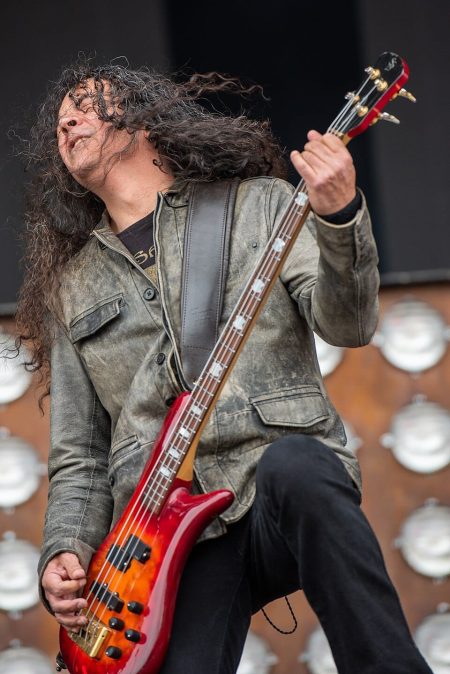
Photo: Wikimedia Commons
Quick Navigation
- Mike Inez: The Bass Voice of Alice in Chains
- Early Life and Musical Roots
- The Road to Seattle: Touring With Ozzy Osbourne
- Mike Inez Joins Alice in Chains
- Jar of Flies: The First Studio Sessions
- Mike Inez and the 1995 Self-Titled Album
- The Long Silence and What Came After
- Mike Inez Returns: Black Gives Way to Blue
- The Devil Put Dinosaurs Here: Staying the Course
- Rainier Fog and Alice in Chains’ Modern Sound
- Side Projects and the Broader Universe
- Mike Inez on Stage: A Live Force
- The Legacy of Mike Inez
Mike Inez: The Bass Voice of Alice in Chains
Mike Inez stepped into one of the most impossible situations in rock history and made it sound inevitable.
Replacing an original band member is always hard.
Doing it inside Alice in Chains, a band whose chemistry was already forged in something darker and more personal than most rock acts ever reach, required more than technical skill.
It required instinct, restraint, and an ability to disappear into the music without disappearing from it.
Inez had all three.
His bass lines across the band’s mid-1990s catalog are locked so tightly into the fabric of those recordings that pulling them out would leave the songs structurally unsound.
He brought a melodic heaviness to the low end that balanced Jerry Cantrell’s crunching guitar work without competing with it.
That is a harder thing to do than most listeners ever realize.
DID YOU KNOW?
Mike Inez has named Geezer Butler of Black Sabbath and John Paul Jones of Led Zeppelin as his two primary bass heroes. Both players share a rare quality: they are melodic first, heavy second, and always in service of the song rather than the spotlight. That dual influence explains a great deal about how Inez plays.
Early Life and Musical Roots
Michael Andrew Inez was born on May 14, 1966, in San Fernando, California.
He grew up absorbing the hard rock and heavy metal that dominated Southern California radio in the late 1970s and early 1980s.
He picked up the bass guitar as a teenager and gravitated immediately toward tone and feel rather than technical speed.
His developing philosophy was simple: the bass exists to serve the song, not to announce the player.
He was not interested in flashy runs or soloing for its own sake.
He was interested in weight, in the way a bass line could make a room feel the music physically before anyone consciously registered what they were hearing.
That instinct, formed early, would become the foundation of everything he built later.
By his late teens he was serious enough about bass to pursue it professionally, building the chops and the work ethic that professional touring demands.
The Road to Seattle: Touring With Ozzy Osbourne
Before joining Alice in Chains, Inez built his touring credentials as a member of Ozzy Osbourne‘s live band.
That gig placed him on some of the biggest rock stages in North America, playing in front of arena crowds who expected nothing less than a complete professional performance every night.
The experience was invaluable in ways that studio work alone could never provide.
He learned how to lock a rhythm section together under pressure.
He learned how to read a crowd, how to hold the groove when everything around you is loud and the monitors are lying.
He learned what it takes to play at that level night after night without letting the grind erode the performance.
Those lessons paid off in every Alice in Chains show that followed.
When the opportunity to join Alice in Chains came, Inez was not a young player being thrown in at the deep end.
He was a road-tested professional who had already proven himself at the highest level of rock touring.
Mike Inez Joins Alice in Chains
Mike Inez officially joined Alice in Chains in 1993, taking the bass chair left by departing original member Mike Starr.
The full story of how that transition unfolded, and what it meant for everyone connected to the band, is documented at Alice in Chains: The Complete Member Story.
What you need to understand about the musical situation Inez walked into is how unusual Alice in Chains already was.
Jerry Cantrell‘s guitar sat somewhere between grunge, doom metal, and something darker that resisted easy classification.
Sean Kinney‘s drumming was both powerful and precise, driving songs forward without flattening them.
And Layne Staley‘s voice pulled everything toward an emotional center that very few rock bands ever find.
Inez understood the assignment.
His bass locked into Kinney’s kick drum with an instinctive tightness that the rhythm section needed.
The music held because the foundation held, and Inez was the man pouring that foundation every night.
Jar of Flies: The First Studio Sessions
The first studio work Mike Inez contributed as a member of Alice in Chains was the 1994 acoustic EP Jar of Flies.
That record arrived as a genuine surprise: a stripped-back acoustic release from a band known for crushing electric heaviness.
It became the first EP in history to debut at number one on the Billboard 200.
Inez’s bass on Jar of Flies is understated in exactly the right way.
On Nutshell his playing holds space without filling it, giving the song room to breathe and ache.
On No Excuses he sits in a melodic pocket that supports the warmth of the track without pushing against it.
On I Stay Away he finds a groove that is gentle on the surface and quietly relentless underneath.
The EP proved immediately that Mike Inez was not a one-setting player.
He could play whatever the song demanded, and Jar of Flies demanded patience, delicacy, and genuine musical sensitivity.
DID YOU KNOW?
Cort Guitars produced a Mike Inez signature bass model built around his preferred playing specifications. The instrument was designed to deliver the thick low-mid punch and dynamic responsiveness that defines his recorded tone, capable of moving from the thunderous weight of the heavy rock records to the acoustic sensitivity of sessions like Jar of Flies without losing character.
Mike Inez and the 1995 Self-Titled Album
If Jar of Flies showed one side of what Mike Inez brought to Alice in Chains, the 1995 self-titled album showed the other.
That record is heavy, slow, and suffocating in the best possible sense.
It moves at a pace that demands a bassist who can carry enormous weight across long, unbroken stretches without losing the thread.
On Grind Inez locks into a low, churning pattern that makes the song feel like it is being dragged forward by gravity alone.
On Again he keeps the bass line clean and direct, letting the tension come from the chord movement rather than from busy playing.
On Heaven Beside You the bass is almost acoustic in character, serving a song that is far more melodic than most of what surrounds it on the record.
The self-titled album is often discussed in terms of Staley’s vocals and Cantrell’s riffs.
But the low end on that record is doing something extraordinary.
The bass lines are not decorative.
They are structural.
Mike Inez is one reason those songs feel as heavy as they do, even before the guitars arrive.
The Long Silence and What Came After
After the self-titled album, Alice in Chains went quiet in a way that felt final to many observers.
Layne Staley retreated from public life as his personal struggles worsened.
The band’s last major performance together as a complete lineup was their 1996 MTV Unplugged appearance, a set that has since become one of the most discussed and emotionally devastating performances in the program’s history.
The band did not officially break up, but they stopped functioning as a working group.
Inez stayed connected to music during those years, playing sessions and keeping his craft sharp.
He understood the situation could not last indefinitely, but no one could say what came next.
In 2002, Layne Staley died at 34.
The loss was felt far beyond the band’s immediate circle.
What Alice in Chains could become without him was a question that would take years and a great deal of courage to answer.
Mike Inez Returns: Black Gives Way to Blue
When Alice in Chains returned to the studio with new vocalist William DuVall, Mike Inez was there.
The 2009 album Black Gives Way to Blue announced the band’s return to a rock world that had changed substantially since the mid-1990s.
It debuted at number five on the Billboard 200 and made clear that Alice in Chains was not running on nostalgia.
They were playing from a place of earned experience and genuine creative drive.
Inez’s bass on that album carries the weight of everything that had come before.
On Check My Brain he drives a propulsive riff-locked groove that sounds exactly like the band the world remembered, updated and sharp.
On Your Decision he holds back completely, letting the acoustic texture breathe while anchoring it from below with a barely-there presence that is nonetheless essential.
The return of Alice in Chains would have rung hollow if the rhythm section had not been locked in.
It was locked in because Mike Inez made sure of it.
DID YOU KNOW?
When Inez toured with Ozzy Osbourne in the early 1990s, the campaign centered on Ozzy’s landmark No More Tears album, the record that produced “Mama, I’m Coming Home” and “No More Tears.” Playing those arenas with Ozzy night after night gave Inez a front-row education in how to hold a massive live rock show together from the bass chair, a skill he would put to immediate use when he stepped into Alice in Chains.
The Devil Put Dinosaurs Here: Staying the Course
The 2013 album The Devil Put Dinosaurs Here confirmed that the reunion was not a one-record event.
The band had settled into the DuVall era and were writing with confidence and consistency.
The record is slower and denser than Black Gives Way to Blue, leaning into the sludge and weight that had always been part of the Alice in Chains sound.
On Hollow, Inez’s bass is a low throb beneath an already heavy arrangement, adding mass without adding clutter.
He plays on that album the way a foundation holds a building: you do not notice it, but the structure collapses without it.
The record received strong reviews and debuted at number two on the Billboard 200, further proof that Alice in Chains had rebuilt their standing as a relevant and powerful working band.
Rainier Fog and Alice in Chains’ Modern Sound
The 2018 album Rainier Fog is arguably the most fully realized version of the post-reunion Alice in Chains.
It was recorded, in part, at Studio X in Seattle, the same facility where much of their 1990s output was made.
The decision to return to those rooms was deliberate, an acknowledgment that place matters in rock and roll, that the sonic character of a room becomes part of the music made inside it.
Inez’s bass on Rainier Fog is thick and warm, rooted in the tradition of the band’s heaviest work while remaining open to the melodic sophistication that DuVall’s presence had brought to the writing.
The album debuted at number four on the Billboard 200, a strong performance for a fifth studio album from a band in its fourth decade of existence.
That kind of sustained commercial and critical presence does not happen without a rhythm section that every member of the band trusts completely.
Side Projects and the Broader Universe
During Alice in Chains’ long silence in the late 1990s and early 2000s, the members pursued their own projects and collaborations.
Jerry Cantrell released his first solo album Boggy Depot in 1998, followed by Degradation Trip in 2002, two records that extended the dark, melodic language of Alice in Chains into solo territory.
Cantrell later returned with Brighten in 2021 and I Want Blood in 2023, records that proved his creative engine never stopped running.
Inez stayed active during the hiatus years, playing sessions and keeping himself ready for whatever came next.
He understood that a musician who stops playing stops being a musician.
When Cantrell’s 2025 tour brought the broader Alice in Chains universe back into focus, Inez was again part of the conversation that keeps this band’s music alive.
Mike Inez on Stage: A Live Force
Mike Inez is a musician whose power is fully apparent only when you see him play live.
From the moment he joined Alice in Chains he was thrown into performing songs he had not recorded, playing alongside the band for audiences who knew every note.
Songs like Man in the Box, Would, Rooster, and Them Bones became his nightly responsibility from the start of his tenure even though he had not played on the original recordings.
He absorbed those songs and performed them with the authority of someone who had been there from the beginning.
Songs like Down in a Hole, Angry Chair, and Rain When I Die became a second language he spoke without an accent.
That is a rare ability, and it speaks to the depth of his musicianship.
The Legacy of Mike Inez
There is a version of Alice in Chains history that undervalues Mike Inez because he arrived after the band’s most mythologized era.
That version is wrong.
The records he played on, Jar of Flies, the self-titled, Black Gives Way to Blue, The Devil Put Dinosaurs Here, and Rainier Fog, represent more than half of the band’s total studio catalog by album count.
The Dirt era songs he inherited became live staples he performed for audiences worldwide, songs from Facelift through SAP that he made his own through years of devoted performance.
He kept the band’s rhythm section grounded through personal tragedy, through commercial uncertainty, through a decade of silence and a comeback that many said could not work.
Follow his current activities on Instagram and Facebook for the latest from one of rock’s most durable and steadying presences.
Read his full profile on Wikipedia for a complete overview of his career.
Every band, every era, every musical challenge only confirmed what was clear from the moment Mike Inez first stepped on stage with Alice in Chains: he was exactly the right player at exactly the right time.
Affiliate Disclosure: As an Amazon Associate, I earn from qualifying purchases. If you click a link on this site and make a purchase, I may receive a small commission at no extra cost to you. This helps support classicrockartists.com and keeps the content coming. Thank you for your support.
Shop Alice in Chains Vinyl, CDs and Merch on Amazon