John 5: The Guitarist Behind Mötley Crüe’s New Sound
John 5 is one of the most technically accomplished guitarists in rock music today, and his arrival in Mötley Crüe in 2022 gave one of rock’s most famous bands a new voice without losing what made them worth watching.
Quick Navigation
John 5: The Guitarist They Couldn’t Ignore
John 5 did not arrive in Mötley Crüe quietly or by accident: he had spent more than two decades building a reputation in rock’s most demanding environments before the call came, and every band he had played with before Mötley Crüe had left him better prepared for exactly this moment.
His guitar playing draws on a range of techniques and influences so wide that describing it to someone who has not heard it requires more categories than most rock musicians ever occupy.
He can play blazing shred runs one moment and Chet Atkins-style country fingerpicking the next, and neither sounds like a party trick: both sound like the natural expression of someone who has spent a lifetime absorbing every dimension of what the guitar can do.
John 5 is also one of the most prolific recording musicians in contemporary rock, with a solo discography that most headline guitarists would envy and a session and production history that touches more records than most fans realize.
When Mötley Crüe needed a guitarist who could step into one of the most scrutinized roles in rock and immediately deliver, John 5 was the answer, and the audiences who watched those first shows understood immediately why.
Born in Michigan: A Guitar Obsessive Emerges
John 5, born John William Lowery on July 31, 1971, in Grosse Pointe, Michigan, grew up in a household where music was a constant presence but where the specific kind of intensity he brought to the guitar was entirely his own invention.
He received his first guitar at age seven, and the relationship that formed between that child and that instrument was less a hobby than a consuming preoccupation that did not leave room for much else.
He spent hours each day practicing, working through techniques on his own without formal instruction, teaching himself by ear and by the obsessive repetition of things he had heard on records and wanted to understand from the inside.
The influences he absorbed during those childhood years were unusually broad for a kid growing up in Michigan in the late 1970s and early 1980s: he was as interested in country picking styles as he was in rock and roll, and that early exposure to multiple guitar traditions gave his playing a texture it would carry through every subsequent phase of his career.
By his early teens it was clear that John 5 was not merely good at guitar but genuinely exceptional, the kind of player who makes other players stop and reconsider what the instrument is capable of.
He left Michigan for Los Angeles in pursuit of the career that his playing made possible, and the city absorbed him into the session and touring world that is the actual engine of the music business at every level below the headlines.
Nashville and the Early Sessions Career
Before John 5 became known for his association with shock rock and heavy music, he spent time in Nashville absorbing the country and roots guitar traditions that would permanently shape his playing style.
Nashville in the late 1980s and early 1990s was a working environment where the technical demands on session musicians were high and the competition for the available work was intense, and John 5 thrived in that environment precisely because his range was already wider than most players his age could claim.
He worked as a session player and developed his picking techniques under conditions that required both speed and precision on a daily basis, building the kind of muscle memory that can only come from playing for hours every day in front of people who need the part to be right the first time.
The country influences he absorbed during this period are not incidental to what John 5 became: they are foundational, the layer beneath the distortion and the heavy riffing that gives his playing its distinctive character and separates him from guitarists who came up entirely within the rock and metal traditions.
He eventually moved to Los Angeles, where the rock and metal world that would define his public career was waiting, and where his session experience made him immediately credible in environments that ate less-prepared players alive.
John 5 Joins Marilyn Manson: Where the Name Was Born
John 5 joined Marilyn Manson’s band in 1998, taking the stage name that he has used ever since and stepping into one of the most theatrical and provocative rock productions of the decade.
His time with Marilyn Manson produced four studio albums, including Holy Wood (In the Shadow of the Valley of Death) and The Golden Age of Grotesque, and demonstrated that his guitar playing could hold its own in an environment where the visual spectacle was extreme enough to overshadow almost anyone on stage.
John 5 contributed both technically precise performances and compositional input to the Manson records of that period, building a working relationship with a notoriously demanding artist that lasted until his departure from the band in 2004.
The split from Marilyn Manson was abrupt, and John 5 has spoken in interviews about moving forward from it quickly rather than dwelling on the circumstances that surrounded it.
What he carried out of those years was invaluable: experience at the highest level of rock theatrics, a deepened facility for writing riffs that worked in extreme contexts, and a public profile that made his next move one that the music press would pay close attention to.
Affiliate disclosure: Some links in this article are affiliate links. If you purchase through them, we earn a small commission at no additional cost to you.
DID YOU KNOW?
John 5 was almost entirely self-taught as a guitarist, developing his technique through obsessive private practice rather than formal instruction. He has described spending so many hours with the guitar as a child that his parents were genuinely concerned about whether he was spending any time doing anything else. That singular focus produced a technical vocabulary on the instrument that encompasses not just rock and metal but country fingerpicking, bluegrass, jazz chord voicings, and classical technique, all absorbed through listening and relentless repetition. You can hear the Marilyn Manson catalog that first brought John 5 to wide attention, including the record that defined their collaboration, with the The Golden Age of Grotesque album.
The Rob Zombie Years: A Decade of Riffs and Road
John 5 joined Rob Zombie’s band in 2005 and spent the better part of the next sixteen years as one of the most recognizable touring and recording guitarists in heavy rock, building a body of work with Zombie that covered multiple studio albums and more tour dates than most bands play in a career.
The partnership with Rob Zombie suited John 5’s playing in ways that the Manson years had only partially revealed: Zombie’s music called for a guitarist who could be simultaneously heavy, melodic, and rooted in the American rock and horror film traditions that Zombie drew from, and John 5 had all of those qualities in abundance.
Studio albums including Educated Horses and Venomous Rat Regeneration Vendor featured John 5’s guitar work at its most developed within the context of a hard rock band, and the live shows gave him a platform that matched his abilities.
He and Rob Zombie developed a genuine creative partnership over those years, and the fact that John 5 departed in 2021 to take the Mötley Crüe position speaks to the weight of that opportunity rather than any dissatisfaction with the work they were doing together.
The Rob Zombie period established John 5 as a long-term, reliable presence in major hard rock productions, the kind of guitarist who could handle the demands of arena touring while continuing to develop as a musician and a solo artist simultaneously.
John 5 Steps Into Mötley Crüe: The Call No One Expected
When founding guitarist Mick Mars announced his retirement from touring in late 2022, the question of who could step into that role without undermining the credibility of one of rock’s most storied bands became one of the most discussed topics in rock media.
The circumstances surrounding Mick Mars’s departure, including the legal dispute that followed and the details of why Nikki Sixx described the situation as a betrayal, are covered in full at the Mick Mars feud story.
John 5 was announced as Mick Mars’s replacement, and the initial response from the rock community was largely positive: here was a guitarist with the technical credentials, the performance experience, and the shock rock history to handle everything the role required.
His first shows with the band demonstrated immediately that the transition was going to work: John 5 delivered the classic catalog with precision and energy while adding his own identity to the guitar parts in ways that felt respectful of the originals rather than imitative of them.
Playing alongside Nikki Sixx, Tommy Lee, and Vince Neil, the complete story of whom is at the members of Mötley Crüe hub, John 5 has established himself as a genuine member of the band rather than a touring placeholder.
He plays Kickstart My Heart and the rest of the catalog every night with the respect they deserve and the technical assurance that only comes from someone who has been performing at this level for twenty-five years.
Country Picking Meets Heavy Metal
The quality that makes John 5 genuinely unusual among rock guitarists is the coexistence within his playing of techniques that most players keep in completely separate compartments.
His country and bluegrass picking style, rooted in the right-hand techniques of Merle Travis and Chet Atkins, produces a clarity and articulation of individual notes that most rock guitarists trained in the distortion-heavy traditions of the genre simply do not possess.
That clarity shows up in his heavy work in ways that are easy to hear once you know to listen for it: his riffs have a definition and a precision that distinguishes them from guitarists who rely on distortion to fill in the spaces between notes.
He has spoken in interviews about the deliberate cultivation of this range, describing his practice approach as one that refused to specialize in any single style because he wanted to be able to reach for any technique the moment it served the music.
The result is a guitarist who can play a banjo-style breakdown in one song and a chugging metal riff in the next without either sounding out of character, which is a much rarer quality than it might appear to someone who has not tried to develop it.
This breadth is part of what made John 5 such a compelling choice for Mötley Crüe: he brought something different to the role rather than simply replicating what came before, which is always the more interesting path when a band has the courage to take it.
DID YOU KNOW?
John 5 is an accomplished banjo and pedal steel player in addition to his work on guitar, giving him a command of string instruments that extends well beyond what his metal career suggests on the surface. He has used these instruments throughout his solo recordings, particularly on albums like “Careful with That Axe” that lean into the country and roots music traditions he absorbed during his time in Nashville. His ability to move between these worlds without sounding like he is switching costumes is one of the defining qualities of his playing and one of the reasons the most respected guitarists in any genre tend to speak about him with particular respect. You can hear the Rob Zombie era that brought John 5 to the widest hard rock audience on the Educated Horses album.
John 5 Solo: A Catalog That Defies Genre
Alongside his work with major rock acts, John 5 has maintained a solo career that is as prolific and as eclectic as anything else in his discography, releasing albums and EPs that document the full range of what he can do without the constraints of a band context.
His solo recordings include “Vertigo” (2004), “Songs for Sanity” (2005), “The Devil Knows My Name” (2007), “Careful with That Axe” (2009), “Season of the Witch” (2006), and a series of subsequent releases that have explored everything from straight-ahead instrumental rock to country-inflected acoustic work.
These albums are where the breadth of John 5’s influences becomes most visible: without a band’s identity to subordinate himself to, he plays whatever the music demands, and the result is a body of work that draws fans from across genre lines who might not otherwise share a playlist.
John 5 has also been extraordinarily productive as a writer and collaborator, contributing guitar, arrangements, and production to recordings by artists across the rock and country spectrum, building a behind-the-scenes profile that is rarely fully accounted for when his name comes up in conversation.
His official website at john-5.com documents both his recording catalog and his upcoming tour dates at john-5.com/tour, and following his activity there gives a clearer picture of how consistently and how broadly he continues to work outside the Mötley Crüe context.
John 5 on Stage: Commanding Attention
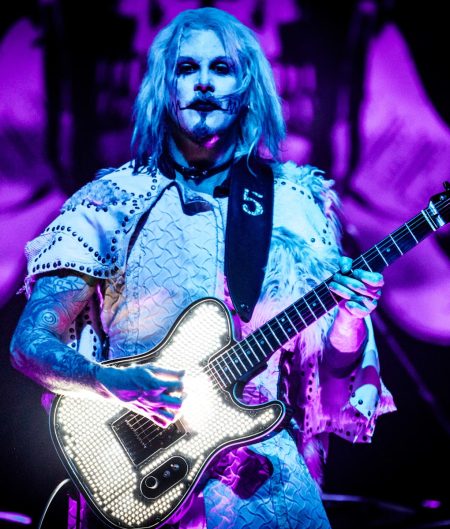
Watching John 5 perform live is one of those experiences that tends to convert people who were not previously paying close attention to who was playing guitar in whatever band was in front of them.
His stage presence is built on an unusual combination: the technical demonstrations that command the attention of other guitarists in the audience, and a showman’s awareness of the broader crowd that keeps the energy of the room engaged regardless of whether those people can identify what they are watching at a technical level.
John 5 performs with a theatricality that draws on his years in the shock rock world without being defined by it, bringing a visual commitment to the performance that matches the musical commitment underneath it.
He is known for guitar solos that serve as mini-performances within the larger show, structured around sudden shifts in style and technique that generate audible reactions from audiences who were not expecting what just happened.
The experience of watching John 5 play is different from watching most guitarists in rock because the range of what he might do in any given moment is genuinely unpredictable, and unpredictability at a high level of execution is one of the rarest qualities a live performer can possess.
You can follow his activity across platforms on Instagram, Facebook, and X for a running account of what John 5 is doing between and around the Mötley Crüe schedule.
The 2026 Mötley Crüe Tour and What John 5 Brings to It
The Carnival of Sins 2026 tour is the clearest statement yet that Mötley Crüe with John 5 is a going concern rather than a transitional arrangement, and the productions being assembled for those shows reflect an investment in the current lineup that speaks to confidence in what it can deliver.
The decisions around setlist changes for the 2026 shows have been made with a band that includes John 5 as a genuine creative voice, not simply an executor of parts someone else wrote.
The band’s appearance on American Idol generated significant attention, with the American Idol performance reaction making clear that the band’s ability to generate a strong response from a mainstream audience has not diminished under the new lineup.
John 5 brings to those shows something specific and irreplaceable: a guitarist who is technically capable of more than most rock stages ever ask of their lead players, and who applies that capability in service of making the band sound as good as it possibly can rather than calling attention to himself at the band’s expense.
That approach, guitarist as essential creative partner rather than hired hand, is the reason the transition from Mick Mars to John 5 has worked as well as it has, and it is the reason the 2026 shows are generating the kind of advance excitement they are.
DID YOU KNOW?
John 5 received a text from Mick Mars after being announced as his replacement with Mötley Crüe, a gesture that John 5 has described as one of the most meaningful communications he received during that transition. He has spoken in interviews about the respect he has always had for Mick Mars’s work with the band and about the responsibility he felt to honor that legacy while bringing his own voice to the guitar position. The relationship between the two players, defined by mutual professional respect despite the circumstances, reflects something important about how the best musicians tend to relate to one another regardless of the business situations that surround them. You can hear John 5’s solo work that demonstrates his full range outside the Mötley Crüe context on Amazon, where his extensive catalog of instrumental recordings is available.
John 5 in His Own Words: The Life Story Interview
John 5 is one of the more thoughtful and articulate interview subjects in rock music, capable of discussing his career, his influences, and the experiences that shaped him with a depth that the guitarist-as-wild-man stereotype leaves no room for.
He speaks candidly about the childhood practice obsession, the Nashville period, the years with Marilyn Manson and Rob Zombie, and what it meant to step into Mötley Crüe with the awareness of exactly how much history he was being asked to carry.
The interview below captures John 5 telling his full life story in his own words, providing context for a career that is considerably more layered than the highlight reel would suggest.
His account of how he approaches the guitar, both technically and philosophically, is worth the time of anyone who plays an instrument or who has wondered what separates a great player from one who is simply technically proficient.
John 5 on the subject of guitar is someone who has thought deeply about what the instrument is for and what it costs to be genuinely good at it, and that perspective comes through clearly in the way he discusses his career at every stage.
The John 5 Legacy in Rock Guitar
John 5 occupies a position in contemporary rock that is unusual in several ways: he is simultaneously a supporting musician in one of the genre’s most iconic bands and a solo artist with a body of work that stands entirely on its own terms.
His guitar playing has influenced a generation of players who found in his work a model for how range and technical ambition can coexist with the discipline to serve whatever musical context you are operating in.
John 5 proved with his Mötley Crüe appointment that the right guitarist, with the right preparation and the right instincts, could join a band forty years into its history and make people feel that the music had not lost anything essential in the transition.
That is a specific and difficult thing to accomplish, and the consistency with which John 5 has accomplished it, night after night across the band’s most recent touring period, is the clearest evidence that his reputation as one of rock’s most complete guitarists is entirely earned.
For the full picture on who he is, the John 5 Wikipedia entry provides a thorough starting point, and his own channels are the most reliable source for what he is working on at any given moment.
John 5 is one of the most complete guitarists rock music has produced in the last thirty years, and the best argument for that claim is simply to go put on one of his records and listen.