

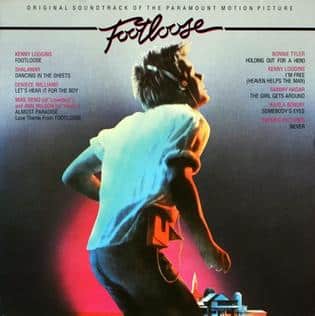
Footloose by Kenny Loggins reached number one on the US Billboard Hot 100 in April 1984 and held the position for three weeks, making it one of the biggest hits of the year and the title track of one of the decade’s most beloved films.
Its energy and directness made it an immediate radio staple, while the film it accompanied turned the song into a cultural landmark that resonated far beyond the pop charts.
Affiliate Disclosure: As an Amazon Associate I earn from qualifying purchases. This helps support the site at no extra cost to you.
| Song | Footloose |
| Artist | Kenny Loggins |
| Album | Footloose soundtrack (1984) |
| Written by | Kenny Loggins, Dean Pitchford |
| Produced by | Lee DeCarlo, Kenny Loggins |
| Released | 1984 |
| Genre | Pop Rock, Hard Rock |
| Record Label | Columbia Records |
| Chart Peak | #1 US Billboard Hot 100 |
Table of Contents
Background and Meaning
The song was written by Kenny Loggins and lyricist Dean Pitchford, who also wrote the screenplay for the 1984 film directed by Herbert Ross.
The film, starring Kevin Bacon and John Lithgow, tells the story of a teenager who moves to a small town where dancing has been banned and who fights to overturn the restriction.
The lyrics capture the spirit of rebellion against authority that runs through the film, expressing a desire for freedom and self-expression that connected immediately with a teenage audience in 1984.
Loggins had already established himself on movie soundtracks with “I’m Alright” for Caddyshack in 1980, but Footloose elevated his profile to a level that none of his previous work had reached.
Pitchford and Loggins wrote it specifically for the film’s opening sequence, designing the track to capture the kinetic energy and emotional urgency the story required from its very first moments.
Musical Composition of Footloose
The track opens with a guitar-driven introduction that delivers its energy before the vocals even begin, setting a pace that never lets up from start to finish.
Loggins’s vocal performance is physically committed and rhythmically precise, matching the driving momentum of the track without straining for effect.
The production by Lee DeCarlo and Loggins keeps the arrangement tightly wound and forward-moving, with every instrumental element serving the song’s primary goal of conveying unstoppable momentum.
The guitar riff that anchors Footloose is among the most recognizable in 1980s pop rock, a compressed and punchy figure that lodges itself in the listener’s memory on first hearing.
The chorus releases the tension built in the verse with an emotional and rhythmic surge, the kind of structural payoff that made the track equally effective on radio, film screens, and in rooms where people were actually dancing.
Chart Success and Impact
The single debuted strongly and climbed to number one on the Billboard Hot 100 within its first weeks of release, spending three weeks at the top position in April 1984.
The Footloose soundtrack album reached number one on the US Billboard 200, a remarkable achievement that reflected how completely the film and its music had captured the popular imagination.
Loggins received a Golden Globe Award for Best Original Song in 1985, recognition that placed it alongside the decade’s most acclaimed film music contributions.
The song’s success with the teenage audience confirmed that movie soundtracks could be as commercially significant as studio albums, a lesson that transformed how Hollywood approached music in subsequent productions.
The soundtrack certified multiplatinum in the United States, with Loggins’s contribution at the commercial center of its widespread appeal.
Lasting Legacy of Footloose
The track remains one of the most recognizable pop rock singles of the 1980s and the song most durably associated with Kenny Loggins’s name across all demographics.
Classic rock and pop radio formats have kept Footloose in regular rotation for more than four decades, and it surfaces consistently on retrospective lists of the essential songs of 1984.
A 2011 remake of the original film used a cover version for its opening sequence, acknowledging that no retelling of the story works without this song at its center.
Loggins went on to contribute to several more major film soundtracks, including “Danger Zone” for Top Gun in 1986, earning a reputation as the defining soundtrack voice of the decade, but this record established that identity first.
Four decades after its release, Footloose by Kenny Loggins stands as one of the rare pop rock singles where the energy of the recording has not dimmed a single degree with the passing of time.
Watch the Official Video
Frequently Asked Questions
FAQ
- Who wrote Footloose?
-
Kenny Loggins and Dean Pitchford wrote it together. Pitchford also wrote the film’s screenplay and designed the song specifically for the opening sequence.
- How long did it stay at number one?
-
It spent three weeks at number one on the US Billboard Hot 100 in April 1984, one of the longest runs at the top for any single that year.
- Did the song win any awards?
-
Yes. It won the Golden Globe Award for Best Original Song in 1985 and received a Grammy nomination for Best Rock Vocal Performance.
- What film is the song from?
-
It is the title track from the 1984 film directed by Herbert Ross and starring Kevin Bacon, in which a teenager fights to restore dancing to a town where it has been banned by the local reverend.
- Why is it still so well known?
-
Three weeks at number one, a film that continues to be watched, an immediately energetic guitar riff, and over forty years of continuous radio play have kept it in front of new audiences since 1984.
You Might Also Like
Driven by an opening guitar riff that signals exactly what is coming and a vocal that delivers on every promise it makes, Footloose by Kenny Loggins is one of the great pop rock singles of the 1980s and the defining soundtrack moment of 1984.