

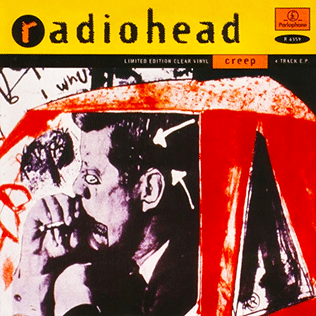
Creep by Radiohead flopped on its original 1992 UK release before breaking internationally in 1993, eventually reaching the top ten in the UK on re-release and becoming the defining song of the band’s early career despite vocalist Thom Yorke‘s long-standing reluctance to perform it live.
Written by Yorke and the band and produced by Sean Slade and Paul Q. Kolderie, Creep drew a copyright claim from the writers of “The Air That I Breathe,” a song Radiohead had absorbed through the radio without consciously drawing on it.
Affiliate Disclosure: As an Amazon Associate I earn from qualifying purchases. This helps support the site at no extra cost to you.
| Song | Creep |
| Artist | Radiohead |
| Album | Pablo Honey (1993) |
| Written by | Thom Yorke, Jonny Greenwood, Colin Greenwood, Ed O’Brien, Phil Selway; Albert Hammond & Mike Hazlewood (credited) |
| Produced by | Sean Slade, Paul Q. Kolderie |
| Released | 1992 (original); 1993 (re-release) |
| Genre | Alternative Rock, Grunge |
| Chart Peak | #7 UK Singles Chart (re-release), #34 US Billboard Hot 100 |
Table of Contents
Background and History
Radiohead formed in Abingdon, Oxfordshire in 1985 under the name On a Friday, building a following in the Oxford area through the late 1980s before signing to Parlophone Records in 1991.
The band’s lineup of Thom Yorke on vocals and guitar, brothers Jonny and Colin Greenwood on guitar and bass, Ed O’Brien on guitar, and Phil Selway on drums had been playing together since their school years.
They recorded Creep in 1992 with American producers Sean Slade and Paul Q. Kolderie, releasing it as their debut single in September of that year.
The BBC initially banned the song for being “too depressing,” and the single reached only number seventy-eight on the UK chart, a commercial failure that suggested the band might struggle to build a mainstream audience.
The song’s trajectory changed when it received significant airplay in Israel and then across continental Europe, prompting a UK re-release in 1993 that reached number seven.
Creep and the Copyright Dispute
Creep‘s chord progression and melodic contour were identified as similar to “The Air That I Breathe,” a song written by Albert Hammond and Mike Hazlewood and recorded by The Hollies in 1974.
Hammond and Hazlewood pursued a copyright claim, and the settlement resulted in both writers being added to the official songwriting credits on all subsequent releases of Creep.
The similarity between the two songs is most audible in the verse structure and the movement of the chord progression, though Radiohead’s arrangement and Yorke’s lyric give the track a distinctly different emotional character.
The case predated the more aggressive sample and similarity litigation that would come to define music copyright disputes in the 2010s, and it stands as an early example of how chord progression similarities could result in formal credit transfers even when conscious copying was not alleged.
Yorke has acknowledged the similarity without suggesting the connection was deliberate, and Hammond and Hazlewood have subsequently praised the song’s quality despite having needed to assert their claim legally.
Creep and the Recording Story
Creep opens with a clean guitar figure before Jonny Greenwood’s deliberate guitar scrape signals the shift from the restrained verse to the distorted chorus.
Greenwood has said he added the scraping sound specifically because he felt the song was too quiet and he wanted to disrupt it, not expecting it to become one of the most recognized guitar sounds in 1990s rock.
Yorke’s lyric addresses the experience of feeling fundamentally inadequate in the presence of someone you admire, using self-deprecation so direct that it became a vehicle for listeners to articulate their own similar feelings.
The production by Slade and Kolderie keeps the arrangement transparent, letting the quiet-loud dynamic carry the emotional weight without the kind of studio layering that would have softened the contrast between Yorke’s vulnerable verse and the distorted chorus.
The song connects to the same alternative rock moment that drove Nirvana and The Cranberries to international audiences in the same period, while Yorke’s specific lyrical register and the band’s melodic instincts set them apart from the grunge core.
Creep and the Charts
Creep reached number seven on the UK Singles Chart on its 1993 re-release, reversing the complete commercial failure of the original 1992 issue.
It peaked at number thirty-four on the US Billboard Hot 100 and performed strongly on the Modern Rock Tracks chart, finding its audience through college radio and MTV alternative programming rather than mainstream pop radio.
Pablo Honey, the debut album that contained the track, was certified double platinum in the United States and performed well across Europe and Australia on the back of the single’s belated commercial success.
The unusual chart trajectory of the song, from domestic flop to international hit over a twelve-month period, became one of the more discussed examples of a record breaking commercially in export markets before succeeding at home.
Lasting Legacy of Creep
This song remains Radiohead’s most widely recognized song despite the band’s subsequent transformation into one of the most critically acclaimed and artistically ambitious acts in rock history.
Yorke’s public ambivalence about the song, including periods where the band refused to perform it live, paradoxically increased its cultural weight by attaching a biographical complexity to an already emotionally charged recording.
The lyric’s expression of self-loathing and inadequacy connected with listeners far outside the alternative rock audience, crossing demographic lines in a way that Radiohead’s more experimental later work did not.
The song is consistently cited as one of the definitive expressions of outsider feeling in rock music, and its influence on subsequent writing about inadequacy and social anxiety is traceable across multiple genres and decades.
More than thirty years after its release, Creep is still the entry point through which most listeners first encounter Radiohead, a position that its creators have accepted with varying degrees of reluctance across the band’s long career.
Watch the Official Video
Frequently Asked Questions
FAQ
- Why did Creep flop initially?
- The single was released in September 1992 and reached only number seventy-eight on the UK chart. The BBC declined to play it, citing its tone as too depressing. The song then found audiences in Israel and continental Europe before a UK re-release in 1993 reached number seven.
- Why are Albert Hammond and Mike Hazlewood credited on Creep?
- Hammond and Hazlewood identified similarities between Creep and “The Air That I Breathe,” which they had written and which The Hollies recorded in 1974. The legal settlement that followed the copyright claim required their addition to the official songwriting credits on all subsequent releases of the song.
- What is the guitar scrape in Creep?
- Jonny Greenwood added the scraping guitar sound between the verse and chorus because he felt the song was too quiet and he wanted to disrupt its flow. He did not expect it to become one of the most recognized moments in the recording, and it now functions as the signal that the distorted chorus is about to arrive.
- Why does Thom Yorke dislike the song?
- Yorke has given varying reasons across different interviews, generally suggesting that the song’s directness and emotional transparency feel limiting after the more complex artistic directions Radiohead pursued from OK Computer onward. There have been periods where the band refused to play it live, though they have returned to performing it at various points.
- What album is Creep from?
- The song appears on Pablo Honey, Radiohead’s debut album, recorded with Sean Slade and Paul Q. Kolderie and released in February 1993. The album was certified double platinum in the United States, driven primarily by the belated commercial success of the single.
You Might Also Like
Banned by the BBC, ignored on its first release, and eventually embraced by an international audience before its own country caught up, Creep stands as the song that launched Radiohead and the one they could never fully escape, a recording whose directness grew more complicated the further the band traveled from it.