

We Built This City by Starship reached number one on the US Billboard Hot 100 in November 1985, becoming one of the best-selling singles of the year and the most commercially successful moment in the band’s evolution from its psychedelic rock origins.
The song attracted massive popular support and strong critical resistance in equal measure, a combination that has kept it in public conversation for four decades.
Affiliate Disclosure: As an Amazon Associate I earn from qualifying purchases. This helps support the site at no extra cost to you.
| Song | We Built This City |
| Artist | Starship |
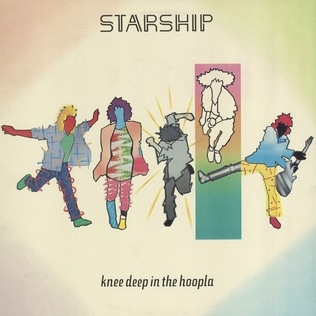
| Album | Knee Deep in the Hoopla (1985) |
| Written by | Bernie Taupin, Martin Page, Dennis Lambert, Peter Wolf |
| Produced by | Peter Wolf, Jeremy Smith |
| Released | 1985 |
| Genre | Synth-Pop, Arena Rock |
| Record Label | Grunt/RCA Records |
| Chart Peak | #1 US Billboard Hot 100 |
Table of Contents
Background and Meaning
Starship evolved through the lineage of Jefferson Airplane and Jefferson Starship, moving further from its psychedelic 1960s origins with each reinvention until the mid-1980s lineup centered on vocalist Mickey Thomas while retaining founding member Grace Slick.
The song was written by an outside team including Bernie Taupin, best known as Elton John‘s longtime lyricist, alongside Martin Page, Dennis Lambert, and Peter Wolf.
The lyrics frame rock and roll as the foundational force of the American city, with the chorus asserting that rock built and owns the urban landscape it came from, an idea that appealed emotionally to its audience even as critics found it ironic coming from a polished synth-pop production.
We Built This City arrived at a moment when arena rock and synth-pop were blending into a commercially reliable major-label format, and producer Peter Wolf shaped the track to hit every pressure point that format required.
There is an inherent tension in the song’s premise, which critics noted loudly, but the commercial audience responded to it on emotional rather than ideological terms.
Musical Composition of We Built This City
The track opens with a synthesizer-driven introduction that establishes its arena-scale ambitions before Mickey Thomas’s vocal enters to deliver the first verse with the kind of confidence the setting demands.
The production centers on layered keyboard textures and a driving rhythm track, leaning far more toward synth-pop than toward the guitar-based rock that defined Starship’s earlier identity.
Grace Slick’s contribution gives this song an audible connection to the band’s past, her voice adding a toughness that the lead vocal alone could not have provided.
The chorus is built for maximum impact in large venues, with the title phrase repeated to create one of the most inescapable vocal hooks of the autumn 1985 radio season.
The reliance on synthetic textures over live instrumentation was a deliberate commercial choice that made the recording sound entirely of its moment and entirely unlike the Jefferson Airplane catalog it descended from.
Chart Success and Impact
The single reached number one on the Billboard Hot 100 and spent two weeks at the top position, making it Starship’s first number one as a band distinct from the Jefferson Starship lineup.
The album Knee Deep in the Hoopla reached number seven on the US Billboard 200, confirming that Starship’s commercial reinvention had connected with the audience its label was targeting.
Heavy MTV rotation brought We Built This City to a generation of viewers who had little awareness of Jefferson Airplane or any of the band’s 1960s and 1970s history.
The single also performed well in the United Kingdom and Australia, extending Starship’s commercial reach into markets that the classic-era lineup had also found receptive.
Its success positioned the band for a follow-up run of singles through 1986 and 1987, including “Sara,” which also reached number one on the Hot 100.
Lasting Legacy of We Built This City
The song has occupied a complicated position in rock history since its release, simultaneously acknowledged as a massive commercial success and cited as a symbol of 1980s corporate rock excess.
Rolling Stone magazine named it the worst song of the 1980s in a 2004 reader poll, a verdict that says as much about critical attitudes toward the decade as it does about the record itself.
That level of notoriety has ensured its continued cultural presence, since even negative recognition keeps a song in public conversation long after more anonymous singles have faded completely.
Classic rock and oldies formats still play it regularly, and it appears on every significant retrospective of the mid-1980s pop rock landscape without exception.
Whatever one’s position on its artistic merits, the song captured the sound and ambition of a specific cultural moment with a precision that time has only made easier to see.
Watch the Official Video
Frequently Asked Questions
FAQ
- Who wrote We Built This City?
- Bernie Taupin, Martin Page, Dennis Lambert, and Peter Wolf wrote it together. Taupin, best known for his work with Elton John, contributed the lyrics that became the song’s defining hook.
- Did it really reach number one?
- Yes. It reached number one on the US Billboard Hot 100 in November 1985 and held the position for two weeks, becoming one of the best-selling singles of the year.
- Why is the song considered controversial?
- Critics argued that its polished synth-pop production contradicted its claim to represent rock’s authentic spirit. Rolling Stone readers later voted it the worst song of the 1980s in a 2004 poll.
- What band became Starship?
- Starship evolved from Jefferson Airplane through Jefferson Starship, adopting the Starship name in 1984 after a legal dispute. The mid-1980s lineup featured Mickey Thomas on lead vocals alongside original member Grace Slick.
- What album is this from?
- It is from Knee Deep in the Hoopla, released by Starship in 1985 on Grunt/RCA Records.
You Might Also Like


Massive in ambition, impossible to ignore, and endlessly debated, We Built This City by Starship captured the commercial spirit of 1985 with a precision that even its harshest critics have never been able to dismiss entirely.