
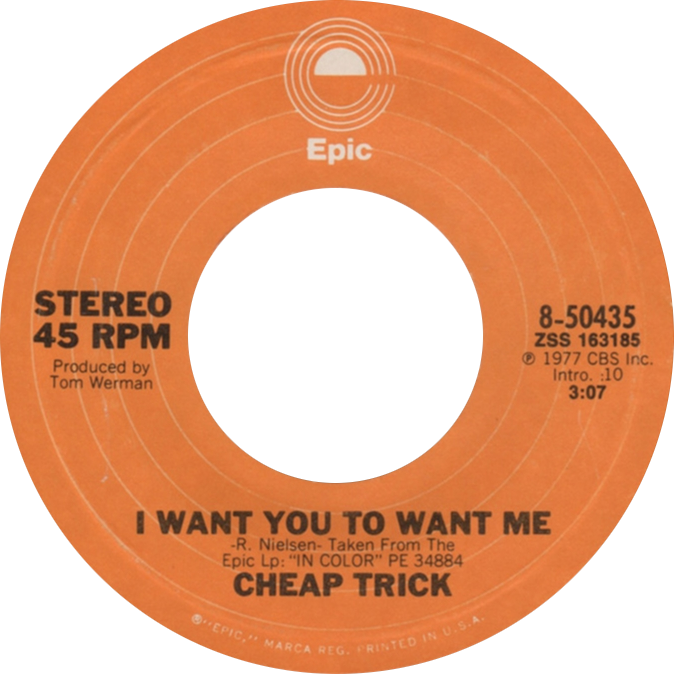
I Want You to Want Me by Cheap Trick is one of the most irresistible power pop hooks of the late 1970s.
Affiliate Disclosure: I am an Amazon affiliate and if you purchase through any amazon links on this site i may earn a small commission at no extra charge to you.
Written by Rick Nielsen, the song first appeared on the studio album In Color in 1977 but became a global hit through the live recording from Cheap Trick at Budokan in 1979.
The live version reached number 7 on the US Billboard Hot 100 and transformed the band from cult favorites into genuine superstars.
Furthermore, few rock songs of the era capture the direct emotional urgency of wanting to be wanted with such complete conviction.
The melodic simplicity of the song conceals a craft that rewards repeated listening.
| Song Title | I Want You to Want Me |
|---|---|
| Artist | Cheap Trick |
| Album | In Color (1977) / At Budokan (1979) |
| Released | 1977 (studio); 1979 (live single) |
| Genre | Power Pop, Hard Rock |
| Label | Epic Records |
| Writer | Rick Nielsen |
| Producer | Tom Werman (studio) |
| Peak Chart | #7 US Billboard Hot 100 (live version, 1979) |
- What Is the Song About?
- The Vibe: Genre, Mood, and Feel
- Behind the Lyrics
- How It Was Made: The Sound and Production
- Legacy and Charts: Impact and Endurance
- A Listener’s Note
- Watch the Official Video
- Collector’s Corner
- Frequently Asked Questions
What Is the Song About?
The song expresses the straightforward longing to have romantic feelings returned.
The lyric is not complex.
It states a desire and then restates it with variations across the verses and chorus.
However, the emotional simplicity is exactly the source of the song’s power.
Nielsen understood that the most universal feelings are often the ones that resist elaborate description.
Wanting someone to want you back is an experience that requires no explanation for anyone who has felt it.
Notably, the lyric avoids self-pity entirely.
The tone is hopeful and direct rather than despairing.
Furthermore, the delivery by Robin Zander gives the words an openness that makes the vulnerability feel like confidence rather than weakness.
The result is a song that invites total identification from the listener without demanding it.
The Vibe: Genre, Mood, and Feel
I Want You to Want Me sits at the intersection of power pop and hard rock, with a melodic directness that owes as much to the Beatles as to the arena rock of the 1970s.
The guitar tone is bright and forward-placed in the mix.
Moreover, the rhythm section drives the song with urgency without ever becoming aggressive.
The tempo is energetic but controlled, creating the sense that everything is building toward the chorus.
In particular, the chorus itself delivers the promised emotional release with complete commitment.
The mood is celebratory even within the context of unrequited feeling.
Similarly, Robin Zander’s vocal brings a warmth to the lyric that prevents it from ever tipping into desperation.
The arrangement is spare enough that every instrument is clearly audible, which gives the recording a live energy even in its studio form.
The overall effect is of a band performing at full commitment without any artifice.
Behind the Lyrics
Nielsen wrote the song during a period when Cheap Trick was building a devoted following on the live circuit without yet breaking through commercially.
The directness of the lyric reflects a band comfortable enough with their own identity to write without pretension.
However, the simplicity was a deliberate choice, not a limitation.
Nielsen had the compositional skill to write in more complex forms and chose clarity because it served the emotional purpose better.
Furthermore, the song’s title is grammatically striking because it positions the singer as the subject who desires rather than the object who is desired.
The reversal of the typical romantic lyric formula, where the singer is pursued rather than pursuing, gives the song an unusual vulnerability for hard rock.
In addition, Nielsen’s guitar work on the recording demonstrates a command of texture and tone that elevates a simple lyric into something memorable.
The hooks he built into the arrangement reinforce the emotional content of the words at every point.
Consequently, the song works as both a lyric and a piece of musical architecture simultaneously.
How It Was Made: The Sound and Production
Producer Tom Werman recorded the studio version for In Color at Kendun Recorders in Burbank, California in 1977.
The studio recording was polished and well-constructed but did not find a large audience on initial release.
In addition, the song was included in Cheap Trick’s April 1978 concerts at Nippon Budokan in Tokyo, which were recorded for a live album.
The Japanese audience’s extraordinary response to the band gave the live recording an energy that the studio version could not match.
Additionally, the Budokan performance captures the song in an environment where the audience reaction becomes part of the musical texture.
The screaming crowd functions almost as an additional instrument, amplifying the emotional stakes of every line.
Meanwhile, Zander’s live vocal is more urgent and physically committed than the studio version, which suits the song’s direct emotional content perfectly.
Epic Records released the live version as a single in 1979 and it became the band’s breakthrough hit.
The Budokan recording demonstrated that the song’s power was always waiting to be fully realized in a live context.
Legacy and Charts: Impact and Endurance
The live version of the song reached number 7 on the US Billboard Hot 100 in 1979 and peaked at number 29 on the UK Singles Chart.
The Cheap Trick at Budokan album went platinum in the United States and introduced the band to a mass international audience.
However, commercial success does not fully explain what the song achieved in the broader cultural context.
The recording became a defining example of how a live performance could reveal dimensions of a song that a studio version could not.
Furthermore, it demonstrated that power pop could function at the same commercial level as the heavier arena rock that dominated American radio in the late 1970s.
In particular, the Budokan album helped build the mythology of Japan as a uniquely receptive market for Western rock acts.
The song has remained a classic rock radio staple for four decades and continues to appear in film and television soundtracks as a reliable shorthand for late-1970s energy.
As a result, the recording is now understood as one of the essential power pop documents of the era.
A Listener’s Note
The moment the audience begins screaming in the Budokan recording is one of the great sounds in live rock music history.
It arrives before Zander has finished the first phrase and tells you everything about the relationship between this band and this crowd.
Moreover, the studio version rewards careful listening because Nielsen’s guitar work is more intricate than the apparent simplicity of the song suggests.
Both versions offer something the other cannot, which is unusual for any rock recording.
Watch the Official Video
Watch Cheap Trick performing the song in this official video:
Collector’s Corner
Original Epic Records pressings of the Cheap Trick at Budokan album from 1979 are among the most sought-after live rock albums in collector circles.
In particular, Japanese pressings of the album carry both historical significance and excellent sound quality from the original analog master.
Similarly, original vinyl pressings of In Color allow collectors to hear the studio version of the song in the context the band originally intended.
You Might Also Like
Foreigner’s debut single combined Mick Jones’s melodic instincts with Lou Gramm’s vocal authority to produce one of the most perfectly constructed arena rock tracks of 1977.
Rush combined Neil Peart’s philosophical lyric with a gentle acoustic opening that builds into a powerful statement about individual responsibility and the potential for social change.
The Kinks delivered one of rock’s most enduring character studies with a lyric that combined humor and genuine warmth in a way that defied every expectation of the genre.
Frequently Asked Questions
What is I Want You to Want Me about?
The song expresses the direct and universal longing to have romantic feelings returned by someone who does not yet feel the same way. Rick Nielsen wrote the lyric with deliberate simplicity, understanding that this particular emotional experience is most honestly expressed in plain language. The directness of the words is precisely what makes the song connect so effectively with listeners who recognize the feeling immediately. Robin Zander’s vocal delivery gives the desire an openness and warmth that transforms vulnerability into something that feels closer to hope.
Why did the Budokan version become the hit instead of the studio recording?
The studio version appeared on In Color in 1977 but did not find a large audience. When Cheap Trick performed at Nippon Budokan in Tokyo in April 1978, the audience’s extraordinary enthusiasm gave the live recording an energy that the studio version could not replicate. Epic Records released the Budokan live version as a single in 1979, and the combination of the song’s melody with the crowd’s visible excitement made it a breakthrough hit. The recording demonstrated that some songs require a live performance to fully realize their potential.
Who wrote the song?
Rick Nielsen wrote the song entirely on his own. Nielsen is the lead guitarist and primary songwriter of Cheap Trick. His approach to songwriting drew heavily on the melodic traditions of British pop, particularly the Beatles, while remaining firmly within the harder rock context that defined the band’s sound. The lyric reflects his understanding that the simplest emotional statements are often the most universally felt and therefore the most effective in a rock song context.
How did the song chart?
The live version from Cheap Trick at Budokan reached number 7 on the US Billboard Hot 100 in 1979 and peaked at number 29 on the UK Singles Chart. The Budokan album itself went platinum in the United States and became one of the best-selling live albums of the decade. The commercial success of the live recording transformed Cheap Trick from a cult band with a devoted following into a mainstream act with genuine mass-market reach.
What albums feature the song?
The studio version appears on In Color, released in September 1977 on Epic Records, produced by Tom Werman. The live version that became the major hit appears on Cheap Trick at Budokan, released in February 1979. The Budokan album captured performances from concerts at Nippon Budokan in Tokyo in April 1978 and remains one of the most celebrated live rock albums in the history of the format.
Why did Japanese audiences respond so strongly to Cheap Trick?
Cheap Trick had developed a substantial following in Japan through their earlier albums, which received more attention there than in the United States at the time. The band’s combination of Beatles-influenced melody, hard rock energy, and the theatrical visual presence of Rick Nielsen and Bun E. Carlos connected strongly with Japanese rock audiences. When the band played Budokan in 1978, they were treated with a level of enthusiasm that surprised even the band members themselves and that gave the live recording its unique electric atmosphere.
How has the song influenced later music?
The recording became a touchstone for the power pop genre and influenced countless bands who sought to combine melodic accessibility with rock energy. Artists from the 1980s through the present day have cited Cheap Trick’s approach to songwriting as a key reference. The Budokan album in particular established a template for the live rock album as a format capable of capturing something a studio recording cannot reproduce. The song’s continued presence on classic rock radio and in film and television soundtracks has kept it in active cultural circulation for over four decades.
I Want You to Want Me connects through generations because the feeling it describes is universal and the melody is genuinely impossible to forget.