

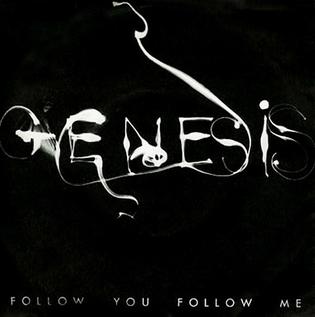
Follow You Follow Me by Genesis arrived in February 1978 as a signal that one of the most admired progressive rock bands in the world had decided to go somewhere different, trading side-long suites and theatrical complexity for a love song so direct and warm it sounded like it had been waiting years to be written.
Affiliate Disclosure: I am an Amazon affiliate and if you purchase through any amazon links on this site i may earn a small commission at no extra charge to you.
Released from the album …And Then There Were Three…, Follow You Follow Me reached number 7 in the UK, Genesis’s first top 10 single. It reached number 23 on the US Billboard Hot 100, becoming their first significant American chart success and opening a door to a mainstream audience that the band would walk through decisively over the following decade.
Written by Tony Banks, Phil Collins, and Mike Rutherford, and produced by David Hentschel and Genesis, the song demonstrated that the same musicians who had made The Lamb Lies Down on Broadway could also make something that sounded completely unpretentious, and the combination of those two capabilities is what made Genesis unique in the landscape of late-1970s rock.
| Song Title | Follow You Follow Me |
|---|---|
| Artist | Genesis |
| Album | …And Then There Were Three… (1978) |
| Released | February 24, 1978 |
| Genre | Pop Rock, Soft Rock, Progressive Rock |
| Label | Charisma Records (UK), Atlantic Records (US) |
| Writers | Tony Banks, Phil Collins, Mike Rutherford |
| Producer | David Hentschel and Genesis |
| Peak Chart | #7 UK, #23 US Billboard Hot 100 |
- What Is the Song About?
- The Vibe: Genre, Mood, and Feel
- Behind the Lyrics
- How It Was Made: The Sound and Production
- Legacy and Charts: Impact and Endurance
- A Listener’s Note
- Watch the Official Video
- Collector’s Corner
- Frequently Asked Questions
What Follow You Follow Me About?
Follow You Follow Me is a love song in the most direct sense of the phrase: a declaration of commitment so complete and unqualified that it requires no metaphor or elaboration, just the simple statement that wherever you go, I will be there.
The lyric offers a kind of unconditional presence that most love songs gesture toward but few achieve as cleanly: the repeated promise to follow wherever the beloved leads is not possessive or dependent but generous, an offer freely given without demand for reciprocation.
What makes the writing effective is its simplicity, which in 1978 required more courage from Genesis than another suite about mythology or science fiction would have: it was easier to be elaborate and obscure than to say something plainly and trust that it was worth saying.
Follow You Follow Me carries the quality of relief, as if the person singing has finally stopped overthinking and simply allowed himself to feel what he feels, which is the emotional register that the most direct love songs occupy and the one that connects most broadly with listeners.
There is nothing in the lyric that requires decoding or interpretation: every line says what it means, and what it means is that love, when it arrives properly, makes the simplest statements the most powerful ones.
The “stay with me” refrain that threads through the recording is the center of the emotional content: not a demand but a wish, not possessiveness but attachment, the voice of someone who has found something they do not want to lose and is saying so as plainly as possible.
For listeners who had followed Genesis through the complex conceptual albums of the Peter Gabriel era and the early Phil Collins years, the emotional directness of the song was itself a kind of communication: the band had found something they wanted to say and had said it without hiding behind complexity.
The universal accessibility of the sentiment is what accounts for the song’s durability: love felt and expressed this simply does not date, and every generation of listeners arrives at the recording with the same capacity to recognize the feeling it describes.
The Vibe: Genre, Mood, and Feel
Follow You Follow Me sits at the exact point where Genesis crossed from progressive rock into pop, and the crossing is so smooth that it is difficult to say exactly when you have arrived on the other side: the song feels like pop from its first note but sounds like Genesis throughout.
The mood is warm and unguarded, a quality that Genesis had rarely permitted themselves before 1978: the usual protective layer of irony or intellectual distance is entirely absent, and what remains is just the feeling, directly expressed.
Phil Collins’s vocal performance is the emotional center of the recording, delivered with the understated sincerity that would define his work throughout the following decade: the voice is not performing but telling, and the distinction is audible.
The guitar work by Mike Rutherford provides the rhythmic and melodic foundation, a clean-toned figure that creates a sense of gentle forward motion without ever becoming urgent or driving, exactly the right tone for a song about quiet, persistent devotion.
The keyboard arrangement by Tony Banks adds harmonic warmth without imposing the kind of elaborate harmonic complexity that characterized the band’s earlier work: the chords support the melody and the vocal rather than competing with them for the listener’s attention.
The tempo is deliberately unhurried, matching the emotional quality of the lyric: this is not a song about passion or urgency but about the steady, enduring variety of love, and the music expresses that steadiness in every production choice.
Listeners who came to the song through radio rather than through Genesis’s catalog often expressed surprise on discovering the band’s earlier work: the recording gives no indication of the band’s progressive origins and stands entirely on its own as a piece of accessible, warm pop songwriting.
Behind the Lyrics
Follow You Follow Me was written during the period when Genesis had contracted from a five-piece to a three-piece following the departures of Peter Gabriel and Steve Hackett, a transition that required the remaining members to find new ways of working and new kinds of material to write.
The song emerged from a collaborative session between Banks, Collins, and Rutherford in which the shared understanding was that the new Genesis needed to be more direct and commercially accessible than the band had been, without abandoning the musicianship and craft that had always defined their work.
Collins’s contribution to the writing brought an emotional openness that reflected his own developing voice as a frontman: the lyric carries his sensibility, his willingness to express vulnerability directly rather than through narrative distance or theatrical persona.
The simplicity of the writing was deliberate and, in the context of what Genesis had previously made, radical: the band was capable of extraordinary complexity, which meant that choosing simplicity required a particular kind of confidence in the value of what was being said.
Banks and Rutherford’s musical contributions shaped the harmonic and melodic context in which Collins’s lyric sits, ensuring that the simplicity of the words was supported by chord movements and melodic lines that gave the sentiment its proper emotional weight without overwhelming it.
The writing of Follow You Follow Me represented a conscious decision to prioritize communication over demonstration: the band had demonstrated its technical capabilities extensively and was now choosing to demonstrate something different, namely the capacity to say something simple and have it mean something.
The result was a song that neither the band nor its progressive rock contemporaries could have predicted would come from Genesis in 1978, and its success suggested that the reinvention had been not just brave but correct.
How It Was Made: The Sound and Production
Follow You Follow Me was produced by David Hentschel and Genesis, a collaboration that had produced the band’s most commercially accessible work and that understood how to balance the technical precision of the band’s musicianship with the warmth that the new direction required.
The recording sessions for …And Then There Were Three… took place at Relight Studios in the Netherlands and at Trident Studios in London, and the production approach for the song was guided by the lyric’s emotional directness: everything in the recording was designed to support the clarity of what was being said rather than to add complexity for its own sake.
Collins’s vocal was recorded to sound intimate and close, placing the listener in the same room as the singer rather than creating the kind of large-scale theatrical production that had characterized earlier Genesis recordings, and the difference in proximity changes the emotional register entirely.
Rutherford’s guitar figure was tracked cleanly and simply, without the elaborate processing or extended technique that might have distanced it from the listener, while Banks’s keyboard work was similarly restrained, providing harmonic support rather than dominant melodic content.
Hentschel’s production instinct was to treat the song’s simplicity as a strength rather than a limitation: every production decision reinforced the directness of the lyric rather than compensating for it, which is the correct approach and one that required the producer to trust the material completely.
The mix places Collins’s vocal prominently in the center of the stereo field and surrounds it with the other elements at a volume and texture that supports without competing, creating a sense of the singer occupying a space and meaning every word he is singing.
The result is a recording that demonstrates what good production sounds like when it is applied to simple material: not the addition of complexity but the careful management of simplicity, ensuring that every element earns its place by contributing to a single, unified emotional effect.
Legacy and Charts: Impact and Endurance
Follow You Follow Me reached number 7 in the UK in March 1978, Genesis’s first top 10 single, and number 23 on the US Billboard Hot 100, their first significant American chart presence: two numbers that do not convey how completely they changed the commercial trajectory of the band’s career.
The song’s success established the template for the commercially oriented Genesis that dominated the early 1980s: Duke, Abacab, and Invisible Touch were all possible because the recording had demonstrated that the audience for this version of the band was large and enthusiastic.
For the progressive rock community, the recording represented a significant moment in the genre’s commercial evolution: the most critically respected progressive rock band of the 1970s had made a pop single and it had worked, suggesting that the boundary between progressive rock and mainstream pop was less fixed than either community had assumed.
Follow You Follow Me has remained a fixture of Genesis live performances across all subsequent configurations of the band, a consistent crowd favorite whose simplicity and warmth make it one of the most reliable moments in any setlist it appears in.
The recording has also served as an entry point for listeners who might not have found their way to Genesis through the band’s earlier progressive work, and many fans of the later commercial period trace their first encounter with the band to this song or to its immediate successors.
The decades of use in wedding playlists, romantic film soundtracks, and nostalgic compilation albums have given the song a cultural presence that extends well beyond its original chart performance, confirming that the emotional content of the lyric is as accessible to listeners in entirely different contexts as it was in 1978.
Tony Banks has described the song as one of the most important records Genesis ever made, not because of its musical ambition but because of what it represented: the moment the band chose accessibility over complexity and discovered that they were capable of both simultaneously.
A Listener’s Note
The opening guitar figure of Follow You Follow Me is one of those sounds that settles a listener immediately: the warmth of the tone and the ease of the rhythm establish the emotional temperature before a word is sung.
What first-time listeners often notice is how the song’s simplicity feels earned rather than lazy: this is not the work of people who could not do more but of people who chose to do less because less was right, and that choice is audible in every element of the performance.
The recording rewards being heard at low volume as much as at high volume, which is characteristic of recordings made with confidence in the material: nothing about the song requires loudness to function, and there is a particular pleasure in hearing Collins’s vocal at the level of a quiet conversation.
Follow You Follow Me is three minutes and thirty-five seconds long, and it does not waste a moment of that time.
Watch the Official Video
Watch Genesis performing Follow You Follow Me in this official video:
Collector’s Corner
Original pressings of Follow You Follow Me on Charisma Records in the UK and Atlantic Records in the US are sought after by collectors of both Genesis’s catalog and late-1970s British pop, particularly copies with picture sleeves in strong condition.
Original vinyl copies of …And Then There Were Three… on Charisma and Atlantic, especially early pressings with the original artwork and any promotional materials, are consistently sought after as the album that marked the band’s commercial turn.
You Might Also Like
Supertramp’s most celebrated single combines progressive rock sophistication with pop accessibility, a lyrical examination of institutional conformity that won the Ivor Novello Award and remains one of the defining recordings of the late 1970s.
Yes’s most accessible progressive rock recording, a single that demonstrated the mainstream appeal of complex musicianship and became one of the most played album tracks in classic rock radio history.
Styx’s ambitious 1977 single combined arena rock with progressive rock ambition, a song about transcendence that became one of the most recognizable recordings of the late-1970s radio era.
Frequently Asked Questions
What is Follow You Follow Me about?
Follow You Follow Me is a direct, unqualified declaration of love and commitment: a promise to remain with the beloved wherever they go, expressed without metaphor or elaboration. The lyric’s simplicity was radical for Genesis in 1978 and represents a conscious choice to communicate plainly rather than through the complexity that had characterized the band’s earlier work.
Who wrote the song?
The song was written by Tony Banks, Phil Collins, and Mike Rutherford — the three remaining members of Genesis after the departures of Peter Gabriel and Steve Hackett. The collaborative writing process reflected the band’s shared understanding that the new three-piece Genesis needed to be more direct and commercially accessible than its previous incarnation.
How did Follow You Follow Me chart?
Follow You Follow Me reached number 7 in the UK, giving Genesis their first top 10 hit, and number 23 on the US Billboard Hot 100, their first significant American chart presence. These positions represented a major commercial breakthrough for a band that had been critically admired but commercially niche throughout its progressive rock period.
Who produced the recording?
The recording was produced by David Hentschel and Genesis. Hentschel had worked with the band on several previous albums and understood how to balance their musicianship with commercial accessibility, making him the ideal collaborator for the band’s deliberate shift toward a more mainstream sound.
What album is the song from?
The song appears on …And Then There Were Three…, Genesis’s eighth studio album, released in March 1978 on Charisma Records in the UK and Atlantic Records in the US. The album marked the band’s transition to a three-piece following Steve Hackett’s departure and represented their most commercially successful release to that point.
Why was the song significant for Genesis?
The song was significant because it demonstrated that Genesis could achieve mainstream pop success without abandoning their musicianship, and because it established the commercial template for the band’s highly successful 1980s period. It also represented a moment of artistic courage: choosing simplicity when complexity had always been the easier option.
How does the song fit in Genesis’s broader catalog?
The song represents the pivot point in Genesis’s catalog between their progressive rock period and their mainstream pop success. Everything that followed — the Duke era, Invisible Touch, Phil Collins’s solo career — became possible because Follow You Follow Me demonstrated that the audience for accessible Genesis was large and enthusiastic, and that the band could reach it without losing themselves.
Why does the song endure?
The song endures because the sentiment at its center — the simple, unconditional desire to be with someone — does not age, and because the musical setting is warm and precise enough to serve that sentiment without overelaborating it. Phil Collins’s vocal delivery communicates complete sincerity, and the combination of that sincerity with Tony Banks and Mike Rutherford’s careful, understated musical arrangement creates a recording that sounds as genuine today as it did when it was released.
The recording Follow You Follow Me endures because it represents something rare in popular music: an act of genuine artistic confidence, a decision to say something simple and mean it completely, made by musicians who could have hidden behind complexity and chose not to.