

Werewolves of London by Warren Zevon is the song that proved absurdist storytelling and genuine musical craft were not mutually exclusive, a track built on a piano riff that lodges itself permanently in the memory and a howl that became one of the most recognizable sounds in 1970s rock.
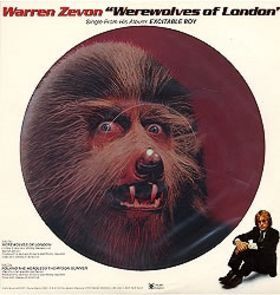
Affiliate Disclosure: I am an Amazon affiliate and if you purchase through any amazon links on this site i may earn a small commission at no extra charge to you.
Released as a single in 1978 from the album Excitable Boy, Werewolves of London reached number 21 on the US Billboard Hot 100, making it the only top-40 hit of Zevon’s career and introducing his particular combination of literary wit and rock energy to the widest audience he ever reached.
Written by Zevon with Waddy Wachtel and LeRoy Marinell, and produced by Jackson Browne, it arrived as the perfect encapsulation of everything that made Zevon unlike any other songwriter working in rock at the time.
Werewolves of London has since become one of the most licensed and sampled recordings of the rock era, its piano figure appearing in advertising, film, television, and as the basis for subsequent hit recordings, a second life that Zevon himself did not live to fully witness.
| Song Title | Werewolves of London |
|---|---|
| Artist | Warren Zevon |
| Album | Excitable Boy (1978) |
| Released | 1978 |
| Genre | Rock, New Wave, AOR |
| Label | Asylum Records |
| Writers | Warren Zevon, Waddy Wachtel, LeRoy Marinell |
| Producer | Jackson Browne |
| Peak Chart | #21 US Billboard Hot 100 |
- What Is the Song About?
- The Vibe: Genre, Mood, and Feel
- Behind the Lyrics
- How It Was Made: The Sound and Production
- Legacy and Charts: Impact and Endurance
- A Listener’s Note
- Watch the Official Video
- Collector’s Corner
- Frequently Asked Questions
What Werewolves of London About?
Werewolves of London is a comic horror story set in the British capital, following a werewolf conducting his evening in London with the manners of a gentleman and the appetites of a monster.
The humor operates through incongruity: the creature visits Lee Ho Fook’s for a plate of beef chow mein, encounters a Chinese menu in the rain, and has its hair as perfectly coiffed as Lon Chaney or Warren Beatty.
The comedy is deadpan rather than broad, delivered with total commitment by Zevon, who understood that playing it completely straight was funnier than winking at the audience about the absurdity of what he was singing.
Underneath the humor, the song taps into something older and more primal: the werewolf mythology that has circulated in European folklore for centuries, the idea of a civilized surface concealing an uncivilized appetite.
The juxtaposition of sophisticated London setting and supernatural predator is what makes the song more than a novelty: it uses the werewolf as a vehicle for commentary on the thin veneer of civilization that separates polite behavior from more fundamental drives.
Zevon was always drawn to characters living at the edge of respectable society, and the creature is the most extreme version of that type: a creature that looks like a gentleman until the moon is full and the mask drops entirely.
For listeners who approach the song purely as entertainment, Werewolves of London delivers exactly what it promises: a funny, memorable story told over one of the most irresistible piano figures in rock history.
The ending of the song, with the creature’s howl and the final verse’s accumulation of images, rewards attention with a performance that is more carefully constructed than its breezy surface suggests.
The Vibe: Genre, Mood, and Feel
Werewolves of London sits at an unusual intersection: it is too weird for mainstream rock, too musically accomplished to be dismissed as novelty, and too genuinely funny to be taken entirely seriously, which is precisely the space Zevon occupied throughout his career.
The mood is one of theatrical menace undercut by comedy, the sonic equivalent of a monster emerging from a fog machine while wearing a tuxedo.
The piano riff that opens the track and drives the entire track is one of those figures that announces itself so completely that the song is identifiable in its first two bars: it has the insistence and forward drive of the best rock piano writing.
Wachtel’s guitar work adds grit and weight to what might otherwise have been a purely comic performance, ensuring that the track has genuine rock energy alongside its humor.
The “Ahh-OOOOO” howl that punctuates the track is the moment that audiences most anticipate and respond to with the most physical enthusiasm, the kind of collective participation that distinguishes songs capable of building real crowd relationships.
The overall production under Jackson Browne is lean and direct, letting the song’s own personality drive the performance rather than overlaying it with studio effects that might soften the impact.
For listeners encountering it for the first time, the immediate impression is the piano, followed almost immediately by the recognition that this song does not sound like anything else they have heard.
Behind the Lyrics
Werewolves of London was written collaboratively by Zevon, Wachtel, and Marinell, though accounts of the exact origin of the song vary and the mythologizing that surrounds Zevon’s career makes precise attribution difficult.
The story told in interviews is that the song began as a joke, a challenge to write a song with the most ridiculous possible title, and that the result somehow transcended its origins to become one of the most durable songs in the rock catalog.
The specific London details, from Lee Ho Fook’s restaurant to the reference to Trader Vic’s, give the song an unexpected geographical precision that grounds the fantasy in recognizable places, making the werewolf feel oddly local rather than mythological.
Zevon’s literary sensibility is visible throughout the lyric in the references to Lon Chaney, the specificity of the images, and the deadpan delivery of information that would be alarming in any other context but here functions as pure comedy.
The writing reflected Zevon’s wider approach to songwriting: finding the absurd within the familiar, the horror within the mundane, and presenting both with a straight face that dared the audience to decide how seriously to take what they were hearing.
What Zevon, Wachtel, and Marinell created in the song was a recording that worked simultaneously as a rock track, a comedy piece, a horror story, and a piece of social observation, hitting all four registers without losing its grip on any of them.
The lyric’s reference to the little old lady who got mutilated late last night is the song’s darkest joke, delivered with the same breeziness as everything else in the narrative, which is where the real edge of the comedy lies.
For a song that began as a challenge to write something ridiculous, Werewolves of London represents one of the most fully realized comic narratives in rock, a song that respects its own absurdity enough to execute it with complete craft.
How It Was Made: The Sound and Production
Werewolves of London was recorded for the Excitable Boy album with Jackson Browne serving as producer, a role Browne had taken on for Zevon’s earlier album as well, providing the technical skill and industry relationships that Zevon needed to translate his compositions into commercially viable recordings.
Browne’s production approach was to let the song do the work rather than imposing a complex sonic environment on material that was already fully formed as a piece of writing.
Waddy Wachtel’s guitar is essential to the sound of the recording, adding the rock energy that prevents the song from being purely comic and ensuring it functions as a genuine piece of music rather than an extended joke set to chords.
The piano figure that drives the track through its entirety was recorded with a directness that preserves the in-the-room quality of a live performance, giving the track the kind of immediacy that more heavily produced recordings often sacrifice.
The production decision to treat the “Ahh-OOOOO” howl as a musical event rather than an effect, placing it deliberately within the arrangement, is one of the key choices that makes the song work: it sounds planned and performed rather than improvised or gimmicky.
Browne’s background as a recording artist who understood how to make records for a mainstream rock audience helped shape the track into something that could reach radio without losing the eccentricity that made it valuable.
The recording captures a performance that sounds exactly right for the material: not overproduced, not undercooked, but precise in the way that the best rock records of the late 1970s were precise when the production served the song rather than the producer’s ego.
The result is a track that sounds as fresh and immediate today as it did when it was first released, which is the reliable indicator that a production decision was correct.
Legacy and Charts: Impact and Endurance
Werewolves of London reached number 21 on the US Billboard Hot 100 in 1978, the only top-40 appearance of Zevon’s career on that chart, and the commercial peak of a recording life that was always more critically celebrated than commercially rewarded.
Werewolves of London has appeared in an extraordinary range of film and television contexts since its release, from Martin Scorsese’s The Color of Money to horror films and comedies, each placement confirming its status as a piece of music that communicates something recognizable across very different contexts.
The piano riff from Werewolves of London became the basis for Kid Rock’s 2008 single “All Summer Long,” which combined it with Lynyrd Skynyrd’s “Sweet Home Alabama” to create one of that year’s biggest worldwide hits, introducing a new generation to the Zevon figure without necessarily knowing its origin.
The howl has become a genuine piece of cultural vocabulary, deployed in contexts ranging from sports arenas to horror film trailers, demonstrating the song’s penetration into the popular consciousness at a level beyond the chart position it achieved.
Zevon died in September 2003, and Werewolves of London has since taken on the additional meaning of representing his legacy to general audiences: the track that most non-specialist listeners associate with his name and that introduces new listeners to the rest of his catalog.
For Warren Zevon’s existing audience, Werewolves of London was always something of a calling card rather than the full measure of his achievement: he wrote more complex and emotionally devastating songs, but the accessibility of this one made it the doorway through which most people entered.
The song continues to be a fixture on classic rock and AOR playlists, its combination of unforgettable piano hook and comedic bravado making it one of the most reliably crowd-pleasing entries in the genre regardless of the audience or the context.
Werewolves of London represents the paradox at the heart of Zevon’s career: the song that made him most accessible to a mainstream audience was also the song that least represented the full scope of what he could do.
A Listener’s Note
First-time listeners are typically caught by the piano riff before they have processed a single word, which is as it should be: the musical hook is irresistible enough to demand attention before the comedy of the lyric arrives.
Werewolves of London rewards the attention of listeners willing to follow the lyric closely: the specificity of the images, the deadpan delivery of genuinely strange information, and the precision of the storytelling reveal a level of craft that the effortless surface disguises.
What keeps the track in rotation is the rarest quality in any genre: genuine originality, the sense that no one else could have written or performed this song, that it exists because Warren Zevon existed and would not exist without him.
The song asks nothing of its audience except a willingness to go along with something that should not work but does, and rewards that willingness with three of the most entertaining minutes in the entire rock catalog.
Watch the Official Video
Watch Warren Zevon performing Werewolves of London in this official video:
Collector’s Corner
Original single pressings on Asylum Records are the primary collector’s item for fans of the recording, with clean copies of the 7-inch increasingly sought after as interest in Zevon’s catalog has grown steadily since his death.
The original Excitable Boy album pressing on Asylum, which provides the full context in which the recording was originally released, is a valued collector’s item, particularly copies with their original inner sleeves and in strong vinyl condition.
International pressings of the single vary in label design and sleeve art across different territories, and the UK Asylum pressing in particular is of interest to collectors who want a complete physical record of the song’s international release history.
Promotional copies marked for radio use are particularly prized, as these were the pressings that built the song’s chart momentum and helped establish Zevon’s reputation with mainstream audiences who had not encountered his earlier work.
You Might Also Like
Blue Oyster Cult’s landmark single combined a meditation on mortality with a guitar riff of unusual beauty, creating one of the most intellectually ambitious rock songs ever to achieve mainstream chart success.
Golden Earring’s psychic-connection epic topped the charts in the Netherlands and reached the US top 20, driven by a bassline that became one of the most copied riffs in rock and a momentum that never lets up for seven and a half minutes.
Joe Walsh’s signature solo statement introduced the talk box guitar effect to a wider audience and demonstrated that his departure from the James Gang had unlocked a level of confidence and musical freedom he had not fully accessed before.
Frequently Asked Questions
What is the song about?
Werewolves of London is a comic horror narrative about a werewolf conducting his evening in London with the manners of a gentleman and the appetites of a monster, visiting Chinese restaurants, encountering little old ladies, and howling at the moon with the insouciance of someone who sees nothing unusual about any of this.
Who wrote the song?
Werewolves of London was written by Warren Zevon, Waddy Wachtel, and LeRoy Marinell. The song reportedly began as a challenge to write something with a ridiculous title, and the resulting collaboration became Zevon’s only top-40 hit and his most enduring recording.
Who produced the recording?
Werewolves of London was produced by Jackson Browne, who had championed Zevon’s career and produced his earlier recordings. Browne’s production approach let the song’s own personality drive the performance rather than imposing a complex studio environment on material that was already fully realized.
How did the song chart?
Werewolves of London reached number 21 on the US Billboard Hot 100 in 1978, making it not only Zevon’s highest-charting single but his only appearance in the top 40 on that chart. Despite his critical reputation, Zevon never replicated the mainstream chart success of this recording.
What album is the recording from?
Werewolves of London appears on Excitable Boy, Warren Zevon’s third studio album, released in 1978 on Asylum Records. The album was a breakthrough for Zevon, establishing him as one of the most distinctive voices in late-1970s American rock and earning him widespread critical recognition.
Who sampled the piano riff?
Kid Rock used the piano riff from Werewolves of London as the basis for his 2008 hit “All Summer Long,” combining it with Lynyrd Skynyrd’s “Sweet Home Alabama” to create one of that year’s biggest worldwide hits. The sampling introduced the Zevon figure to a new generation of listeners who may not have known its origin.
What is the famous howl in the song?
The “Ahh-OOOOO” howl that punctuates Werewolves of London is the song’s most recognized moment, a werewolf cry delivered with complete commitment by Zevon and treated as a genuine musical event in the arrangement rather than a comic sound effect. It has become one of the most recognized moments in 1970s rock and a standard audience participation element in live performances.
Why does the song endure as a classic?
Werewolves of London endures because it achieves something genuinely rare in any genre: it is both funny and musically excellent, combining an irresistible piano riff with a lyric of real wit and a performance of complete conviction. The song is original in the truest sense, the product of a sensibility so distinctive that nothing quite like it existed before Zevon created it.
Werewolves of London endures because it is the product of a genuinely original sensibility, a song that could only have been written by Warren Zevon and that demonstrates with every bar that intelligence, humor, and rock energy are not competing values but complementary ones.