

Rock On by David Essex is one of the most unusual and innovative hit singles of the early 1970s, a track built on a bass line and echo effects rather than chords and melody, that reached #5 on the US Billboard Hot 100 and #3 on the UK Singles Chart in 1973.
Affiliate Disclosure: I am an Amazon affiliate and if you purchase through any amazon links on this site i may earn a small commission at no extra charge to you.
Written by Essex himself and produced by Jeff Wayne, Rock On was recorded with a deliberate minimalism that was radical for a mainstream pop hit: there are no chord-playing instruments anywhere on the track, only a double-tracked bass line devised by session bassist Herbie Flowers, Essex’s voice processed through heavy slapback delay, and a rhythm part inspired by the sound of a trashcan.
Essex had originally demoed the song using a dustbin lid to generate the track’s percussion rhythm, and Wayne built the sparse arrangement around that concept, creating something that sounded like nothing else on radio in 1973.
The result reached #1 on the Canadian RPM chart and the US Cash Box chart, and its influence can be heard in the work of subsequent artists ranging from R.E.M. to Def Leppard, who have all acknowledged the track’s avant-garde approach to pop production.
It remains one of the most distinctive-sounding recordings to reach the top ten on either side of the Atlantic in any decade, a track whose production approach was so unusual that it should not have worked commercially, and yet worked brilliantly.
| Song Title | Rock On |
| Artist | David Essex |
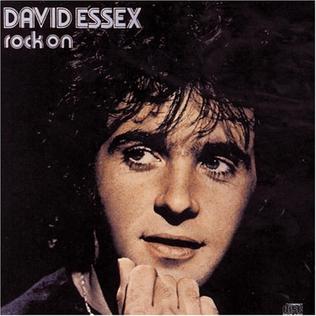
| Album | Rock On (1973) |
| Release Year | 1973 |
| Written By | David Essex |
| Producer | Jeff Wayne |
| Label | Columbia Records |
| Chart Peak | #5 US Billboard Hot 100, #3 UK Singles Chart, #1 Canada |
Table of Contents
What Is the Song About?
Rock On is a nostalgic homage to the early rock and roll era, a song that conjures the spirit of 1950s youth culture through references to James Dean, blue jeans, and the music that defined a generation.
The lyric is fragmentary and impressionistic rather than narrative, building its emotional impact through the accumulation of iconic cultural images rather than through any conventional song structure.
Essex’s references to Bobby Brown (referring to the rockabilly style, not the later R&B artist), blue suede shoes, and “hey, hey, mama” (an echo of Elvis Presley’s That’s All Right Mama) place the song in conscious dialogue with the founding recordings of rock and roll.
The command to rock on functions both as a tribute to the music that came before and as an invitation to keep that spirit alive in the present, a message delivered with the wistful nostalgia of someone who understands that the original moment cannot be recaptured but can at least be honoured.
The Vibe: Genre, Mood, and Search Intent
Rock On opens with Herbie Flowers’s distinctive bass figure, processed with a slapback delay that gives it an almost underwater quality, followed by Essex’s vocal entering with the same heavy echo treatment that runs throughout the entire recording.
The absence of any harmonic instrument creates a production space that is simultaneously sparse and full, a paradox that Jeff Wayne managed through the precise use of echo, reverb, and the textural depth of the double-tracked bass.
- Genre: Glam Rock, Art Pop, Nostalgic Rock
- Mood: Nostalgic, Atmospheric, Wistful
- Tempo: Slow to mid-tempo
- Best For: 1970s pop rock collections, glam era playlists, atmospheric driving mixes
- Similar To: T. Rex “Bang a Gong”, David Bowie “Ziggy Stardust”
- Fans Also Search: David Essex discography, Jeff Wayne production, Herbie Flowers session work
Behind the Lyrics: The Song’s Story
David Essex wrote Rock On while developing his early songwriting style in the late 1960s and early 1970s, and it appeared on his debut studio album in 1973 as the opening track and lead single.
The recording process was shaped by Essex’s original demo, in which he had used a trashcan to generate the basic rhythmic pulse, establishing from the start that this would be a production built from unconventional elements rather than traditional rock instrumentation.
Jeff Wayne embraced the unconventional approach rather than correcting it: he commissioned Herbie Flowers to devise the double-tracked bass part that would become the track’s harmonic and rhythmic spine, and he built the entire production around the deliberate absence of guitars, keyboards, and any chord-playing instrument.
According to the Wikipedia entry on the song, Herbie Flowers received double his usual session fee of twelve pounds for devising the creative bass solution, a small financial recognition of what turned out to be one of the most inventive bass contributions to a major pop hit.
For listeners interested in the more experimental side of 1970s British rock, the track stands alongside T. Rex’s Bang a Gong as an example of British pop’s willingness to take structural and sonic risks within the commercial mainstream.
Technical Corner: Gear and Production
Jeff Wayne’s production of Rock On is one of the most radical in the history of the commercial pop single: the deliberate exclusion of all chord-playing instruments was not a budget constraint but an artistic choice that defined the track’s entire character.
Herbie Flowers’s bass is recorded in C-sharp minor and processed with a pronounced slapback delay effect, creating a warm, slightly blurred tone that is immediately recognizable and unlike the bass sound on any other major hit of the era.
Essex’s vocal is similarly processed with heavy echo and delay, placing his voice in the same atmospheric space as the bass and creating the impression of a performance unfolding in a large, reverberant room rather than a close-miked studio booth.
The rhythm track, inspired by Essex’s demo use of a trashcan, retains that unconventional quality in the final recording: the percussive element sounds like nothing that could be categorised as a standard drum kit, contributing to the track’s alien, slightly out-of-time feel.
Only three musicians contributed to the backing track, making Rock On one of the sparsest-arranged top-ten hits in rock history, a production that demonstrates how much atmosphere can be generated from the most minimal of means.
Legacy and Charts: Impact and Endurance
Rock On reached #5 on the US Billboard Hot 100, #3 on the UK Singles Chart, and #1 on both the Canadian RPM chart and the US Cash Box chart, establishing David Essex as an international artist of considerable commercial power.
The track’s influence on subsequent artists has been widely noted: R.E.M. and Def Leppard are among those who have acknowledged the recording’s impact on their own approaches to production and arrangement.
Michael Damian’s 1989 cover of Rock On reached #1 on the US Billboard Hot 100, introducing the song to a generation of listeners who were born after the original chart run and demonstrating that the track’s distinctive production had lost none of its power in the intervening sixteen years.
Critics have increasingly recognised the original as an avant-garde masterpiece that operated successfully within the commercial mainstream, a rare achievement that speaks to both Essex’s songwriting instinct and Wayne’s production vision.
The track remains a benchmark for what minimalist production can achieve when every sonic choice is made with complete conviction and musical intelligence.
Listener’s Note: A Personal Take
Rock On is one of those recordings that creates a specific physical environment the moment it begins: that bass with its echo processing drops you into a space that feels both intimate and vast, and Essex’s vocal enters that space with the confidence of someone who knows exactly where they are.
There is no moment in the recording where it sounds like it is working hard to achieve its effects: everything sounds inevitable, as if no other arrangement could have existed for this song.
The echo treatment is not a gimmick but a structural decision, integrating voice and bass into a single sonic world that has no need of any additional instrumentation.
Hearing it alongside the guitar-driven rock of its era makes its singularity even more striking: it operates by completely different rules and arrives at a completely different destination, yet it belongs entirely to the same moment in popular music.
It is a record that rewards careful listening more than almost anything else from 1973, each play revealing details of the echo processing and the bass work that pass unnoticed at first encounter.
Watch: The Official Music Video
Collector’s Corner: Own a Piece of Rock History
David Essex: Rock On (1973)
Own the debut album that launched one of the most innovative production approaches in 1970s pop.
Original Columbia pressings, remastered editions, and vinyl available.
Frequently Asked Questions
Who wrote Rock On?
The song was written by David Essex. It appeared on his debut studio album of the same name, released on Columbia Records in 1973, and was produced by Jeff Wayne, who later became famous for his War of the Worlds concept album.
Why are there no guitars on Rock On?
The absence of guitars and other chord-playing instruments was a deliberate production choice by Jeff Wayne. Essex had originally demoed the song with a trashcan for rhythm, and Wayne built the final arrangement around that minimal approach, using only Herbie Flowers’s double-tracked bass, Essex’s processed vocal, and a sparse percussion track to create the recording’s distinctive atmosphere.
Who is Herbie Flowers and what did he do on Rock On?
Herbie Flowers was one of the most in-demand session bassists of the 1970s, known for his work on Lou Reed’s Walk on the Wild Side and many other major recordings. On Rock On, he devised the double-tracked bass part, processed with slapback delay, that forms the harmonic and rhythmic foundation of the entire recording. He was paid double his normal session fee of twelve pounds for the creative contribution.
How did Rock On chart?
The song reached #5 on the US Billboard Hot 100, #3 on the UK Singles Chart, and #1 on both the Canadian RPM chart and the US Cash Box chart. It established David Essex as an international artist and remains his most celebrated and commercially successful recording.
Has Rock On been covered?
Yes. The most commercially successful cover is Michael Damian’s 1989 version, which reached #1 on the US Billboard Hot 100 and was featured in the film Dream a Little Dream. The Damian version introduced the song to a new generation and remains the second-best-known recording of the track after Essex’s original.
What does Rock On mean?
The song is a nostalgic tribute to early rock and roll culture, referencing James Dean, blue suede shoes, and the spirit of 1950s youth rebellion. The command to “rock on” functions as both a homage to the founders of the form and an invitation to keep the energy of that era alive. The song’s fragmentary lyric evokes rather than narrates, building atmosphere through iconic images rather than conventional storytelling.
Who is Jeff Wayne?
Jeff Wayne is a British-American composer, musician, and record producer best known for his 1978 concept album Jeff Wayne’s Musical Version of The War of the Worlds, which became one of the best-selling albums in UK chart history. Before that, he produced several recordings for David Essex in the early 1970s, including Rock On, demonstrating the ambitious production imagination that would later characterise his most famous work.
What artists have cited Rock On as an influence?
R.E.M. and Def Leppard are among the artists who have cited the track as an influence, particularly its innovative use of minimalist production and echo processing. The track has also been recognised by music critics as an early example of dub-influenced production techniques applied within mainstream pop, anticipating approaches that would become more widespread in subsequent decades.
You Might Also Like
T. Rex: Bang a Gong (Get It On) (1971)
A British glam rock classic from two years before this track that shares the same commitment to atmosphere and the same willingness to let a minimal arrangement do all the work the song requires.
Cat Stevens: Wild World (1970)
A fellow British singer-songwriter classic that shares the same acoustic intimacy and the same gift for using simplicity as a production value rather than a limitation.
David Bowie: Ziggy Stardust (1972)
A 1972 British rock landmark that shares the same period, the same commitment to making every sonic choice meaningful, and the same understanding that a rock song can be an act of genuine artistic imagination.
More than fifty years after its release, Rock On retains its status as one of the most sonically distinctive recordings of the entire 1970s, a track whose production approach was so unconventional that it still sounds unlike anything else in the classic rock catalogue.