

American Woman by The Guess Who is one of the most powerful hard rock recordings ever made by a Canadian band, a track that held the #1 position on the US Billboard Hot 100 for three weeks in May 1970 and became an anthem of the era.
Affiliate Disclosure: I am an Amazon affiliate and if you purchase through any amazon links on this site i may earn a small commission at no extra charge to you.
Written spontaneously by all four band members during a live concert in Southern Ontario, American Woman began as an improvisation when guitarist Randy Bachman broke a string and began playing a new riff while retuning, with Burton Cummings improvising the lyrics in real time before the audience.
A bootlegger in the crowd captured the performance on tape, the band tracked down the recording to retrieve the improvised lyrics Cummings had sung, and producer Jack Richardson helped shape the studio version that would become an international hit.
American Woman reached #1 in the United States and Canada and #19 on the UK Singles Chart, and ranked #3 on the year-end US Billboard Hot 100 for 1970, making it the most commercially successful song in the band’s career.
The recording has since been confirmed Gold by the RIAA and stands as one of the defining rock singles of the early 1970s, a performance that captured the raw energy of a band at the absolute peak of its powers.
| Song Title | American Woman |
| Artist | The Guess Who |
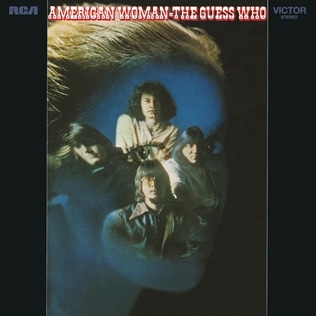
| Album | American Woman (1970) |
| Release Year | 1970 |
| Written By | Bachman, Cummings, Kale, Peterson |
| Producer | Jack Richardson |
| Label | RCA Victor |
| Chart Peak | #1 US Billboard Hot 100, #1 Canada, #19 UK |
Table of Contents
What Is the Song About?
This song’s meaning has been disputed almost since its release, with different members of The Guess Who offering contradictory interpretations across the decades.
Burton Cummings has said that his improvised lyric was driven by an observation about the difference between American and Canadian women, expressing a preference for Canadian women rooted in his personal experience of touring the United States during the Vietnam War era.
Randy Bachman, by contrast, has characterised it as an anti-war protest song, with the titular figure representing the draft, the military-industrial complex, and the social and political upheaval of the United States at the turn of the decade.
The ambiguity is not accidental: the song was improvised, and the lyric carries both readings simultaneously, which is part of what gives it its enduring resonance.
The character of the American woman addressed in the song is simultaneously a specific person, a cultural archetype, and a political metaphor, and listeners in different contexts have always found their own meaning in the address.
The Vibe: Genre, Mood, and Search Intent
American Woman opens with Bachman’s guitar riff, one of the most recognizable introductions in rock history, a figure built from the descending pattern he found while retuning a broken string that immediately signals the scale of what follows.
The track builds from that riff through Cummings’s extraordinary vocal performance, which moves between a conversational verse delivery and a chorus that opens up into full rock abandon with a power few vocalists of the era could match.
- Genre: Hard Rock, Blues Rock, Classic Rock
- Mood: Defiant, Powerful, Electric
- Tempo: Driving mid-tempo
- Best For: Hard rock playlists, 1970s rock collections, Canadian rock deep dives
- Similar To: Bachman-Turner Overdrive, Neil Young “Heart of Gold”
- Fans Also Search: Guess Who discography, Burton Cummings, Lenny Kravitz cover
Behind the Lyrics: The Song’s Story
The origin of this track is one of the great spontaneous-creation stories in rock history: the band was performing at a curling rink in Cobourg, Ontario, in August 1969 when Bachman broke a string and began improvising a new riff while retuning.
The other band members gradually joined him onstage, and Cummings began inventing words to fit the music in front of the audience, with no prepared lyric and no rehearsal of any kind.
The improvised performance was recorded by an audience member on a cassette tape, and the band later obtained a copy of the bootleg in order to transcribe the words Cummings had extemporised, giving them a starting point for the studio version they recorded for producer Jack Richardson.
According to the Wikipedia entry on the song, Richardson shaped the raw improvisation into a studio performance that retained the energy and spontaneity of the original while giving it the production quality needed for commercial release.
For listeners exploring the explosion of Canadian rock in the early 1970s, the recording belongs alongside Bachman-Turner Overdrive’s You Ain’t Seen Nothing Yet as one of the signal recordings of that tradition’s emergence onto the world stage.
Technical Corner: Gear and Production
Jack Richardson’s production here worked from the principle of preserving the raw energy of the original improvised performance while adding the studio craft needed to make it commercially viable.
Bachman’s guitar work on the recording is built around the iconic descending riff, which he plays with a tone and presence that immediately establishes the track’s authority, and the rhythm section of Jim Kale (bass) and Garry Peterson (drums) locks in around the riff with the solidity of a band that had been playing together for years.
Cummings’s vocal performance is the centrepiece of the production, and Richardson made the correct decision to capture it with a directness that let the voice’s natural power come through rather than processing it into smoothness.
The extended fadeout of the recording, which allows the band to explore the groove beyond the formal structure of the song, is one of the great fades in classic rock: it gives the impression that the performance is not ending but continuing into a space the listener cannot follow.
The overall production is a textbook example of how a great rock producer serves a great performance: by getting out of the way and letting the band do what it does best.
Legacy and Charts: Impact and Endurance
American Woman spent three weeks at #1 on the US Billboard Hot 100 beginning on May 9, 1970, making The Guess Who the first Canadian band to top the American singles chart with an original recording.
The achievement was historically significant: it demonstrated that Canadian rock acts could compete at the highest commercial level of the American market, a door that Bachman and others would push open further in the years that followed.
Lenny Kravitz’s 1999 cover of American Woman reached #1 in several countries and won the Grammy Award for Best Male Rock Vocal Performance, confirming the song’s durability and introducing it to a generation of listeners who were born after the original chart run.
The song has been featured in numerous film and television soundtracks and remains a constant presence on classic rock radio, its combination of Bachman’s riff and Cummings’s vocal performance retaining every degree of its original power.
It stands as the definitive statement of The Guess Who at their commercial and artistic peak, and one of the essential recordings of 1970s rock music.
Listener’s Note: A Personal Take
There is a quality to the best rock recordings that makes them feel inevitable, as if the song always existed and the musicians simply had the good fortune to discover it, and American Woman is one of those recordings.
Bachman’s riff has that quality: it sounds like something that should have existed before it was written, a piece of rock vocabulary so complete that it is impossible to imagine its absence from the catalogue.
Cummings’s vocal performance is one of the great moments of early 1970s rock: the verse delivery is almost conversational, drawing the listener in, and then the chorus arrives with a force that is entirely physical in its impact.
The ambiguity of the lyric is one of its great strengths: it is a song that means different things in different contexts, and that flexibility has allowed it to remain culturally relevant across five decades without requiring reinterpretation.
It is a record that deserves to be heard at full volume, in a context where nothing competes with it, and anyone who has experienced it that way will understand why it reached number one.
Watch: The Official Music Video
Collector’s Corner: Own a Piece of Rock History
The Guess Who: American Woman (1970)
Own the album that launched Canada’s greatest rock anthem onto the world stage.
Original RCA Victor pressings, remastered editions, and vinyl available.
Frequently Asked Questions
Who wrote American Woman?
The song was written by all four members of The Guess Who: Randy Bachman, Burton Cummings, Jim Kale, and Garry Peterson. It emerged spontaneously during a live performance in Ontario in August 1969, with Bachman improvising the guitar riff and Cummings inventing the lyrics in real time before the audience.
What is American Woman about?
The song’s meaning has been interpreted differently by its own writers. Burton Cummings has said it expresses a preference for Canadian women over American women, while Randy Bachman has described it as an anti-war protest song referencing Vietnam-era tensions. The ambiguity reflects its improvised origins and has contributed to its lasting resonance with listeners.
How did American Woman reach #1?
The song spent three weeks at #1 on the US Billboard Hot 100 beginning May 9, 1970, and simultaneously reached #1 in Canada. It was the first Canadian-authored song to top the US Billboard Hot 100, making it a landmark achievement in the history of Canadian rock music.
How did American Woman originate as an improvisation?
Randy Bachman broke a guitar string during a live show at a curling rink in Cobourg, Ontario. While retuning, he discovered a new riff and the band joined him onstage. Burton Cummings improvised lyrics to the riff in real time. An audience member recorded the performance, and the band retrieved that bootleg tape to learn the words Cummings had spontaneously created.
Who covered American Woman?
The most famous cover is Lenny Kravitz’s 1999 version, which appeared on the Austin Powers: The Spy Who Shagged Me soundtrack, reached #1 in multiple countries, and won the Grammy Award for Best Male Rock Vocal Performance. The Kravitz version introduced the song to a new generation of listeners worldwide.
Was The Guess Who the first Canadian band to reach #1 in the US?
Yes. American Woman made The Guess Who the first Canadian act to reach #1 on the US Billboard Hot 100 with an original composition by a Canadian artist. The achievement was a significant milestone for Canadian rock music and preceded the international success of other Canadian artists who followed in the 1970s and beyond.
Who are the members of The Guess Who?
The classic lineup of The Guess Who that recorded American Woman comprised Randy Bachman (lead guitar), Burton Cummings (lead vocals, keyboards), Jim Kale (bass), and Garry Peterson (drums). The band was formed in Winnipeg, Manitoba, Canada, and was active throughout the 1960s and 1970s. Randy Bachman later left to form Bachman-Turner Overdrive.
What happened to The Guess Who after American Woman?
After this, Randy Bachman departed The Guess Who to form Bachman-Turner Overdrive, which scored its own major hits in the mid-1970s. Burton Cummings continued leading The Guess Who until the band’s initial breakup in 1975, then pursued a solo career. Both Bachman and Cummings have remained active in rock music in various forms since.
You Might Also Like
Bachman-Turner Overdrive: You Ain’t Seen Nothing Yet (1974)
Randy Bachman’s next great chapter after leaving The Guess Who, a track that shared the same Canadian hard rock DNA and the same gift for a riff that immediately establishes its dominance over everything else on the radio.
Neil Young: Heart of Gold (1972)
Another Canadian rock landmark from the same fertile era, a track that shares the same organic quality and its writer’s instinct for capturing something emotionally true in the most economical form possible.
David Bowie: Ziggy Stardust (1972)
A 1972 British rock classic that shares the same combination of guitar power and vocal commitment that made the Guess Who recording a landmark, and the same ambition to make rock music carry more than just entertainment.
More than fifty years after its release, American Woman retains every volt of the energy that made it number one on two continents, a song whose riff and vocal performance remain benchmarks against which all subsequent hard rock has been measured.