Elvis Costello: The Voice That Rewrote British Rock
Elvis Costello: A Legacy Built One Record at a Time
Elvis Costello stepped onto the British music scene in 1977 wearing horn-rimmed glasses and a fury that few artists have matched before or since.
He arrived during the punk explosion but refused to be contained by it.
His debut set the tone immediately: melody sharp enough to cut, lyrics that demanded attention, and a delivery that never apologized for being clever.
The music press struggled to categorize Elvis Costello.
His audience needed only one listen to know they had found something rare.
Over the next four decades, he released more than thirty studio albums and collaborated with Burt Bacharach, the Brodsky String Quartet, Paul McCartney, and Emmylou Harris.
No genre was off-limits.
No critical consensus ever fully kept up with where he went next.
This is the story of a songwriter who treated the rock record as a form worth fighting for, and fought for it harder than almost anyone else of his generation.
He built that reputation note by note, album by album, argument by argument.
From Declan MacManus to a Name the World Knows
Declan Patrick MacManus was born on August 25, 1954, in London, the son of Ross MacManus, a trumpet player who toured with the Joe Loss Orchestra.
Growing up between London and Liverpool, he absorbed working-class Britain at a pivotal moment in its cultural history.
He borrowed Elvis from Presley and Costello from his maternal grandfather’s Irish surname.
The combination had weight: American rock royalty pressed against Irish immigrant grit.
It suited the man perfectly.
While writing songs in the mid-1970s, Elvis Costello worked as a computer operator at Elizabeth Arden’s cosmetics warehouse in London.
The contrast between the factory floor and the songs he was writing at night was no coincidence.
He understood from the start that the best rock and roll comes from people who have something to be angry about.
He sent demos to record labels and received little response until Stiff Records took notice in 1976.
Stiff was the right home: a label that prized eccentricity, speed, and attitude over commercial calculation.
My Aim Is True and the Birth of a New Voice
“My Aim Is True” arrived in July 1977, produced by Nick Lowe, one of the sharpest pop producers of his era.
The sessions featured American country-rock musicians Clover, a band that would later produce Huey Lewis and the News.
The irony was sharp: a British new wave record backed by California country players.
Tracks like “Alison” showed a gift for romantic devastation in under three minutes.
“(What’s So Funny ‘Bout) Peace, Love and Understanding” gave rock a protest anthem that sounded like a hook-filled pop song.
“Less Than Zero” took aim at British fascist Oswald Mosley and dressed the attack up as a cool, clean rocker.
Critics reached for words like “urgent” and “essential” and still came up short.
Elvis Costello’s debut landed at number fourteen on the UK charts and established a template that would influence everything from power pop to post-punk to the indie rock of the 1990s.
Stiff Records had taken a small risk on a young man with enormous ambition, and the return on that risk changed British rock for a generation.
Elvis Costello and This Year’s Model: New Wave Gets Teeth
“This Year’s Model” (1978) introduced The Attractions and changed the shape of the project entirely.
Steve Nieve on keyboards, Bruce Thomas on bass, and Pete Thomas on drums formed a unit that sounded like four musicians sharing one nervous system.
The album was leaner, harder, and more politically charged than anything on the debut.
“Pump It Up” became an instant floor-filler and a declaration: this band was not going to slow down for anyone.
“The Beat,” “No Action,” and “This Year’s Girl” were not songs you forgot after one listen.
Compared to the melodic sophistication of Paul Simon’s work in the same era, Elvis Costello was doing something rawer, more confrontational, and harder to dismiss.
Critics placed it among the best albums of 1978 before the year was even over.
Watch “Pump It Up” below and hear exactly what made this record the defining new wave statement of its year.
Elvis Costello & The Attractions, “Pump It Up” (1978). Via YouTube.
Armed Forces: When Pop Songs Carried Political Weight
“Armed Forces” (1979) had a glossier sheen and a colder fury than anything that came before it.
“Oliver’s Army,” built on an ABBA-like piano riff, reached number two on the UK charts.
The song became one of the most important political recordings of its decade.
Its subject, British imperialism and the working-class boys sent to fight its battles, sat beneath a melody so irresistible that radio programmers played it without stopping to read the words.
That tension between a catchy surface and a sharp political edge became a defining Elvis Costello signature.
“Accidents Will Happen” showed a craftsman refining his melodic tools to precision.
“Green Shirt” was an Orwellian pop song that disguised its dark meanings inside a three-chord hook.
The album reached number two in the United Kingdom and cracked the top forty in the United States.
This was a songwriter operating at the absolute top of his abilities at only twenty-four years old.
Three albums in three years, each one better than the last: very few artists in rock history have managed that run.
The Attractions: Four Players, One Unstoppable Sound
Steve Nieve’s organ runs were unlike anything heard in British rock at the time.
His keyboard work on “Armed Forces” and “This Year’s Model” defined the sound of new wave in ways that influenced a generation of bands.
Bruce Thomas held the bottom end with a melodic intelligence that pushed far beyond the role of a standard rock bassist.
Pete Thomas drove every track with a precision that never once sounded mechanical.
Together, The Attractions turned what could have been clever singer-songwriter records into something that hit the body and the mind simultaneously.
Like the tight arrangements behind British new wave peers Simple Minds, The Attractions understood that energy lives in the space between notes.
They were not backing musicians in any traditional sense.
They were equal partners in an ongoing argument about what rock music could be.
The four of them made records that still sound immediate decades after they were pressed.
When Elvis Costello eventually worked without them, the absence was always felt.
Imperial Bedroom and Elvis Costello’s Artistic Peak
“Imperial Bedroom” (1982), produced by Geoff Emerick, is the album that stops arguments about where Elvis Costello ranks among the all-time greats.
Emerick had engineered the Beatles’ most ambitious recordings, and he brought that same attention to texture and space to these sessions.
The result was sprawling, orchestrated, emotionally raw, and structurally daring in ways that most rock artists would not attempt for another decade.
“Almost Blue” was a torch song of devastating emotional clarity.
“Man Out of Time” compressed a lifetime of social observation into four minutes.
“Beyond Belief” opened the album with a lyric that felt like reading a very good short story at full speed.
Rolling Stone placed it among the best albums of the decade upon release.
Elvis Costello had made five essential records in six years, and this one sat at the top of the pile.
No one who heard it in 1982 had any doubt they were listening to a major work.
It remains the record most critics reach for first when explaining why his name belongs in any serious conversation about rock greatness.
Country, Strings, and a Career Without Borders
“Almost Blue” (1981) was an album of country covers recorded in Nashville, which baffled his core audience and delighted an entirely different one.
Country music was not fashionable in British new wave circles in 1981.
Elvis Costello did not care.
Like Brian Setzer, who moved freely between rockabilly, big band, and rock without apology, Elvis Costello treated genre loyalty as a limitation for lesser artists.
“The Juliet Letters” (1993) paired him with the Brodsky String Quartet for an album that drew from classical song form and Schubert’s late work.
“Kojak Variety” (1995) was a set of obscure pop covers that functioned as a love letter to his own record collection.
These were not side projects or novelties.
They were a working musician applying serious craft to unfamiliar material in unfamiliar rooms.
Like Tom Petty, who described his own musical approach as “whatever feels true at the time,” Elvis Costello had lived by that same logic for thirty years.
The audience that followed him through these shifts was smaller but fiercely loyal, and they were never disappointed.
Painted from Memory: Meeting Burt Bacharach
The 1998 collaboration with Burt Bacharach produced “Painted from Memory,” an album that proved both men were more interested in songcraft than in their own reputations.
Bacharach brought his legendary melodic architecture to the sessions: chord changes that move in unexpected directions while feeling completely inevitable.
Elvis Costello brought lyrics that matched the emotional intelligence the older composer had always demanded of his collaborators.
The partnership had started with “God Give Me Strength,” written for the 1996 film “Grace of My Heart.”
That song’s success convinced both men there was a full album in the collaboration.
The result won a Grammy Award for Best Pop Collaboration with Vocals.
It silenced the remaining skeptics who had missed the point of his genre experiments.
The album also featured “The Sweetest Punch,” a song that showed what happened when Bacharach’s melodic instinct and Costello’s lyrical precision operated without compromise.
For anyone who doubted that a rock songwriter could hold his own in a formal pop collaboration, “Painted from Memory” was the definitive answer.
Elvis Costello Live: Where the Songs Come Alive
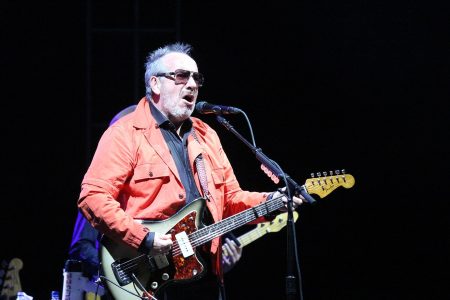
Any serious list of essential rock live performers from the late twentieth century has Elvis Costello near the top.
He plays with an intensity that suggests every performance might be the last one he ever gives.
The horn-rimmed glasses stay on.
The guitar stays up.
The voice, equal parts snarl and ache, does not moderate itself for the comfort of the audience.
Long sets draw from more than thirty years of material, rewarding listeners who know the catalog well.
He does not build sets around nostalgia.
He builds them around the idea that the songs still have something to say right now.
The setlists shift between appearances, drawing from the full catalog rather than leaning on a fixed run of hits.
Current tour dates are listed at elviscostello.com/tour.
Fans who have seen Elvis Costello perform describe the experience as watching someone argue with the entire history of popular music, and winning every round.
The Spike Years and a New American Chapter
“Spike” (1989) introduced Elvis Costello to an American mainstream audience that had been watching from a respectful distance.
The album featured McCartney co-writes, a duet with Chrissie Hynde, and the single “Veronica,” which reached the top ten in the United States.
It was his most commercially successful American moment to that point.
Paul McCartney had co-written “Veronica” with him, and the song’s melodic strength showed what happened when two serious songwriters focused on the same three minutes.
“Mighty Like a Rose” (1991) followed with a denser, more challenging set that kept his critical profile high even as commercial pop moved in other directions.
His growing American audience found in him a songwriter who took the craft as seriously as any artist they already loved.
Each new project introduced Elvis Costello to a different listener without alienating the ones who had been there since 1977.
The 1990s also brought extended touring with both The Attractions and new groupings of musicians.
Every new record added another chapter to a catalog that already had no weak links.
Elvis Costello Today: Still Writing, Still Raging
In 2018, Elvis Costello was diagnosed with an aggressive form of cancer and underwent surgery that doctors said had a significant chance of ending his singing career permanently.
He came back.
“Hey Clockface” arrived in October 2020, recorded from a Paris hotel room during the pandemic lockdown with collaborators spread across multiple countries.
The music was restless, strange, and unmistakably his.
“The Boy Named If” followed in January 2022 with guitar-driven rock that sounded like a man with unfinished arguments to pursue.
He continues to tour, write, and record at a pace that would exhaust younger artists.
His official website at elviscostello.com and his Facebook page keep fans current on new work and upcoming dates.
The horn-rimmed glasses are still there.
The anger has not softened into nostalgia.
He is a songwriter who has earned every argument he has ever started.
Elvis Costello remains one of the most important voices in rock history, a restless artist who never stopped pushing himself or the music he loves.
Essential Elvis Costello Albums and Merch
Five decades of records, from new wave debut to late-career experiments.
Find albums, vinyl, and merchandise on Amazon.
Affiliate Disclosure: This post contains affiliate links to Amazon. If you purchase through these links, we may earn a small commission at no extra cost to you. Thank you for supporting Classic Rock Artists.