
Looks That Kill: How Mötley Crüe Arrived in 1983
Looks That Kill announced Mötley Crüe to the world in 1983 with a guitar riff that felt like a challenge to every other band on the Sunset Strip.
The song arrived on the Shout at the Devil album and immediately told you everything you needed to know about who these four people were and what they intended to do to rock radio.
There was no subtlety in it, no concession to polish, and absolutely no apology for any of it.
If you were paying attention in 1983, you heard Looks That Kill and understood that something had changed.
Affiliate Disclosure: I am an Amazon affiliate and if you purchase through any amazon links on this site i may earn a small commission at no extra charge to you.
Quick Navigation
- What Looks That Kill Is Really About
- The Making of Looks That Kill in 1983
- Shout at the Devil: The Album Behind the Song
- How Looks That Kill Found Its Audience
- The Music Video for Looks That Kill
- Mötley Crüe in 1983: Before the Fall and Rise
- Looks That Kill and the Legacy It Built
- Watch Looks That Kill Now
What Looks That Kill Is Really About
Looks That Kill is built around the oldest rock and roll subject in the catalog: a woman so dangerous and irresistible that she destroys everyone who gets close to her.
Nikki Sixx wrote the lyric with the directness that defined everything Mötley Crüe put on tape in those early years, a directness that left no room for misinterpretation.
The character at the center of the song is not a person but a force, and the song treats her with both fear and admiration in equal measure.
What makes the song work is the match between the lyric and the music: the riff is as aggressive as the woman it describes, and the combination locked the two together in a way that radio programmers could not separate once they heard it.
This is not a complicated song and it was never meant to be.
Mötley Crüe had no interest in hiding what they were selling, and they delivered it at full volume with the lights up.
The Making of Looks That Kill in 1983
Producer Tom Werman worked with Mötley Crüe on Shout at the Devil and brought a clarity to the recording that their debut had lacked.
Mick Mars (full biography) built the central riff as a mid-tempo groove designed to hit the sweet spot between aggression and accessibility, and it did exactly that.
The riff is instantly identifiable within the first two seconds, which is the kind of opening that radio programmers remember and listeners do not forget.
Tommy Lee (see his full story) tracked a drum performance that pushed the tempo without rushing it, giving the track a controlled heaviness that kept it from collapsing into pure noise.
Vince Neil (biography) delivered the vocal with a sneer that matched the lyric exactly, and the combination of his delivery with the track’s aggression gave the song a personality that distinguished it from everything else playing alongside it in 1983.
The recording captured the band at the moment they were at their most instinctive, before the commercial pressures of later records softened any of the edges.
Shout at the Devil: The Album Behind the Song
Shout at the Devil arrived on August 26, 1983, and became the commercial breakthrough that the band’s self-titled debut had not fully delivered.
The full story of Mötley Crüe makes clear how important this album was to the band’s survival and growth as a commercial force.
Looks That Kill was the lead single and the opening statement for a record that also contained “Shout at the Devil,” “Too Young to Fall in Love,” and “Knock ‘Em Dead, Kid.”
The album eventually reached number seventeen on the Billboard 200 and was certified platinum in the United States, a commercial result that proved the band could convert their live following into record sales.
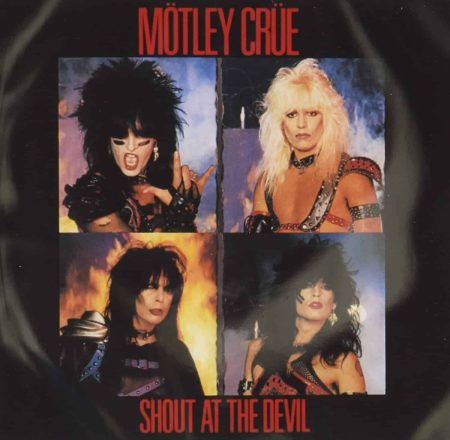
The visual identity of the Shout at the Devil era, the pentagram, the leather, the face paint, gave Looks That Kill an image context that amplified everything the song communicated on its own.
You did not just hear Looks That Kill; you saw it in every piece of band photography from that period, and the two reinforced each other in a way that is harder to achieve in an era without that kind of unified visual presentation.
How Looks That Kill Found Its Audience
Looks That Kill reached radio at a moment when hard rock was beginning to dominate both FM stations and the nascent MTV format in ways that no one had fully anticipated at the start of the decade.
The song filled a very specific lane: too heavy for pop radio, too melodic for the emerging metal underground, and perfectly positioned for the audience that had been waiting for exactly this combination.
MTV put the video into rotation and the song’s profile expanded rapidly across markets that the band had not yet toured.
The internal conflicts that would later define conversations about the band were nowhere visible in 1983, and Looks That Kill was the product of four people who were fully committed to the same objective.
By the time the Shout at the Devil tour ended, Mötley Crüe had built an audience large enough to carry them into the arena level, and this song most reliably reminded that audience why they had chosen the band.
The Music Video for Looks That Kill
The music video for Looks That Kill gave MTV exactly what it needed in 1983: a band that understood the visual medium as well as they understood the sonic one.
The clip featured the band in their full Shout at the Devil-era presentation, surrounded by imagery that matched the song’s aggressive energy without tipping into self-parody.
Director Wayne Isham, who would go on to build a long working relationship with the band, knew how to frame rock performers for maximum impact on a small screen.
The video locked in the visual identity of Looks That Kill permanently, making the song inseparable from its imagery in the same way that a handful of clips from that era managed to achieve.
Every time the clip aired, it converted another viewer into a ticket buyer, and the compound effect of radio play and video exposure drove the Shout at the Devil album’s sales well into 1984.
Mötley Crüe in 1983: Before the Fall and Rise
The version of Mötley Crüe that recorded Looks That Kill was raw, ambitious, and operating entirely on instinct.
The tragedies and recoveries that would define the band’s later narrative had not happened yet, and the four people on the Shout at the Devil record were in the first act of a story that would take multiple dramatic turns before it reached its commercial peak with Kickstart My Heart six years later.
Vince Neil (read about his recent return) was twenty-two years old when Looks That Kill was recorded, and the vocal captures a confidence that comes from being young enough to believe nothing can stop you.
That particular quality, the sound of a band that does not yet know what is coming, gives Looks That Kill an energy that later Mötley Crüe recordings could reference but never quite replicate.
The official band site at motley.com presents the Shout at the Devil era as a foundational moment, which is the only accurate description of what it was.
Looks That Kill and the Legacy It Built
Looks That Kill has never left Mötley Crüe’s live set for any meaningful stretch of time in four decades.
The song appears on greatest hits compilations, streaming playlists, and tribute records because it does something that few rock songs from any era manage to do: it sounds exactly as aggressive and alive on its hundredth listen as it did on the first.
When the band launched the 2026 Carnival of Sins tour, the song returned to the set list in a prominent position because the audience’s response to it has not diminished.
John 5 (full biography) performs the Mick Mars riff live with the same mid-tempo authority that made the original recording work, and the song translates across decades and lineup changes without losing its essential character.
The 80s rock catalog is full of songs that made an impression in their moment and then receded; this one is not among them.
It built the foundation that every subsequent Mötley Crüe hit stood on, and forty years later, it still sounds like a band arriving with something to prove.
Watch Looks That Kill Now
The official music video below captures Mötley Crüe at their most elemental: four people in 1983 who knew exactly what they were doing and were not asking permission from anyone.
Turn it up and remember why Looks That Kill was the only song that mattered the first time you heard it.
Own the Shout at the Devil Album
The record that introduced Looks That Kill to the world and launched one of rock’s most notorious careers is available on Amazon.