
The Too Fast for Love album is where Motley Crue began, and if you want to understand what this band actually was before the arena lights and the pyrotechnics, this is the record that tells you.
Affiliate Disclosure: I am an Amazon affiliate and if you purchase through any amazon links on this site i may earn a small commission at no extra charge to you. This helps support classicrockartists.com and allows me to keep providing deep-dive content on the legends of rock. Thank you for your support!
Quick Navigation
Too Fast for Love Album: The Record That Started Everything
Released on November 10, 1981, the Too Fast for Love album was recorded in October 1981 at Hit City West in Los Angeles, and it sounds like every second of it.
The sessions cost almost nothing and came out that way: raw, compressed, and driven by energy that had nowhere else to go.
The full story of how the members of Motley Crue assembled into a band makes the record’s urgency make more sense.
Nikki Sixx had built the lineup from scratch in 1981, finding Tommy Lee on drums, Mick Mars on guitar, and scrambling to land a vocalist in the days before tracking began.
The Too Fast for Love album sounds like four people playing as if someone might pull the plug at any moment.
At that stage in their career, someone might have.
Critics who first encountered it compared the sound to the Stooges, the New York Dolls, and the Sex Pistols: more raw punk than the polished glam metal Motley Crue would become known for on later records.
That rawness was not an accident.
It was the sound of a band making a record before anyone had told them what they were supposed to sound like.
Too Fast for Love Album’s Leathür Pressing: Only 900 Copies
The Too Fast for Love album was first released on the band’s own Leathür Records label, a name chosen for its combination of rock imagery and deliberate misspelling.
Only 900 copies were pressed in the original first edition.
That original Leathür pressing is now worth over $1,000 to collectors, making it one of the more valuable debut pressings in hard rock history.
The band sold copies out of the trunk of a car and at shows across the Los Angeles area, building a following street by street.
Within four months of the independent release, they had sold 20,000 copies.
That number did not come from radio play or retail distribution: it came from word of mouth and live performance in an era when neither of those things could be automated.
You can hear the full Too Fast for Love album in its remastered form below, before diving into the version debates that came with the Elektra deal.
How Too Fast for Love Album Got Signed to Elektra Records
The 20,000 copies sold gave Elektra A&R man Tom Zutaut the ammunition he needed to convince the label to sign Motley Crue.
The Too Fast for Love album was re-released on Elektra on August 20, 1982, remixed and resequenced for a major label audience.
The business story behind the deal had a darker chapter attached to it.
Manager Alan Coffman had originally financed the record and helped the band find equipment.
He later ran off with the advance money for the band’s second album.
That betrayal directly inspired “Bastard,” one of the most pointed tracks on Shout at the Devil.
The Too Fast for Love album launched a career, but it also handed the band their first education in how the music business actually works.
Leathür vs. Elektra: The Two Versions Explained
The Too Fast for Love album exists in two meaningfully different forms, and most reviews treat this as a footnote rather than the defining story it actually is.
The Leathür Records version has 10 tracks; the Elektra version has 9, with a different running order and one song cut entirely.
The only early Canadian pressing used the original Leathür mix, which makes it a separate collector’s item apart from the standard first edition.
The 2002 reissue was the first time on CD that the cut tracks were restored, giving listeners who came to the record after the Elektra era their first chance to hear what the original pressing actually contained.
The Leathür version has a rawer, more compressed sound that reflects both the recording budget and the four-day mix.
The Elektra version sounds notably more polished.
Both are documented on the album’s Wikipedia page, which remains the clearest single reference for comparing track listings, personnel, and release dates across both versions.
Why “Stick to Your Guns” Was Cut
“Stick to Your Guns” was the track dropped from the Elektra version of the Too Fast for Love album, though the label’s specific reasoning was never publicly explained in detail.
The title track was also edited: the first verse was cut on the Elektra pressing, shortening the song and changing its structure from the original Leathür recording.
Both changes reflect the commercial recalibration that came with the major label deal: Elektra was positioning Motley Crue for mainstream radio, and the rougher elements of the original needed smoothing before that could happen.
Who Produced Too Fast for Love Album?
The Too Fast for Love album was self-produced by Motley Crue, which in practice meant the band made the decisions while engineer Michael Wagener handled the technical side.
Wagener mixed the entire record in four days.
Four days.
That timeline is worth sitting with: the debut album of one of the most commercially successful rock bands of the 1980s was mixed in less time than most bands spend choosing a drum sound.
For the Elektra re-release, the label brought in Roy Thomas Baker to remix the Too Fast for Love album for a wider audience.
Roy Thomas Baker’s Remixing Pedigree
Baker’s resume explained why Elektra hired him: he had produced Queen’s A Night at the Opera, worked on records for Journey, and shaped the debut album by The Cars.
He understood how to make a hard rock record sound like it belonged on radio without stripping out what made it dangerous.
His remix of the Too Fast for Love album added definition and clarity while preserving enough of the original’s grit to keep the record honest.
The result was a record that could get played on rock radio in 1982 while still sounding like a band that had something to prove.
Live Wire: The Track That Opened Everything
“Live Wire” opens the Too Fast for Love album with a riff that announces itself before the rest of the band has time to respond.
It was ranked number 17 on VH1’s 40 Greatest Metal Songs of All Time, a placement that acknowledged its lasting influence on the hard rock that followed it through the decade.
The full breakdown of “Live Wire”, including its chart history and live performance legacy, is documented on this site.
The track is the album’s defining statement: tight, punishing, and melodic enough to stay in your head after the volume drops.
The Self-Directed Video and Nikki Sixx’s Fire Stunt
The band directed their own “Live Wire” music video because they had no budget to hire anyone else.
The video features Nikki Sixx setting himself on fire, a stunt performed because they could not afford real pyrotechnics.
It also includes Mick Mars drooling blood on stage, a detail that would have been a liability for a band with more to lose.
At the time, they had nothing to lose, which is precisely why the video works.
The resourcefulness behind those images: fire instead of budget, blood instead of production value, explains the Too Fast for Love album‘s entire aesthetic in two minutes of footage.
Vince Neil Almost Missed the Band Entirely
Vince Neil had originally missed his audition for Motley Crue.
The band tried another vocalist named O’Dean, but when that arrangement didn’t work, Neil was called back.
He had only been in the band a couple of days when they went into the studio to record the Too Fast for Love album.
He had to read the lyrics off a sheet of paper while laying down his vocal tracks.
That image tells you everything about the pace and chaos behind the sessions: the vocalist was reading words he barely knew while the clock was running and the tape was rolling.
The fact that the vocals on the Too Fast for Love album don’t sound like a cold reading is either a credit to Neil’s natural ability or proof that raw confidence covers a lot of gaps.
Probably both.
The Rolling Stones Connection: The Album Cover Explained
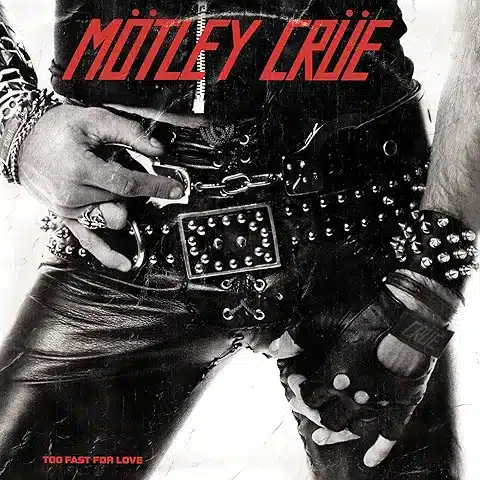
The album cover of the Too Fast for Love album is a direct tribute to The Rolling Stones’ Sticky Fingers, one of the most recognizable sleeves in rock history.
Almost no album review of the record explores this connection, which is a mistake: it signals the band’s classic rock ambitions from the very first thing you see before the needle hits the record.
Motley Crue in 1981 was not presenting itself as a new invention.
They were presenting themselves as heirs to a tradition that included the Stones, Aerosmith, and the hard rock acts of the previous decade, filtered through a Los Angeles perspective and a punk attitude toward cost and refinement.
The cover says: we know what the great albums looked like, and we want to be part of that line.
Tommy Lee has cited the Stones as one of his earliest influences on stage performance, and the cover art is the first visible evidence of that reverence embedded in the Too Fast for Love album.
How Too Fast for Love Album Charted and What It Sold
The Elektra version of the Too Fast for Love album peaked at number 77 on the Billboard 200.
That is not a chart position that screams commercial success, but the eventual certification tells a different story: the album went platinum.
It was the first of seven consecutive Motley Crue albums to be certified gold or platinum by the RIAA, a streak that ran from the Too Fast for Love album through Generation Swine in 1997.
Every album they released in that sixteen-year span reached at least gold.
That consistency began here, with an album pressed in 900 copies on a label the band invented themselves.
The catalog that followed included some of the most commercially successful hard rock records of the decade, from Girls Girls Girls to Dr. Feelgood, but the platinum run started on a shoestring in 1981.
Life Inside the Studio: Broke, Wild, and Recording
The band’s living conditions during the recording of the Too Fast for Love album are almost never discussed in album reviews, and they belong in every one.
The house where the band was living was barely furnished.
There was no money for food.
Booze and drugs, however, were never in short supply.
That context explains the energy on the record in ways that track listings and chart data cannot.
The Too Fast for Love album sounds like it was made by people who had nothing to fall back on because that is exactly what it was.
Every riff, every vocal take, every compressed kick drum hit carries the weight of a band that understood this record was either the beginning of something or the end of it.
There was no safety net, no second deal waiting, and no label money to cushion a failure.
What came out of those conditions was raw enough to be honest and tight enough to be remembered.
Critical Reception: Then vs. Now
At the time of the Elektra re-release, the Los Angeles Times praised the Too Fast for Love album for combining melodic pop hooks with heavy metal overdrive, describing it as sounding like a collaboration between Sweet and Deep Purple, with some Aerosmith thrown in.
That comparison was accurate and also revealing: the critics who understood the record recognized that Motley Crue was not inventing something new but executing a specific blend with unusual effectiveness.
The album’s current standing, decades after the initial reviews, is considerably stronger than its chart peak suggested it would be.
It is now recognized as a foundational document in the development of Los Angeles hard rock and the template for an entire decade of bands that came after it.
Ultimate Classic Rock’s deep dive into how Motley Crue helped launch the hair metal movement traces that lineage from the Too Fast for Love album forward, and Loudwire’s anniversary retrospective documents how the record’s reputation has grown in the years since.
Both are worth reading alongside the album itself.
Too Fast for Love Album’s Legacy in Motley Crue’s Career
The Too Fast for Love album sounds nothing like what Motley Crue would become, and that is precisely what makes it essential listening.
The band that made this record was running on adrenaline and necessity; the band that made Theatre of Pain four years later was operating with a budget, a producer, and a label with commercial expectations.
Both are valid, but only the Too Fast for Love album captures the band in the moment before the machinery of success reshaped them.
“Live Wire” became a catalog staple that sits alongside later songs like “Looks That Kill” and “Piece of Your Action” in the band’s permanent setlist rotation.
The album’s influence on the bands that followed it through the 1980s was direct: it showed that a self-released record made for almost no money could build an audience large enough to force a major label to take notice.
The ongoing story of this band, including the Mick Mars feud that Nikki Sixx has called a betrayal, and the band’s return to stages on the 2026 Carnival of Sins tour, would not exist without the foundation laid on this record.
The Too Fast for Love album is where it all began, and it earns its place in the catalog with every listen.
You Might Also Like
Disclosure: This post contains affiliate links.
If you purchase through these links, we may earn a small commission at no extra cost to you.
Buy Too Fast for Love on Amazon
If you have never heard the Too Fast for Love album from start to finish, start with “Live Wire” and let the rest of the record follow, because this is where Motley Crue earned everything that came after it.