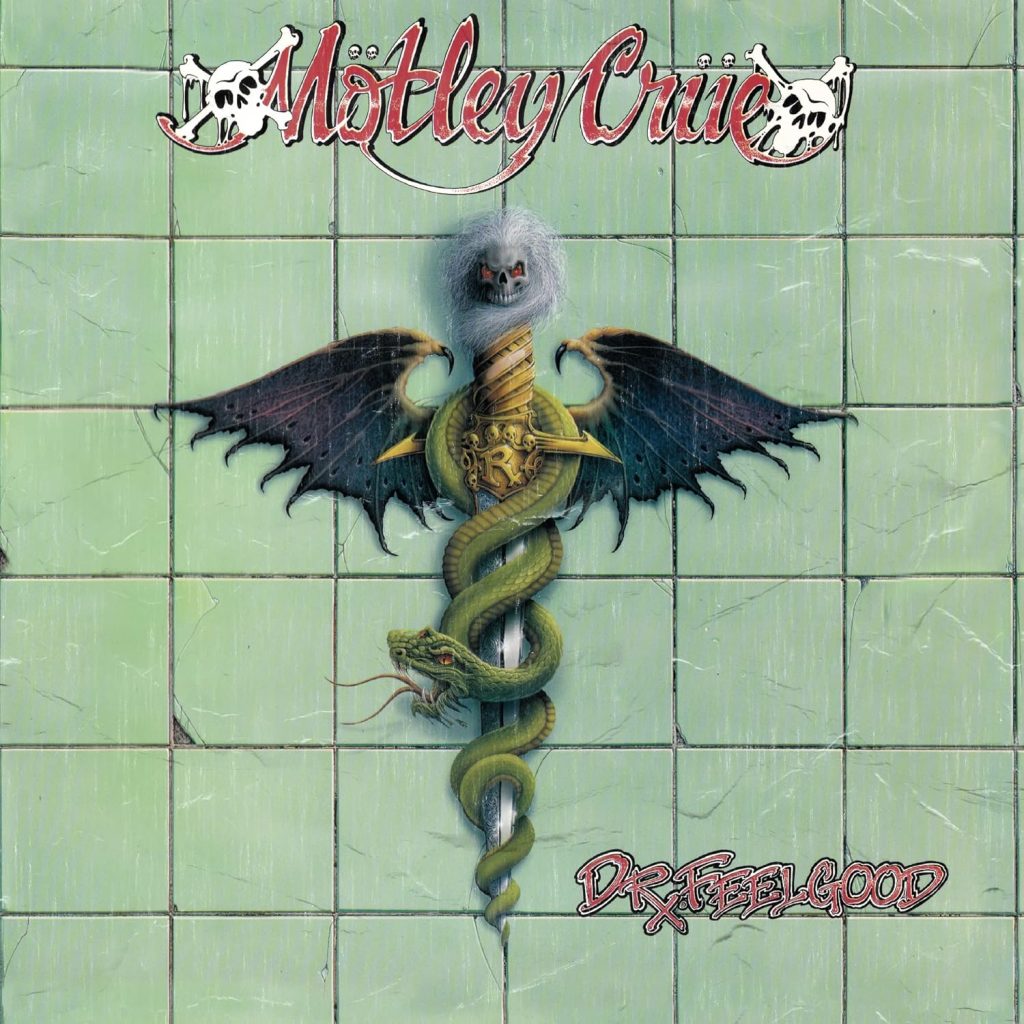
The Dr Feelgood Album stands as the defining achievement of Mötley Crüe’s career, a 1989 record that proved a band could survive everything and come back harder than ever.
Affiliate Disclosure: I am an Amazon affiliate and if you purchase through any amazon links on this site i may earn a small commission at no extra charge to you. This helps support classicrockartists.com and allows me to keep providing deep-dive content on the legends of rock. Thank you for your support!
Quick Navigation
- Dr Feelgood Album: What Made 1989 the Right Moment
- The Band That Cleaned Up and Found Their Power
- Bob Rock: The Producer Who Pushed Them Further
- Dr Feelgood Album Track by Track
- The Title Track: Raw Power in Three Minutes
- Inside the Dr Feelgood Album: Hidden Depths
- Why the Dr Feelgood Album Still Hits in 2026
- The Tour That Made Legends of Them
- Chart Performance and Critical Reception
- Legacy: The Album That Outlasted the Era
- Get the Dr Feelgood Album on Amazon
- You Might Also Like
Dr Feelgood Album: What Made 1989 the Right Moment
By the late 1980s, Mötley Crüe had survived a level of excess that would have ended most bands permanently.
Lead vocalist Vince Neil had faced criminal charges following a 1984 drunk driving accident that killed Nicholas “Razzle” Dingley of Hanoi Rocks.
Bassist Nikki Sixx had been clinically dead for two minutes following a heroin overdose in December 1987, an experience that would later become the spark behind the album’s most celebrated track.
Drummer Tommy Lee and guitarist Mick Mars had each fought through years of addiction and physical deterioration that would have retired lesser musicians permanently.
The band entered rehabilitation collectively in 1989, and what followed was not a retreat from the spotlight but the most aggressive creative charge of their career.
Sobriety gave them discipline, and discipline gave them the most focused, purposeful record they had ever made.
The timing was also cultural: Los Angeles hard rock had reached its commercial peak, and the Dr Feelgood Album arrived at exactly the moment the genre needed a statement worthy of the stage it had built.
No album before or after has captured that era’s swagger, precision, and raw will to survive quite as clearly as this one.
The Band That Cleaned Up and Found Their Power
Getting sober did not make Mötley Crüe gentle or cautious in the studio.
It made them precise.
Nikki Sixx, the band’s primary songwriter and creative engine, emerged from addiction with sharper instincts and a ferocious need to prove that the music came first.
Vince Neil’s voice, freed from years of physical abuse and neglect, carried a new rawness and emotional authority on every track.
Mick Mars, always the most technically rigorous and underrated member of the group, played with surgical discipline throughout every recording session.
Tommy Lee brought a kinetic physicality to the drums that engineers and drummers still study as a reference point today.
The four men who walked into the studio in 1989 were a fundamentally different band from the one that had recorded Girls, Girls, Girls just two years earlier.
They were leaner, more purposeful, and more ambitious than at any previous point in their career.
The complete story of Mötley Crüe’s history shows how much of a genuine turning point this period represented for every member of the band.
Bob Rock: The Producer Who Pushed Them Further
The decision to hire producer Bob Rock was one of the most consequential calls in Mötley Crüe’s entire history.
Bob Rock had built a reputation for converting raw rock energy into polished, powerful records without stripping out the danger or attitude that made bands worth recording.
He had previously worked with The Cult and would go on to produce Metallica’s landmark Black Album just two years later.
He challenged every member of the band to perform beyond what they believed they were capable of delivering.
He ran Vince Neil through vocal take after vocal take until each performance reached a standard the singer had never previously approached.
He worked with Nikki Sixx and Mick Mars to construct guitar tones that were simultaneously massive and precise without crossing into sterile or overworked territory.
The production across the entire record is warm, muscular, and physically present, which is exactly what a record built around survival, reinvention, and raw power demands.
Bob Rock’s contribution to the Dr Feelgood Album cannot be overstated: he gave the band the mirror they needed and then helped them build something genuinely worth reflecting.
Dr Feelgood Album Track by Track
The Dr Feelgood Album opens with “T.N.T. (Terror ‘N Tinseltown)” and establishes within the first thirty seconds that everything here hits harder than what came before.
Across twelve tracks, the record moves between hard-charging rock, emotionally honest ballads, and pure sleaze with a confidence that never falters.
Kickstart My Heart
No honest reckoning with this album is complete without Kickstart My Heart, the track that became Mötley Crüe’s single most recognizable cultural moment.
Written by Nikki Sixx about the 1987 heroin overdose that stopped his heart, the song transforms a near-death experience into two minutes and fifty-eight seconds of sustained adrenaline.
Tommy Lee’s opening drum fill is one of the most immediately recognized sounds in hard rock history.
Mick Mars built a guitar riff that functions simultaneously like a machine and a lightning bolt, and neither quality has dimmed with age.
The song reached number one on the Mainstream Rock chart and has since appeared in films, television series, sporting events, and video games with a frequency no other rock song from this era can match.
It is also, arguably, the single greatest encapsulation of everything the Dr Feelgood Album set out to accomplish.
Without You
Without You is the record’s emotional counterweight, a power ballad that revealed a dimension of the band their earlier work had never fully exposed.
Vince Neil’s vocal performance here stands as one of the most technically committed and emotionally genuine of his entire career.
The song peaked at number four on the Billboard Hot 100 and demonstrated that a band this loud could be this vulnerable without sacrificing a single measure of credibility.
Don’t Go Away Mad (Just Go Away)
Don’t Go Away Mad (Just Go Away) sits precisely between the album’s hardest-charging tracks and its most melodic moments, and it handles that position with complete ease.
The chorus is among the most singable and most durable moments in the entire Mötley Crüe catalog.
It reached number one on the Mainstream Rock chart and showcased the band’s ability to write hooks that remain fully intact thirty-five years after they were recorded.
Nikki Sixx has cited this song as one of the clearest examples of what the band set out to achieve when they entered the studio with Bob Rock.
The Title Track: Raw Power in Three Minutes
The song Dr. Feelgood is where the band plants its flag in sleaze rock territory with total conviction and zero apology.
Mick Mars constructs a guitar riff that crawls through the track with a controlled menace that is almost impossible to resist.
The lyric paints a street-level portrait of a charismatic dealer operating with supernatural confidence, delivering exactly the atmosphere the title promises without blinking once.
The song reached number one on the Mainstream Rock chart and became the visual centerpiece of the album’s entire promotional campaign.
This track is Mötley Crüe at their most primal, which is also Mötley Crüe at their most effective, and it remains the song most closely associated with the record for good reason.
If there is a single moment across the entire Dr Feelgood Album that captures what the whole thing is built around, it is the first time that riff comes through the speakers.
Inside the Dr Feelgood Album: Hidden Depths
Beyond the singles that dominated radio in 1989 and 1990, this record rewards careful and repeated listening with tracks that deserve more attention than they typically receive.
“Slice of Your Pie” delivers a groove-heavy riff that could anchor any of the album’s better-known moments without embarrassment.
“She Goes Down” and “Sticky Sweet” carry the record’s harder edge into territory that album-only tracks rarely occupy with this much confidence.
“Same Ol’ Situation (S.O.S.)” builds through a structural shift in its mid-section that opens into something almost cinematic before pulling back with precision.
Mick Mars contributes guitar work across every track that consistently elevates the material beyond what the songs might achieve in lesser hands.
The Dr Feelgood Album, experienced from first track to last without interruption, is a cohesive and deliberate piece of work from a band operating at the absolute peak of its creative output.
Listeners who built their entire relationship with this record through its radio hits are genuinely missing the full scope of what Mötley Crüe built in 1989.
Why the Dr Feelgood Album Still Hits in 2026
More than three decades after its release, the Dr Feelgood Album sounds like it was built with a permanent eye on the future.
Bob Rock’s production has aged without cracking, a quality that separates genuinely great records from merely popular ones.
The songs are structured with a discipline and economy that most hard rock albums of the era could not approach, let alone match.
Every track earns its position on the record, and there is no filler anywhere across the twelve songs.
The current generation of hard rock and metal listeners who discover this album respond to it exactly the way 1989 audiences did: with immediate recognition that something exceptional is playing.
Mötley Crüe’s 2026 return to touring has introduced the record to a new wave of listeners who go back to the source and are not disappointed in the slightest.
The songs from the Dr Feelgood Album remain the loudest, most requested, and most electric moments of every setlist the band plays.
The Tour That Made Legends of Them
The touring campaign that followed the album’s September 1989 release was one of the largest and most theatrically ambitious hard rock tours of the entire decade.
The production involved pyrotechnics, elaborate stage construction, and a level of visual spectacle that matched the scale the album had established on record.
Tommy Lee’s drum kit, mounted on a rotating arm that carried him directly over the audience, became one of the most iconic visual signatures in concert rock history.
The band sold out arenas across North America and Europe, demonstrating that their audience had not only survived the years of chaos but had expanded significantly during them.
The connection between this record and live performance is inseparable: these songs were written to occupy massive spaces, and they do exactly that every time they are played.
The ongoing conversation around the 2026 setlist choices confirms that tracks from this record remain the most requested in the band’s live catalog.
Vince Neil’s return to performing after recent health challenges has placed the music from this album squarely back at the center of the conversation about what Mötley Crüe means in 2026.
Chart Performance and Critical Reception
The Dr Feelgood Album debuted at number one on the Billboard 200 in September 1989 and remained on that chart for more than a year.
It was certified six times platinum in the United States, making it the best-selling album of the band’s career by a wide margin.
The record produced four top-five singles on the Mainstream Rock chart, a performance that very few hard rock albums of any era have equaled.
Critics who had dismissed Mötley Crüe as a spent product of the early 1980s Los Angeles scene were forced to revisit their assessments entirely.
The album is cited consistently in retrospectives as the commercial and artistic peak of the Los Angeles hair metal movement, arriving precisely at the moment before the genre’s rapid commercial decline.
It is the record that demonstrated Mötley Crüe was not simply a product of a cultural moment but a band genuinely capable of creating music that outlasts those moments by decades.
The full Wikipedia entry on Dr. Feelgood documents the recording details, chart history, and critical reception in depth for listeners who want the complete historical picture.
Legacy: The Album That Outlasted the Era
When grunge arrived and repositioned the American rock landscape in the early 1990s, most of the Los Angeles hard rock catalog was swept off radio within months.
The Dr Feelgood Album survived that transition because its songs were built on craft and conviction rather than on the visual aesthetics of a passing moment.
“Kickstart My Heart” appears in films, television series, sporting events, and video games with a regularity that no other song from this era can match.
The complex questions surrounding Mick Mars’s departure and the band’s legal battles have not diminished the standing or the impact of this record by any measure.
The band’s official home at motley.com reflects how central this album remains to the band’s ongoing identity and the story they continue to tell.
Every conversation about the greatest hard rock albums ever recorded returns to this one.
The Dr Feelgood Album is not just a product of its time: it is one of the most enduring and authoritative statements in the history of hard rock, and it will still be turning up the volume when the next generation of rock fans needs something that rises to meet them.
Get the Dr Feelgood Album on Amazon
If you do not already have this record in your collection, that is a gap worth closing today.
Pick up the Dr. Feelgood album on Amazon and hear for yourself why this record still commands every room it plays in, more than thirty-five years after its release.
Whether you are returning to it after years away or discovering the Dr Feelgood Album for the very first time, it will not leave you unchanged.