

Sweet Dreams (Are Made of This) by Eurythmics reached number one on the Billboard Hot 100 in 1983 and remains one of the most instantly recognisable songs of the synth-pop era.
Written and produced by Annie Lennox and Dave Stewart during a period of financial difficulty and creative frustration, the track transformed the duo from a struggling act into global stars within months of its release.
Affiliate Disclosure: As an Amazon Associate I earn from qualifying purchases. This helps support the site at no extra cost to you.
The song’s hypnotic synthesiser riff, Lennox’s commanding vocal, and a music video that challenged every expectation of pop presentation combined to make “Sweet Dreams (Are Made of This)” something genuinely difficult to ignore.
Eurythmics formed in 1980 after Lennox and Stewart ended a romantic relationship but chose to continue working together musically.
Their first album had sold poorly, and by 1982 the duo were recording in Stewart’s home studio with little money and no certainty that a record label would release what they were making.
“Sweet Dreams (Are Made of This)” was created in those conditions — Stewart developed the synthesiser riff during what has been described as a break in an argument, and Lennox shaped the lyric and vocal around it in the same session.
| Detail | Info |
|---|---|
| Artist | Eurythmics |
| Song | Sweet Dreams (Are Made of This) |
| Year | 1983 |
| Written by | Annie Lennox, Dave Stewart |
| Produced by | Dave Stewart |
| Lead Vocals | Annie Lennox |
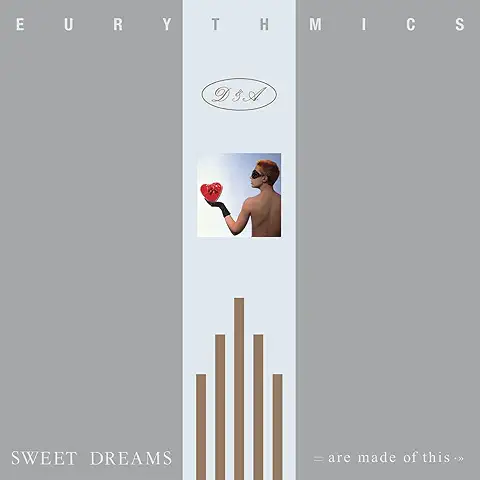
| Album | Sweet Dreams (Are Made of This) |
| Peak Chart Position | #1 Billboard Hot 100 / #2 UK |
| Genre | Synth-Pop, New Wave |
Table of Contents
What Is “Sweet Dreams (Are Made of This)” About?
The lyric operates on two levels simultaneously: a philosophical observation about human desire and a personal account of resilience in the face of frustration.
The refrain “everybody’s looking for something” functions as both an anthropological statement and a direct reflection of where Lennox and Stewart found themselves when they wrote it.
The verses catalogue the ways people use and are used by others — the song’s perspective is clear-eyed rather than cynical, acknowledging the mechanics of ambition and disappointment without judgment.
Lennox has said the lyric emerged from a genuine place of tiredness and determination, the product of a period when she was uncertain whether the music she was making would ever find an audience.
The song does not resolve into hope or despair — it simply names the condition of wanting something just out of reach and presses on.
How the Song Came Together
By late 1982, Lennox and Stewart were recording in a converted eight-track home studio, working without a budget or label commitment.
Stewart has described the writing of “Sweet Dreams” as one of those sessions where something arrives unexpectedly — he picked up the synthesiser during a tense moment between them and began playing the now-iconic riff.
Lennox heard it, moved to the microphone, and began constructing the melody and words more or less simultaneously.
The whole track was assembled in a single extended session, and neither of them immediately understood what they had made.
Dave Stewart and the Roland SH-101
The central riff of “Sweet Dreams” was played on a Roland SH-101 synthesiser, an analogue monosynth that Stewart had acquired cheaply.
The pattern is repetitive and almost mechanical, but Stewart’s voicing of it gave the line a weight and insistence that made it immediately memorable.
The production is deliberately sparse — layers of synthesiser, a drum machine, and very little else — which gave Lennox’s vocal the space it needed to dominate the recording without competing against a dense arrangement.
Stewart’s instinct to leave the mix wide rather than fill it would prove to be one of the most consequential production decisions either of them made.
Annie Lennox’s Vocal
Lennox delivered the vocal in a register and with a control that was unlike anything dominating pop radio at the time.
Her voice is cool and precise on the verses, then expands into something more open and searching on the chorus — a shift that gives the track its emotional centre without ever becoming obviously emotive.
The combination of her vocal texture and the electronic backdrop created a contrast that was striking: human warmth against a cold machine pulse.
That contrast became the defining sonic identity of Eurythmics across the decade that followed.
The Road to Release
RCA Records released the Sweet Dreams (Are Made of This) album in January 1983, and the title track was initially not the lead single in all markets.
The song gained traction in the United States after radio stations in Cleveland began playing it heavily, generating a listener response that convinced the label to push it nationally.
Stewart has said that he and Lennox learned of the song’s American success from a pay phone in London, having heard very little from the label for weeks.
The track eventually reached number one on the Billboard Hot 100 in August 1983, more than six months after the album was released.
Chart Performance
“Sweet Dreams (Are Made of This)” reached number two on the UK Singles Chart — kept from the top spot by a single from The Police — and number one on the Billboard Hot 100 in the United States.
The track also charted in West Germany, Australia, Canada, and across most of Western Europe.
The album of the same name peaked at number three on the UK Albums Chart and reached the top twenty in the United States.
The success transformed Eurythmics’ commercial position almost overnight and secured them a recording future that had been genuinely uncertain only months before.
The Music Video
The video for “Sweet Dreams (Are Made of This)” was one of the most distinctive images to appear on MTV in 1983.
Lennox appeared with cropped orange hair, a dark suit, and an expression that challenged any easy reading of her gender or mood — assertive, detached, entirely in control of the frame.
The video intercuts boardroom imagery, a cow in a field, and performance footage in a way that resists any straightforward interpretation but lodges itself in the memory regardless.
Lennox’s visual presentation sparked widespread discussion about gender expression in pop music at a moment when those conversations were not yet common.
Her image from the “Sweet Dreams” video became one of the most referenced visual moments of the decade.
Critical Reception and Legacy
Critics praised Sweet Dreams (Are Made of This) for its originality and for the precision of its production, which felt modern in a way that most British synth-pop of the period did not.
In subsequent decades, the track has appeared on virtually every major list of the greatest songs of the 1980s and has been covered or sampled more than almost any other single from the era.
Marilyn Manson’s 1995 industrial rock version introduced the song to a new generation and reached the Top 40 in the United States.
The original remains the standard against which every version is measured.
Why Sweet Dreams (Are Made of This) Still Matters
“Sweet Dreams (Are Made of This)” endures because it arrived from a genuine place — desperation, exhaustion, and the refusal to stop working despite both — and that honesty is audible in every element of the recording.
The riff is as inescapable now as it was in 1983, Lennox’s vocal has not dated, and the lyric’s central observation — that everyone is looking for something — has not become less true.
The song was built from very little and became one of the most recognised pieces of music the decade produced.
That is not a small thing, and it accounts for the kind of staying power that most pop music never achieves.
Frequently Asked Questions
Who wrote “Sweet Dreams (Are Made of This)”?
Annie Lennox and Dave Stewart wrote and produced the song together during a home recording session in late 1982.
Did “Sweet Dreams” reach number one?
The track reached number one on the Billboard Hot 100 in the United States in August 1983. In the UK it peaked at number two.
What synthesiser is used on “Sweet Dreams”?
Dave Stewart played the central riff on a Roland SH-101, an analogue monosynth.
What is the “Sweet Dreams” music video about?
The video blends boardroom imagery, a cow in a field, and performance footage. Annie Lennox appeared with cropped orange hair and an androgynous look that challenged gender expectations and became one of the most discussed visual moments of the MTV era.
What album is “Sweet Dreams” on?
It appears on the second Eurythmics album, also titled Sweet Dreams (Are Made of This), released in January 1983.
You Might Also Like



More than forty years after its release, Sweet Dreams (Are Made of This) by Eurythmics remains one of the most enduring records of the synth-pop era — a song built from almost nothing that became one of the most recognised pieces of music the 1980s produced.