

Money for Nothing by Dire Straits is the defining guitar anthem of 1985.
It satirised the music industry from the inside while becoming one of the decade’s most dominant recordings.
Written by Mark Knopfler with assistance from Sting, Money for Nothing reached number one on the US Billboard Hot 100.
It won the Grammy for Best Rock Performance by a Duo or Group in 1986.
Affiliate Disclosure: I am an Amazon affiliate and if you purchase through any amazon links on this site i may earn a small commission at no extra charge to you.
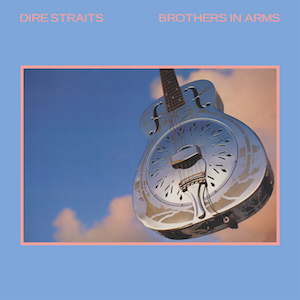
Produced by Knopfler and Neil Dorfsman, Brothers in Arms was one of the first albums built around the commercial potential of the compact disc.
It sold over 30 million copies worldwide and remains one of the best-selling albums of the 1980s.
| Song Title | Money for Nothing |
| Artist | Dire Straits |
| Album | Brothers in Arms (1985) |
| Released | 1985 (single) |
| Written By | Mark Knopfler, Sting |
| Producer | Mark Knopfler, Neil Dorfsman |
| Label | Vertigo Records |
| Chart Peak | #1 US Billboard Hot 100 |
Table of Contents
- What Is Money for Nothing About?
- The Vibe: Genre, Mood, and Search Intent
- Behind the Lyrics: The Story of Money for Nothing
- Technical Corner: Instruments and Production
- Legacy and Charts: Why This Classic Still Matters
- Listener’s Note: A Personal Take
- Watch: Money for Nothing by Dire Straits
- Collector’s Corner: Own a Piece of Rock History
- Frequently Asked Questions About Money for Nothing
- You Might Also Like
What Is Money for Nothing About?
Money for Nothing is written from the perspective of a working-class man watching music videos on television.
The narrator delivers refrigerators and appliances for a living.
He watches rock musicians on MTV and cannot understand why they receive fame and wealth for what appears to him to be little effort.
The lyric is laced with the resentment and confusion of someone who works physically hard for modest pay.
Knopfler lifted the voice and much of the language directly from a man he overheard in an appliance store in New York.
The narrator’s dismissive attitude toward rock music is the central irony of the song.
It became a massive MTV hit performed by the very musicians the narrator would have scorned.
Money for Nothing works because Knopfler does not judge the narrator.
He presents the perspective faithfully and lets the irony do its own work.
The Vibe: Genre, Mood, and Search Intent
The guitar intro is one of rock’s great slow builds, a riff that takes its time establishing itself before the full band arrives.
- Genre: Rock, Blues Rock, Pop Rock
- Mood: Sardonic, Driving, Powerful
- Tempo: Midtempo (~134 BPM)
- Best For: 1980s rock playlists, guitar rock collections, MTV era classics
- Similar To: Dire Straits “Sultans of Swing”, The Police “Every Breath You Take”, Tom Petty “American Girl”
- Fans Also Search: Dire Straits discography, Brothers in Arms album, Mark Knopfler guitar, 1980s rock radio
Behind the Lyrics: The Story of Money for Nothing
Mark Knopfler was in a New York appliance store when he overheard a delivery man watching the televisions.
They were all tuned to MTV.
The man made comments about the musicians he saw that Knopfler recognised as the raw material for a song.
He wrote it quickly after returning home.
He captured the voice and attitude of the overheard man as precisely as he could.
Sting contributed the “I want my MTV” refrain.
The phrase worked as both a satirical comment and an endorsement of the channel that would make the video famous.
MTV chose it as the first clip when the channel launched in Europe.
The video used groundbreaking computer-generated animation that was unlike anything seen on music television at the time.
Brothers in Arms was released in May 1985 and entered the charts immediately.
The single reached number one in the United States in August 1985 and remained there for three weeks.
The album spent nine weeks at number one in the UK.
It became a global commercial phenomenon.
Technical Corner: Instruments and Production
Mark Knopfler’s guitar playing on Money for Nothing is technically remarkable for a specific reason.
He plays almost entirely with his fingers rather than a pick.
This gives his guitar tone a warmth and attack unlike any other major rock guitarist of his era.
The main riff is built around a distorted tone that Knopfler achieved through a Mesa/Boogie amplifier set to specific parameters he has never fully disclosed.
The resulting sound is immediately recognisable and has been imitated but never precisely replicated.
The rhythm section provides a steady, driving pulse underneath the guitar.
Neil Dorfsman’s production gives Brothers in Arms a clear, detailed sound that was specifically designed for the CD format.
The album was among the first where producers made decisions based on the dynamic range available on CD rather than vinyl.
This gave the recording a sonic quality that helped drive early CD adoption among rock listeners.
Sting’s vocal contribution is brief but structurally essential.
The “I want my MTV” phrase provides the melodic hook that makes the arrangement complete.
Legacy and Charts: Why This Classic Still Matters
Money for Nothing reached number one on the US Billboard Hot 100 in August 1985.
It won the Grammy for Best Rock Performance by a Duo or Group with Vocal at the 1986 ceremony.
The music video won the first MTV Video Music Award for Video of the Year.
Brothers in Arms has sold over 30 million copies and was for many years the best-selling CD in history.
The song’s irony has outlasted its original context.
The narrator’s complaint has become a cultural shorthand.
It is applied to any professional others perceive as not doing real work.
Money for Nothing also caused lasting controversy over language in its original lyric that some broadcast regulators have restricted.
Various broadcast regulators in different countries have restricted it at different times.
The recording endures because the guitar playing is genuinely extraordinary.
The satirical premise also remains sharp regardless of the era in which it is heard.
Listener’s Note: A Personal Take
The guitar intro is deceptive.
It starts quietly enough that you might think the song is going somewhere gentle.
Then the full riff arrives and changes the character of everything that came before it.
Knopfler never explains the narrator’s worldview.
He lets you hear it and form your own opinion, which is why the song has never stopped generating discussion about what it means and whether the irony lands the way the writer intended.
Watch: Money for Nothing by Dire Straits
Collector’s Corner: Own a Piece of Rock History
Dire Straits: Brothers in Arms (1985)
Own the album that gave the world Money for Nothing.
Original Vertigo Records pressings, remastered editions, and immersive audio releases available.
Frequently Asked Questions About Money for Nothing
Who wrote Money for Nothing?
It was written by Mark Knopfler, with Sting contributing the “I want my MTV” vocal hook.
Knopfler developed the lyric from a conversation he overheard in a New York appliance store.
What is Money for Nothing about?
The song is written from the perspective of a working-class appliance delivery man who watches rock musicians on MTV and resents their apparent effortless wealth.
The central irony is that the song itself became a massive MTV hit.
Did Money for Nothing reach number one?
Yes.
It reached number one on the US Billboard Hot 100 in August 1985 and held that position for three weeks.
What album is Money for Nothing on?
The song appears on Brothers in Arms, Dire Straits’ fifth studio album.
Released in May 1985, it became one of the best-selling albums of the decade and one of the first major commercial successes built on CD sales.
Why did it win a Grammy?
The song won the Grammy for Best Rock Performance by a Duo or Group with Vocal at the 1986 ceremony.
The award recognised its commercial impact and the quality of the performance and production.
What was significant about the music video?
The video used pioneering computer-generated animation that was unlike anything seen on music television at the time.
It won the first MTV Video Music Award for Video of the Year and was chosen by MTV Europe as the first video aired when the channel launched.
Who produced Money for Nothing?
It was produced by Mark Knopfler and Neil Dorfsman.
The production approach was specifically tailored to demonstrate the superior sound quality of the compact disc format.
Is the song still played on radio?
Yes, though various edited versions exist.
The original lyric contains language that some broadcast regulators have restricted, leading to multiple versions with different edits for different markets.
You Might Also Like
Dire Straits: Sultans of Swing (1978)
The debut single that introduced Knopfler’s finger-picking guitar style to the world.
Sultans of Swing and Money for Nothing together define the range of what Dire Straits were capable of across seven years of recording.
The Police: Every Breath You Take (1983)
Sting’s other defining moment of the early 1980s, a recording that demonstrated his ability to embed a dark idea inside a commercially perfect melody.
Both songs show how the best British rock of the era combined craft with irony.
David Bowie: Let’s Dance (1983)
The other great British rock crossover of the early 1980s, produced to the same standard of commercial precision.
Let’s Dance belongs to the same tradition of serious craft applied to mainstream commercial rock, and appeared just two years earlier.
Decades on, Money for Nothing by Dire Straits endures as one of the greatest songs in classic rock history, a recording that has outlasted trends and generations to remain as vital and sardonic as the day it was made.