

Roger Glover is one of rock music’s most complete bassists, a Welsh-born musician who spent over five decades shaping the sound of Deep Purple from the inside out.
He joined Deep Purple in 1969 and immediately became the band’s low-end anchor, its in-studio architect, and one of its most reliable creative forces.
His fingerprints are on some of the greatest hard rock recordings ever made, including the albums that defined a genre and established Deep Purple as one of the most influential bands in history.
This is the complete story of Roger Glover: bassist, producer, songwriter, and one of the quiet giants of classic rock.
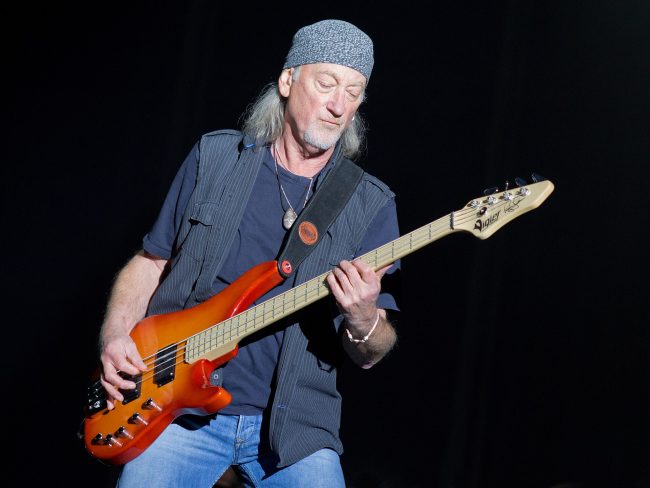
Image credit: Wikimedia Commons
📋 Table of Contents [+]
Early Life and Musical Roots
Roger David Glover was born on November 30, 1945, in Brecon, Powys, Wales.
His family moved to the South Kensington area of London when he was around nine years old, and the city’s music scene would shape everything that came next.
By the age of thirteen, Glover had picked up a guitar, drawn in by the rock and roll sounds that were beginning to electrify British youth in the late 1950s.
His early musical education was informal, built on listening, watching, and playing along to records in whatever band situation presented itself.
Growing up in London placed him close to a thriving circuit of local bands, and it was through this network that his first real musical partnerships would form.
The bass guitar eventually became his primary instrument, not because of formal training but because the role suited his instincts as both a listener and a team player.
He gravitated toward bassists who said something musically without getting in the way, and that philosophy would define his approach for the next six decades.
💡 Did You Know?
Roger Glover grew up listening to Jack Bruce, John Entwistle, and Tim Bogert, but he credits Paul McCartney as the bassist who had the most impact on him. He admired McCartney’s ability to serve the song with melodic, lyrical bass lines that never overshadowed the rest of the music.
Episode Six: Where It All Began
In the early 1960s, Glover formed a band called the Madisons with school friends in North London.
The Madisons eventually merged with another local group called the Lightnings, and the combined unit began performing on the London club circuit.
By late 1963, the group had renamed themselves Episode Six, and over the following years they would release a string of singles without achieving the commercial breakthrough they were chasing.
Episode Six cycled through personnel changes, and it was during this period that a young vocalist named Ian Gillan joined the band as frontman.
Gillan’s powerful voice gave Episode Six a serious asset, and the Glover-Gillan creative partnership that would later define Deep Purple’s greatest era quietly took root in these early years.
The band released more than a dozen singles between 1966 and 1969, moving stylistically from pop to psychedelia to early progressive rock, but commercial success remained just out of reach.
When Deep Purple came knocking in 1969, the end of Episode Six was at hand.
Roger Glover Joins Deep Purple
Roger Glover’s path into Deep Purple was not a straightforward audition.
Deep Purple had initially approached Ian Gillan for the vocalist role, and it was Gillan who later brought Glover into the picture.
As Glover has described, Gillan called him and said that the band was looking for songs, so Glover came in to play them some of what he and Gillan had been writing.
Jon Lord heard Glover play and offered him the bass position that same night, though Glover initially turned it down.
He eventually accepted the offer, and both Gillan and Glover made their Deep Purple debut on the 1970 album Deep Purple in Rock.
The arrival of Gillan and Glover completed what became known as the Mark II lineup: Gillan on vocals, Ritchie Blackmore on guitar, Jon Lord on keyboards, Glover on bass, and Ian Paice on drums.
That lineup would produce the most celebrated work in Deep Purple’s career.
The Mark II Era: Peak Creative Power
The Mark II lineup hit the ground running, and Roger Glover was immediately central to the band’s creative output.
Deep Purple in Rock, released in June 1970, was a ferocious debut for the new lineup and announced a harder, more aggressive Deep Purple to the world.
Glover’s bass work on that record was punchy, locked in, and rhythmically inventive without being showy, exactly the kind of playing the band needed as the riff-heavy arrangements grew louder and more complex.
He contributed to the songwriting process throughout this period, co-writing tracks and helping shape the sonic character of the band in the studio.
The follow-up album, Fireball, arrived in 1971 and reached number one in the UK, further cementing the band’s status as one of Britain’s heaviest acts.
Live performances during this era were legendary, built on extended improvisation and raw power, qualities that Glover supported from below with a bass tone that was both warm and authoritative.
Glover has spoken about how Deep Purple was fundamentally a jamming band, a group that thrived on spontaneity rather than rehearsed solos, and his bass playing reflected that live-wire energy.
💡 Did You Know?
Roger Glover is credited with coming up with the title “Smoke on the Water” for the now-legendary track on Machine Head. He witnessed the fire at the Montreux Casino from across Lake Geneva during the recording sessions in December 1971, and the phrase stuck with him as the perfect way to describe the scene.
Machine Head and Beyond
The Machine Head sessions in late 1971 were where Roger Glover’s role as studio anchor came into sharpest focus.
Recorded in Montreux, Switzerland, using the Rolling Stones’ mobile recording truck after a fire destroyed the original venue, the sessions produced one of the most iconic hard rock albums ever made.
The bass lines throughout Machine Head are precise and muscular, providing an unshakeable foundation beneath Blackmore’s guitar and Lord’s organ.
Highway Star opens the album with one of rock’s most explosive first minutes, and Glover’s bass locks into Paice’s drums with the kind of synchronicity that holds the whole thing together.
The track that became the band’s signature, Smoke on the Water, features one of rock’s most recognizable bass grooves, steady and supportive beneath the immortal guitar riff.
Lazy showcases the band’s blues instincts and Glover’s ability to sit deep in a groove while the soloists wander freely above him.
Machine Head reached the top ten in several countries and became the commercial and artistic peak of the Mark II era.
Departure and Life After Deep Purple (1973-1978)
Personality conflicts within the band, particularly tensions between Glover and guitarist Ritchie Blackmore, led to Glover’s departure from Deep Purple in mid-1973.
His exit came during a turbulent period for the band, and the lineup that followed, known as Mark III, replaced both Glover and Gillan with David Coverdale and Glenn Hughes.
Rather than retreating, Glover moved into record production, an area where his studio instincts and musical intelligence proved immediately valuable.
He produced albums for Judas Priest, Nazareth, and Elf during this period, developing a reputation as a producer with a strong ear for hard rock arrangements.
Status Quo also worked with Glover, and his production credits from this era represent a significant body of work that extended well beyond his own bands.
He also collaborated closely with former bandmate Ian Gillan on various projects during this time, the Glover-Gillan axis remaining creatively active even after their shared exit from Deep Purple.
In 1978, Glover released his first solo album, Elements, a more experimental and atmospheric record that showed a different side of his musical personality.
Roger Glover and Rainbow (1979-1984)
Roger Glover rejoined forces with Ritchie Blackmore in 1979, signing on as bassist and contributing songwriter for Rainbow, Blackmore’s post-Deep Purple band.
The reunion of Glover and Blackmore was notable given the tensions that had ended their first working relationship, but both men put that history aside for the sake of the music.
Glover worked on four Rainbow studio albums between 1979 and 1983: Down to Earth, Difficult to Cure, Straight Between the Eyes, and Bent Out of Shape.
His role extended beyond playing bass, as he contributed to songwriting, arrangements, and production across the Rainbow catalog during this period.
Working with singers of the calibre of Graham Bonnet and Joe Lynn Turner gave Glover experience with a range of vocal approaches, all of which fed back into his development as a producer and arranger.
By 1983, Glover was also working on his third solo album, Mask, which was released in 1984.
That same year, the call came to rejoin Deep Purple for the reunion that rock fans had been waiting for.
The Butterfly Ball and Solo Work
One of the most unexpected chapters in Roger Glover’s career came in 1974 with The Butterfly Ball and the Grasshopper’s Feast.
Glover wrote the music for this ambitious concept album, a project based on a children’s book by William Plomer that was later staged as a spectacular event at the Royal Albert Hall in London.
The album featured Ronnie James Dio on vocals, and the track “Love is All” became a genuine UK hit single, reaching the top twenty.
The Butterfly Ball showed Glover’s range as a composer, moving far beyond the power trio arrangements of Deep Purple into orchestral, theatrical, and whimsical musical territory.
The Royal Albert Hall concert was a landmark event, an indication of Glover’s ambition to work on a grander creative canvas than Deep Purple alone allowed.
His collaborative instincts and willingness to work across different genres would remain a consistent thread throughout his career outside the main band.
💡 Did You Know?
When Deep Purple disbanded in 1975, Roger Glover was appointed head of A&R at Purple Records, the band’s own label. In this role he signed and developed artists beyond his production work, operating as a full executive in the music industry while continuing to pursue his own creative projects.
Roger Glover Returns to Deep Purple (1984)
Roger Glover returned to Deep Purple in April 1984, reuniting with Ian Gillan, Ritchie Blackmore, Jon Lord, and Ian Paice to reform the classic Mark II lineup.
The reunion was one of the most anticipated events in rock history, coming nearly a decade after the band’s original dissolution.
The decision to bring both Gillan and Glover back meant the band had its most creatively potent lineup intact for the first time since the early 1970s.
To prepare mentally for the reunion, Glover played through a collection of Deep Purple bootlegs he had accumulated over the years, using them to remind himself what made the band special.
He has spoken about how those recordings made him realize that Deep Purple’s greatness lay in its spontaneity, in the fact that nobody ever quite knew what was going to happen next on stage.
That understanding shaped his approach to the reunion recordings, keeping the improvisational spirit alive even in a more polished studio context.
Perfect Strangers and the Comeback
The reunion album, Perfect Strangers, was released in October 1984 and proved that the Mark II lineup had lost none of its power.
It reached the top five in several countries and demonstrated that the band’s audience had remained loyal through the intervening years.
The title track and “Knocking at Your Back Door” became instant classic rock staples, and Glover’s bass work throughout the album was as assured and purposeful as it had ever been.
The accompanying world tour sold out arenas across the globe and confirmed that Deep Purple’s comeback was not merely nostalgic but creatively vital.
Glover remained with the band through subsequent lineup changes, including the departure of Gillan in 1989 and the brief tenure of Joe Lynn Turner on Slaves and Masters.
When Gillan returned in 1992 for The Battle Rages On, Glover was still in place, the most consistent creative bridge between the band’s classic era and its later output.
He has now been a member of Deep Purple for well over four continuous decades, making him one of the band’s longest-serving members alongside Ian Paice.
Roger Glover as Producer
Roger Glover’s production career represents a significant contribution to rock music that often gets overlooked beside his role as a bass player.
His work with Judas Priest in the early 1970s helped shape that band’s early sound before they became one of metal’s defining acts.
He produced Nazareth’s Hair of the Dog album in 1975, which contains the band’s signature cover of “Love Hurts,” one of the most recognizable power ballads in rock history.
His sessions with Status Quo, Elf, and various other hard rock acts during the 1970s gave him a broad understanding of how to capture live energy in a studio environment.
Glover’s production philosophy reflected his playing philosophy: serve the song, support the arrangement, and never let ego get in the way of the best outcome for the music.
His experience as a producer also informed the way he operated within Deep Purple’s recording sessions, where his ability to listen critically to the full band arrangement made him an invaluable creative contributor beyond the bass chair.
For an overview of how Glover fits into the band’s full story, the Members of Deep Purple hub covers every member and era in detail.
Roger Glover’s Continued Legacy with Deep Purple
Roger Glover has toured and recorded with Deep Purple consistently since the 1984 reunion, contributing to albums including The House of Blue Light, Slaves and Masters, The Battle Rages On, Purpendicular, Abandon, Bananas, Rapture of the Deep, Now What?!, InFinite, Whoosh!, and Turning to Crime.
That catalog of post-reunion work spans four decades of recording and represents a remarkable second act for a band that many assumed had said everything it had to say.
Deep Purple was inducted into the Rock and Roll Hall of Fame in 2016, with Roger Glover among the inductees, a formal recognition of the band’s lasting importance in rock history.
On the 2021 album Turning to Crime, Glover performed co-lead vocals on “The Battle of New Orleans,” the first time he had sung any part on a Deep Purple studio record.
His side project work has continued alongside Deep Purple, including a second Guilty Party album in 2011 called If Life Was Easy, which featured guest appearances from Nazareth’s Dan McCafferty and Pete Agnew.
He has also contributed to tribute projects and guest appearances, including a bass performance on Gov’t Mule’s The Deep End in 2001, a tribute album dedicated to the late Allen Woody.
Glover keeps a close eye on the Deep Purple 2026 tour schedule, as the band continues its extended farewell run of live dates.
Roger Glover’s Bass Gear Through the Years
Roger Glover’s gear choices reflect a pragmatic, tone-first approach rather than collector obsession or brand loyalty.
During his early years with Deep Purple, he played Fender Precision and Fender Mustang basses, instruments known for their solid, punchy midrange character that cut through the dense live mix.
He also used a Rickenbacker 4001 during this period, a bass associated with the progressive and hard rock sounds of the era.
In the late 1970s, Glover switched to a Gibson Thunderbird, bringing a darker, more resonant tone to his Rainbow-era recordings.
During the mid-1980s, he used Peavey Foundation basses modified with Peavey Fury necks, a practical choice that prioritized playability over prestige.
Since the mid-1990s, Glover has been associated with Vigier Bass Guitars, a French brand known for their stability, precision, and modern playing feel.
He has stated that he prefers the Fender Precision for studio work due to its meatier tone, while using the Vigier live for its precise high-end response and comfort across the full neck.
His amplification has centered on SWR heads and cabinets for an extended period, with Picato and Ernie Ball strings completing his signal chain.
People Also Ask
How long has Roger Glover been with Deep Purple?
Roger Glover first joined Deep Purple in 1969 and left in 1973, then rejoined in 1984 when the band reformed its classic Mark II lineup. His cumulative time with Deep Purple exceeds four decades of continuous membership since the 1984 reunion, making him one of the longest-serving members in the band’s history.
What is Roger Glover known for?
Roger Glover is best known as the bassist and songwriter for Deep Purple, particularly during the Mark II era that produced Machine Head, Deep Purple in Rock, and Fireball. He is also recognized as a successful record producer who worked with Judas Priest, Nazareth, and Status Quo, and as the composer of The Butterfly Ball and the Grasshopper’s Feast, which yielded a top twenty UK hit single in 1974.
What bands has Roger Glover been in?
Roger Glover began in Episode Six alongside Ian Gillan before joining Deep Purple in 1969. After leaving Deep Purple in 1973, he reunited with Ritchie Blackmore in Rainbow from 1979 to 1984. He also pursued solo projects under his own name and as Roger Glover and the Guilty Party. He has been a member of Deep Purple continuously since the 1984 reunion.
What bass does Roger Glover play?
Roger Glover has used several basses throughout his career, including Fender Precision, Fender Mustang, Rickenbacker 4001, Gibson Thunderbird, and Peavey Foundation basses. Since the mid-1990s, he has primarily used Vigier Bass Guitars on stage, while preferring Fender Precision basses for studio recording. He runs his signal through SWR heads and cabinets with Picato and Ernie Ball strings.
Who did Roger Glover produce?
Roger Glover has produced albums for Judas Priest, Nazareth, Elf, and Status Quo, among others. His most notable production credit outside Deep Purple is Nazareth’s Hair of the Dog album from 1975, which contains the power ballad “Love Hurts” and became one of the band’s defining records. He also produced material for several Rainbow albums during his time with that band.
Is Roger Glover in the Rock and Roll Hall of Fame?
Yes, Roger Glover was inducted into the Rock and Roll Hall of Fame in 2016 as a member of Deep Purple. The induction recognized the band’s enormous influence on hard rock and heavy metal, and came after years of campaigning by fans who felt Deep Purple had been unjustly overlooked by the institution.
Watch: Roger Glover Interview
In this interview, Roger Glover discusses Deep Purple bootlegs, progressive rock, and shares his thoughts on Black Sabbath and Led Zeppelin, offering candid insight into the band’s era and his own musical perspective.
Essential Deep Purple Albums Featuring Roger Glover
Affiliate Disclosure: I am an Amazon affiliate and if you purchase through any amazon links on this site i may earn a small commission at no extra charge to you. This helps support classicrockartists.com and allows me to keep providing deep-dive content on the legends of rock. Thank you for your support!
As an Amazon Associate, I earn from qualifying purchases.

Machine Head
1972 — The Crown Jewel
Essential listening
Contains Smoke on the Water, Highway Star, and Lazy. Roger Glover’s bass anchors every track with commanding precision.

Perfect Strangers
1984 — The Comeback Album
Essential listening
The triumphant Mark II reunion. Glover’s bass work is mature and authoritative, perfectly suited to the album’s epic scope.

Deep Purple in Rock
1970 — Where It Began
Essential listening
Roger Glover’s debut with the Mark II lineup. Child in Time and Speed King show a band operating at full ferocious power.

The Very Best of Deep Purple
Best-Of Compilation
Essential listening
The definitive single-disc entry point to Roger Glover’s work with Deep Purple. Every essential track in one place.
You Might Also Like
Roger Glover remains one of the most important figures in Deep Purple’s long story, a bassist who never played to impress and always played to serve the song, and that distinction is precisely what made him so effective for so long.
His career arc, from a Welsh kid playing in a North London pub band to a Rock and Roll Hall of Fame inductee with over 100 million album sales to his credit, tells the story of someone who understood the music from the inside and never lost sight of what made it work.
To explore the full lineage of the band he helped define, read the complete history at Members of Deep Purple.
Roger Glover is not the loudest or most flashy bass player in rock history, but he may well be one of the most essential.