
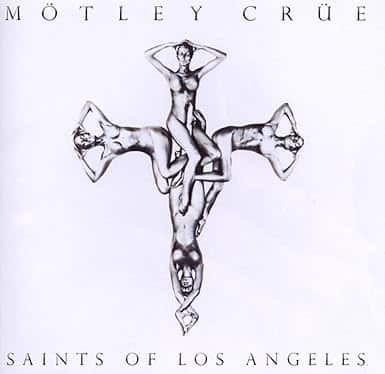
Saints of Los Angeles by Mötley Crüe: 2008 Album Review
Saints of Los Angeles arrived on June 24, 2008, as the ninth studio album from Mötley Crüe and the first record the original four-piece had made together since Generation Swine eleven years earlier.
Tommy Lee was back behind the kit.
The Sunset Strip mythology was back as the subject matter.
And underneath the reunion story was something more complicated: a producer who played most of the guitar while the credited guitarist received full sleeve credit, a working title that got scrapped, and a promotional strategy built partly on downloadable video game content.
The album debuted at number four on the Billboard 200, sold roughly 100,000 copies in its opening week, and earned the band their third Grammy nomination.
What it did not do was resolve the tensions that had been building since the Generation Swine sessions a decade before.
Buy on Amazon
Affiliate Disclosure: I am an Amazon affiliate and if you purchase through any amazon links on this site i may earn a small commission at no extra charge to you. This helps support classicrockartists.com and allows me to keep providing deep-dive content on the legends of rock. Thank you for your support!
Quick Navigation
- Saints of Los Angeles: Album Overview
- How Saints of Los Angeles Got Made
- Full Tracklist and Track-by-Track Guide
- 1. L.A.M.F.
- 2. Face Down in the Dirt
- 3. What’s It Gonna Take
- 4. Down at the Whisky
- 5. Saints of Los Angeles (Gang Vocal)
- 6. Mutherfucker of the Year
- 7. The Animal in Me
- 8. Welcome to the Machine
- 9. Just Another Psycho
- 10. Chicks = Trouble
- 11. This Ain’t a Love Song
- 12. White Trash Circus
- 13. Goin’ Out Swingin’
- Singles and Chart Performance
- The Grammy Nomination for Saints of Los Angeles
- Crüe Fest 2008: The Tour Behind Saints of Los Angeles
- The Rock Band and Gaming Crossover
- Critical Reception
- Why Saints of Los Angeles Is More Complicated Than It Looks
- What Happened After Saints of Los Angeles?
- FAQs About Saints of Los Angeles
- Where to Buy and Stream Saints of Los Angeles
- You Might Also Like
Saints of Los Angeles: Album Overview
Saints of Los Angeles was released on June 24, 2008, on Mötley Records, the band’s own imprint distributed through Eleven Seven Music.
The album was produced by James Michael, Nikki Sixx, and DJ Ashba, and recorded at The Lightning Bolt Garage in Los Angeles in 2007 and 2008.
It runs 44 minutes and 3 seconds across 13 tracks.
The album debuted at number four on the Billboard 200, hit number one on both the US Independent Albums and US Hard Rock Albums charts, and reached number two on the US Top Rock Albums chart.
Canada certified it Gold; Sweden placed it at number five.
As of 2026, Saints of Los Angeles remains the band’s most recent studio album, a position it has held for over 16 years.
For the full arc of every member’s career before and after this record, the complete story of Mötley Crüe’s members covers the timeline in depth.
How Saints of Los Angeles Got Made
Tommy Lee Returns: The Full Lineup Reunion
Tommy Lee had left Mötley Crüe in 1999 following his assault conviction and four-month jail sentence.
He was replaced first by Randy Castillo, who died of cancer in February 2002, then by Samantha Maloney for part of the New Tattoo touring cycle, and then by Bryan Hitt for additional dates.
The 1994 self-titled album with John Corabi had already shown the band could record without Lee; the New Tattoo era showed they could tour without him too.
Saints of Los Angeles was the first studio recording to bring the original four members back into the same room since Generation Swine in 1997, an eleven-year gap that gives every track on the album a charged quality the band had not captured in years.
The Album Originally Called The Dirt
The working title for this record was The Dirt, borrowed directly from the band’s bestselling 2001 autobiography of the same name.
The title was scrapped before release, but the concept was not: Nikki Sixx described the album as “loosely based on The Dirt,” with each song functioning as a mini-story that can be plugged back into the book’s narrative.
“Face Down in the Dirt,” “Down at the Whisky,” and “Saints of Los Angeles” itself are the clearest examples of that approach, each referencing a distinct chapter in the band’s mythology.
Renaming the album removed the direct link to the book but preserved the storytelling framework that gives the record its structural coherence.
The Sixx:A.M. Team Takes Over Production
The creative infrastructure behind Saints of Los Angeles came almost entirely from Sixx’s side project, James Michael, a vocalist and keyboardist, co-produced and co-wrote across the album alongside Sixx and DJ Ashba, then serving as Sixx:A.M.’s guitarist.
Marti Frederiksen also co-wrote on several tracks, bringing an Aerosmith-honed instinct for radio-ready structure that shapes the album’s better moments.
Frederiksen had previously co-written songs for Aerosmith’s Nine Lives and Just Push Play, and his experience in constructing melodic hard rock songs with commercial anchors is audible throughout Saints of Los Angeles.
The result was an album written and produced by a team that operated as a unit, with the Mötley Crüe brand providing the framework and the Sixx:A.M. engine doing much of the creative work.
Mick Mars Sidelined, Again
Mick Mars received full band-member credit on Saints of Los Angeles, but the guitar work on the record was performed largely by DJ Ashba.
This mirrors exactly what happened on Generation Swine in 1997, when session musicians replaced virtually all of Mars’s contributions while he remained credited on the sleeve.
Nikki Sixx later confirmed the situation publicly, stating that Mars “couldn’t play his parts or remember his parts” in the studio.
That statement, made years after the album’s release, reframed the entire Saints of Los Angeles narrative and foreshadowed the legal dispute detailed in the coverage of the Mick Mars and Mötley Crüe feud.
The pattern across two albums, 1997 and 2008, draws a direct line between the Generation Swine sessions and the eventual 2022 split.
Saints of Los Angeles: Full Tracklist and Track-by-Track Guide
All 13 tracks were written by Nikki Sixx, James Michael, DJ Ashba, and Marti Frederiksen, except where noted.
The standard edition runs 44 minutes and 3 seconds.
1. L.A.M.F. (1:23)
The album opens with a spoken word piece rather than a proper song, and the title tells you exactly what kind of record you are about to hear.
L.A.M.F. stands for “Like A Mother F**ker,” a phrase rooted in the New York punk scene of the 1970s, specifically the Heartbreakers’ 1977 debut album of the same name.
Choosing this as the opening statement was a deliberate nod to punk’s outlaw lineage, linking Mötley Crüe’s self-mythology to a harder, rawer tradition than glam metal typically claims.
2. Face Down in the Dirt (3:44)
“Face Down in the Dirt” is the album’s true opening track and its clearest statement of intent.
The song retells the band’s origin story as a manifesto: four broke kids with nothing to lose arriving on the Sunset Strip and deciding that failure was not an option.
The production is punchy and direct, and the track establishes the album’s approach of treating the band’s own history as mythology worth celebrating rather than interrogating.
3. What’s It Gonna Take (3:45)
“What’s It Gonna Take” covers the period when the band was grinding to secure a record deal, pitching themselves to labels that were not yet sure what to do with four unhinged kids from Hollywood.
The frustration in the narrative translates cleanly into the track’s energy, and it is one of the better examples of the album’s concept of using individual songs as chapter summaries from the band’s history.
The Dr. Feelgood album from 1989 represented the commercial payoff of that grind, and the gap between the story this track tells and the position the band occupied in 1989 is enormous.
4. Down at the Whisky (3:50)
“Down at the Whisky” is a nostalgic portrait of the Sunset Strip headquarters where Mötley Crüe built their early reputation, night by night and set by set.
The Whisky a Go Go on Sunset Boulevard is as central to the band’s origin story as any song they have ever written, and this track makes that connection explicit.
It is one of the more melodic tracks on the record, built for an audience who already knows the story and wants to feel inside it.
5. Saints of Los Angeles – Gang Vocal Version (3:40)
The title track is the album’s commercial and conceptual center, the Grammy-nominated lead single and the song that does the most work to explain what the record is about.
According to Mick Mars, the song specifically references the band’s signing to Elektra Records, the moment four broke, loud, dangerous kids from the Sunset Strip became signed artists.
The “saints” is entirely ironic: these were not holy men, and the song knows it.
The album version opens with a recitation of the Lord’s Prayer before the gang vocals begin, a detail that almost never appears in standard reviews of the record.
The gang vocalists are Jacoby Shaddix of Papa Roach, Josh Todd of Buckcherry, Chris Taylor Brown of Trapt, and James Michael of Sixx:A.M., all of whom were Crüe Fest touring partners that summer.
The single version strips both the Lord’s Prayer and the backing vocalists out entirely.
6. Mutherfucker of the Year (3:55)
The second single is the album at its most direct: a hard rock anthem that states its thesis in the title and spends four minutes defending it.
It reached number 29 on the US Mainstream Rock chart after its August 25, 2008 release.
As a live track, it is consistently one of the louder moments in the band’s post-reunion set, built to be played at volume in large rooms.
7. The Animal in Me (4:16)
“The Animal in Me” is the album’s longest track and one of its most musically varied.
The song moves through tempo shifts that keep the four-minute runtime from feeling static, and it is among the tracks where the Sixx and Frederiksen collaboration produces something that sounds less like a formula and more like a real song with a shape.
It is not one of the record’s most-discussed tracks, but it rewards a close listen from anyone who approaches the album as more than a nostalgia exercise.
8. Welcome to the Machine (3:00)
Not the Pink Floyd composition, and the parenthetical clarification in the liner notes suggests the band was aware of the confusion risk.
Mötley Crüe’s “Welcome to the Machine” is a tight three-minute hard rock track without the elaborate prog structure its homonymous predecessor carried.
It sits at the midpoint of the album and functions as a divider between the record’s more narrative-driven first half and its slightly harder second half.
9. Just Another Psycho (3:36)
“Just Another Psycho” leans into the outlaw persona that the band has maintained since the first album, presenting the kind of character study that works better as music than it would as a screenplay.
The track is one of the album’s harder moments, with a guitar tone that pushes against the cleaner production choices elsewhere.
It is also one of the tracks where the influence of the Sixx:A.M. production approach is least obvious, which may be why it sounds slightly different from its neighbors.
10. Chicks = Trouble (3:13)
“Chicks = Trouble” is a deliberate throwback to the bubblegum hard rock of the early 1980s, the kind of track that would have fit on Too Fast for Love or Theatre of Pain.
In 2008, it reads as affectionate nostalgia rather than regression, a brief detour into the band’s sleazier early sound in the middle of a more serious concept album.
Vince Neil’s vocal performance here is the most relaxed on the record, which suits the track’s deliberately lightweight intent.
11. This Ain’t a Love Song (3:25)
“This Ain’t a Love Song” was singled out by Billboard in its review as one of the album’s standout tracks, a sleaze anthem that captures the band’s mid-1980s energy without simply copying it.
The title is direct enough to be funny and the track is well-constructed, with a melodic chorus that anchors the harder verses.
It is the kind of song the record needed more of: confident, tight, and honest about exactly what it is.
12. White Trash Circus (2:51)
“White Trash Circus” became the album’s third single, released on February 25, 2009, and peaked at number 37 on the Mainstream Rock chart.
At under three minutes, it is one of the most compact tracks on the record, built around a riff that is punchy enough to justify the single status.
The official music video is embedded below.
13. Goin’ Out Swingin’ (3:27)
“Goin’ Out Swingin’” closes the album on a defiant note, consistent with the record’s overall tone of looking back at the band’s worst moments and framing survival itself as a form of victory.
The title says everything: whatever happened, whatever was lost, the band is not going quietly.
As a closing statement, it is honest about the kind of record Saints of Los Angeles is: a comeback record that knows it is a comeback record and is not embarrassed by that.
Singles and Chart Performance from Saints of Los Angeles
“Saints of Los Angeles” was released as the lead single on April 11, 2008, and peaked at number five on the US Mainstream Rock chart, the band’s second-highest charting single ever in that format.
The track was performed on Jimmy Kimmel Live! and Late Show with David Letterman, giving the reunion significant mainstream television exposure.
The official music video premiered at a press conference on April 15, 2008, and features cameos from Jacoby Shaddix, Josh Todd, Chris Taylor Brown, James Michael, and Norwegian singer Marion Raven, who appears as a dark-winged angel figure.
That Raven cameo goes entirely unmentioned in virtually every review of the album, despite being a notable visual element in one of the record’s most-watched videos.
“Mutherfucker of the Year” was released as the second single on August 25, 2008, and peaked at number 29 on Mainstream Rock.
“White Trash Circus” followed on February 25, 2009, reaching number 37.
The Grammy Nomination for Saints of Los Angeles
The title track was nominated for Grammy Award for Best Hard Rock Performance at the 51st Grammy Awards in 2009.
It was Mötley Crüe’s third Grammy nomination in that category.
The previous two were for Dr. Feelgood and Kickstart My Heart, both from the Dr. Feelgood album era, and both of which lost to Living Colour.
The “Saints of Los Angeles” nomination extended the streak: all three of the band’s Grammy nominations in the category ended in a loss.
The connection between all three is almost never made in a single article, even though it provides useful context for how consistently the band was recognized and how consistently they were passed over.
Details on the nomination can be found at the Wikipedia entry for the Saints of Los Angeles single.
Crüe Fest 2008: The Tour Behind Saints of Los Angeles
Saints of Los Angeles was supported by Crüe Fest, a multi-band festival touring package that ran through the summer of 2008 and featured Buckcherry, Papa Roach, Sixx:A.M., and Trapt on the bill.
The package was notable for having Sixx:A.M., Nikki Sixx’s own side project, as a featured act on the same tour the band was using to promote their own album.
The frontmen of all four supporting acts appeared together in the “Saints of Los Angeles” music video, making the video itself a promotional document for the tour package rather than simply a single release.
Further detail on the touring logistics and lineup is documented at the Crüe Fest Wikipedia entry.
The Rock Band Connection and Gaming Crossover
On the same day the single was released, April 11, 2008, “Saints of Los Angeles” became available as downloadable content on both Xbox Live Marketplace and the PlayStation Store.
The simultaneous day-and-date gaming release was a deliberate strategy to reach a younger audience that the band’s traditional promotional channels no longer reliably touched in 2008.
The track was also used in X-Games 14 promotional material, extending the reach further into action sports demographics.
This combination of gaming and extreme sports placement was unusual for a legacy classic rock act in 2008 and reflects a calculated approach to cultural relevance that most album reviews of Saints of Los Angeles completely ignore.
Critical Reception
The album received a Metacritic score of 54 out of 100, reflecting what the aggregator describes as mixed or average reviews.
Billboard noted “This Ain’t a Love Song” as a standout, calling it a sleaze anthem that captures the band’s early-period energy honestly.
The consensus from critics was that Saints of Los Angeles worked best as a functional hard rock record for the band’s existing fanbase, not as something that would attract new listeners or stand alongside the classic albums.
Fan reception was considerably warmer than critical reception, which is consistent with most Mötley Crüe releases across the catalog, where the critical and commercial readings have rarely agreed.
The AllMusic entry for Saints of Los Angeles provides the most thorough critical summary of the record’s contemporary reception.
Why Saints of Los Angeles Is More Complicated Than It Looks
Read as a straightforward comeback record, Saints of Los Angeles is easy to understand: the original lineup reunited, made a heavy rock album, released it on their own label, and charted well.
But the record is also the last studio document of a band in the process of fracturing at its core.
Mick Mars, whose guitar playing defined the sound of every great Mötley Crüe record from Shout at the Devil forward, barely played on the album that carries his name.
The Shout at the Devil era riff style that gave the band its original identity is largely absent from Saints of Los Angeles, replaced by something cleaner and more modern that reflects Ashba’s playing rather than Mars’s.
The record that was supposed to prove the original lineup could still function was, in a significant way, not actually performed by the original lineup.
That detail does not make Saints of Los Angeles a bad album, but it does make it a more honest document of where the band actually was in 2008 than any straightforward review has acknowledged.
What Happened After Saints of Los Angeles?
The band toured extensively on the back of Saints of Los Angeles through 2008 and into 2009.
In 2015, they signed a formal “cessation of touring” agreement, effectively announcing their retirement, and played a farewell tour.
They broke that agreement in 2019 and reunited for the Stadium Tour alongside Def Leppard, Poison, and Joan Jett.
Mick Mars retired from touring in 2022 due to Ankylosing Spondylitis, a degenerative spinal condition he has managed for decades.
He was subsequently dismissed from the band and filed a lawsuit, the fallout of which is detailed in the ongoing coverage of the Mick Mars and Mötley Crüe feud.
John 5, formerly of Rob Zombie and Marilyn Manson, replaced Mars as the touring and recording guitarist.
Vince Neil’s own health and activity is covered in the recent reporting on the Vince Neil stroke, Mötley Crüe Vegas comeback, and new collection.
The band has stated they are focusing on singles rather than full albums, making Saints of Los Angeles, as of 2026, the final studio entry in the catalog.
The Mötley Crüe 2026 Return of the Carnival of Sins Tour and the coverage of setlist changes on the 2026 tour track where the catalog is playing live right now.
FAQs About Saints of Los Angeles
What is Saints of Los Angeles about?
The album is loosely based on The Dirt, the band’s 2001 bestselling autobiography.
Each track functions as a mini-story drawn from a different chapter of Mötley Crüe’s history, from signing to Elektra Records to the early nights on the Sunset Strip to the band’s outlaw self-image.
Nikki Sixx described the concept as a record where every song “can be plugged into The Dirt.”
Did Mick Mars actually play guitar on Saints of Los Angeles?
Barely.
Mars received full band credit on the sleeve, but DJ Ashba performed the vast majority of the guitar work on the album.
Nikki Sixx later confirmed publicly that Mars “couldn’t play his parts or remember his parts” in the studio.
This mirrors exactly what happened on Generation Swine in 1997, when session musicians replaced Mars’s contributions in a similar fashion.
Who are the saints in Saints of Los Angeles?
According to Mick Mars, the title track specifically refers to the band’s signing to Elektra Records, four broke and reckless kids from the Sunset Strip who conned and willed their way into becoming rock stars.
The “saints” label is entirely ironic.
These were not holy men, and the song is fully aware of that.
Was Saints of Los Angeles commercially successful?
It was a qualified success.
The album debuted at number four on the Billboard 200 with roughly 100,000 first-week sales, hit number one on both the US Hard Rock and Independent Albums charts, and received a Grammy nomination.
The title single peaked at number five on Mainstream Rock, the band’s second-highest charting single ever in that format.
Follow-up singles underperformed, and the album received a mixed Metacritic score of 54.
What does L.A.M.F. stand for?
“Like A Mother F**ker.”
The acronym originated in the New York punk scene, specifically the Heartbreakers’ 1977 debut album L.A.M.F.
Using it as the opener for a comeback album was a deliberate tip to punk’s outlaw tradition, a lineage Mötley Crüe has always claimed as part of their DNA.
Was Saints of Los Angeles nominated for a Grammy?
Yes, the title track was nominated for Grammy Award for Best Hard Rock Performance at the 51st Grammy Awards in 2009.
It was Mötley Crüe’s third nomination in that category; the previous two, for “Dr. Feelgood” and “Kickstart My Heart,” both lost to Living Colour.
“Saints of Los Angeles” also lost, completing a three-nomination shutout for the band in that category.
Why is DJ Ashba credited on Saints of Los Angeles?
Ashba co-wrote, co-produced, and performed the majority of the guitar work across the album.
At the time of release, this was not publicly disclosed, and Mars received the lead guitar credit on the sleeve.
Ashba’s full role was confirmed by Sixx only after the Mars situation became public following the 2022 split.
More context on Ashba’s background and career is available at his Wikipedia entry.
Is Saints of Los Angeles the band’s last album?
Yes, as of 2026, Saints of Los Angeles remains the most recent Mötley Crüe studio album.
The band dissolved in 2015, reunited in 2019, released the single “Dogs of War” in 2024, but has not released another full-length studio album.
The official Mötley Crüe discography confirms the current catalog position.
What was the gang vocal version of Saints of Los Angeles?
The album version of the title track opens with a recitation of the Lord’s Prayer, then brings in gang vocals from Jacoby Shaddix (Papa Roach), Josh Todd (Buckcherry), Chris Taylor Brown (Trapt), and James Michael (Sixx:A.M.).
All four were Crüe Fest touring partners and appeared in the music video.
The commercial single version strips both the Lord’s Prayer and the guest vocalists, presenting a cleaner, more straightforward hard rock track.
What happened to Mötley Crüe after Saints of Los Angeles?
They toured through 2008 and 2009, then announced retirement via a “cessation of touring” agreement in 2015.
They broke that agreement and reunited for the 2019 Stadium Tour.
Mick Mars retired from touring in 2022 and was subsequently dismissed from the band, leading to a lawsuit.
John 5 replaced him as guitarist.
The band has since stated a preference for releasing singles over full albums, meaning Saints of Los Angeles remains the final chapter in the studio catalog.
The band’s recent American Idol appearance is covered in the Mötley Crüe on American Idol article, with audience reaction detailed in the American Idol reaction coverage.
Where to Buy and Stream Saints of Los Angeles
Saints of Los Angeles is available on all major streaming platforms and in physical formats through Amazon.
Disclosure: This post contains affiliate links. If you purchase through these links, we may earn a small commission at no extra cost to you.
The CD and digital versions of Saints of Los Angeles are available at the link below.
The Dirt is the autobiography that Saints of Los Angeles is explicitly based on, and it remains the essential companion to the record.
The Heroin Diaries by Nikki Sixx was published the same year as Saints of Los Angeles and covers the same creative period from a deeply personal angle.
The Sixx:A.M. Heroin Diaries Soundtrack was produced by the same team behind Saints of Los Angeles and provides useful context for how that creative partnership actually sounded when it was operating as its own project.
Full critical context for the album is available at the AllMusic Saints of Los Angeles entry and the Wikipedia entry for the album.
You Might Also Like
From the Elektra signing that the title track immortalizes to the Mars sidelining that the record’s production history reveals, Saints of Los Angeles is a document of a band that survived more than most and still could not quite resolve what it cost them, and that tension is exactly what makes it worth returning to.