

Don Airey is one of the most recorded and respected keyboard players in rock music history.
He joined Deep Purple in 2002 as the permanent replacement for the legendary Jon Lord, and has been an indispensable member of the band ever since.
Before Deep Purple, he had already built a remarkable resume with bands like Rainbow, Ozzy Osbourne, and Judas Priest, cementing his status as one of hard rock’s most versatile musicians.
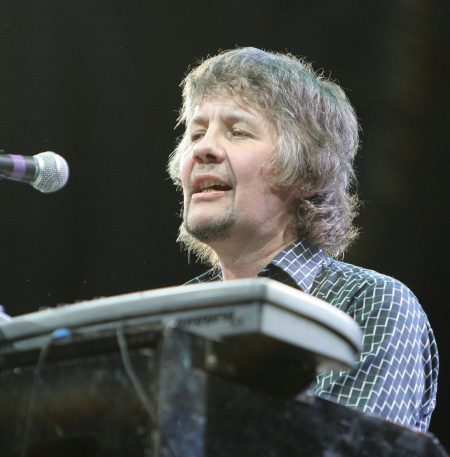
Table of Contents [hide]
Don Airey: Early Life and Musical Training
Don Airey was born on June 21, 1948, in Sunderland, England.
He grew up with a natural inclination toward music and began studying classical piano from a young age.
His formal training led him to the Royal Northern College of Music in Manchester, where he developed the technical foundation that would later define his playing.
That classical grounding gave him a depth and precision that set him apart from most rock keyboardists of his era.
Don Airey absorbed the works of classical composers while simultaneously developing a love for the blues and rock music that was emerging during the 1960s.
That combination of formal training and raw rock energy became the signature of his playing style throughout his career.
Don Airey’s Career Before Deep Purple
His professional career began in the early 1970s with session work and touring stints that quickly established his reputation in British rock circles.
He played with Colosseum II from 1976 to 1978, a jazz-rock fusion band that allowed him to demonstrate his technical versatility across multiple musical styles.
His time with Colosseum II introduced him to guitarist Gary Moore, a relationship that would continue across several projects over the following decade.
He also contributed keyboard work to Gary Moore’s G Force album in 1980, further expanding his presence in the rock world.
By the late 1970s, he had become one of the most sought-after keyboard players for both studio sessions and live touring in British rock.
His ability to read situations quickly, learn material fast, and deliver polished performances made him a reliable presence in high-pressure rock environments.
Rainbow, Ozzy Osbourne, and Beyond
One of his most significant early roles came when he joined Ritchie Blackmore‘s Rainbow in 1979.
He played on the Down to Earth album that year, contributing keyboard arrangements that helped define Rainbow’s melodic hard rock sound during that period.
The record featured vocalist Joe Lynn Turner and remains one of the band’s most commercially successful releases.
He then went on to play with Ozzy Osbourne on two landmark albums: Blizzard of Ozz (1980) and Diary of a Madman (1981).
Those two records are widely considered among the greatest heavy metal albums ever made, and his keyboard work added an orchestral dimension that elevated the music beyond straightforward metal.
His playing on tracks like “Mr. Crowley” is still frequently cited as a high point of heavy rock keyboard performance.
He also contributed to Whitesnake’s Come an’ Get It album in 1981, adding another major rock act to his growing list of credits.
Perhaps most notably, he played on Judas Priest’s Screaming for Vengeance in 1982, one of that band’s defining albums and a cornerstone of heavy metal.
That list of credits from a single five-year stretch is extraordinary by any measure and speaks to just how central he had become to British heavy rock.
How Don Airey Joined Deep Purple
When Jon Lord announced his intention to leave Deep Purple in 2001 to focus on classical composition, the band faced the challenge of replacing one of rock’s most iconic keyboard players.
Don Airey had filled in on keyboards for the band’s touring lineup during the late 1990s, which made him a natural candidate for a permanent role.
His familiarity with the catalog and his ability to honor Jon Lord’s legacy while bringing something of his own made him the right fit for the position.
He officially joined as a full member in 2002, reuniting him with Ian Gillan, Roger Glover, Ian Paice, and Steve Morse.
Taking over from Jon Lord was a task that would have intimidated most musicians, but he approached the challenge with characteristic confidence and professionalism.
He has spoken in interviews about the importance of respecting the Deep Purple catalog while finding ways to make the music his own on stage.
The transition was smoother than many fans had anticipated, and he quickly became an accepted and valued part of the band’s identity.
Keyboard Style and Sound
Don Airey plays with a combination of classical precision and hard rock aggression that is difficult to replicate.
His classical training means he approaches chord voicings, counterpoint, and melodic development with a sophistication that most rock keyboardists never achieve.
At the same time, he understands the rhythm and weight that hard rock requires, which allows him to lock in with a heavy rhythm section without losing his musicality.
He is equally comfortable playing ornate solo passages, atmospheric organ drones, and driving keyboard riffs depending on what the song demands.
He also has a strong improvisational instinct that shows up in Deep Purple’s extended live performances, where he often trades solos with guitarist Steve Morse in real time.
His use of the Hammond organ keeps the classic Deep Purple sound intact, while his piano and synthesizer work adds texture that keeps the music from feeling dated.
Fans have consistently praised his ability to honor the spirit of Jon Lord’s playing without simply copying it note for note.
Deep Purple Studio Albums
Don Airey made his studio debut with Deep Purple on Bananas in 2003, his first full album with the band.
Bananas was generally well received by fans and signaled that the transition from Jon Lord had been handled effectively.
Two years later, the band released Rapture of the Deep (2005), an album that many consider one of the stronger efforts from the later era of Deep Purple’s catalog.
The band went through a period of relative quiet before returning with Now What?! in 2013, a record that was widely praised as a late-career creative resurgence.
Now What?! debuted at number one in several European countries and demonstrated that Deep Purple could still produce vital rock music well into their fifth decade as a band.
Infinite followed in 2017 and featured some of his most ambitious keyboard contributions to date on a Deep Purple record.
Whoosh! arrived in 2020 and became the band’s highest-charting album in the United Kingdom in over thirty years.
The most recent studio release, =1, came out in 2023 and continued the creative momentum that had defined the band’s output since the early 2010s.
Across six studio albums, he has helped Deep Purple maintain their relevance and creative identity in an era when many classic rock contemporaries have struggled to do the same.
Solo Work and Film Soundtracks
Alongside his work with Deep Purple, he has maintained an active solo career that showcases his range as a composer and performer.
His debut solo album, K2, was released in 1988 and featured a mix of rock and classical influences that reflected his dual musical background.
He has released several additional solo albums over the years, each exploring different facets of his musical personality beyond the hard rock context of Deep Purple.
He has also continued to contribute to film and television soundtracks throughout his career, a reminder that his skills extend well beyond the concert stage.
His solo work has never overshadowed his band commitments, but it has given him a creative outlet that keeps his musicianship sharp and his artistic ambitions fulfilled.
Fans who want to hear him outside the Deep Purple context will find his solo recordings genuinely rewarding and musically distinct from anything he does with the band.
You can find more about his releases and current news on his official Facebook page.
Don Airey’s Legacy in Rock Keyboard
Don Airey’s place in rock history was formally recognized when he was inducted into the Rock and Roll Hall of Fame in 2016 as a member of Deep Purple.
That recognition was meaningful not just for his work with the band but for a career that touched nearly every corner of hard rock over five decades.
Few keyboard players can claim credits spanning Rainbow, Ozzy Osbourne, Judas Priest, Whitesnake, Gary Moore, and Deep Purple across consecutive years at the peak of each band’s powers.
He has managed to contribute meaningfully to all of those projects without losing his own musical identity in the process.
He remains an active and enthusiastic performer, and those who have seen him live report that his energy and commitment on stage have not diminished with age.
His biography is featured on the Deep Purple official website for those who want to read more about his role with the band.
His full career and discography are also documented in detail on his Wikipedia page.
More than twenty years after joining Deep Purple, Don Airey continues to be one of the most dependable and musically sophisticated keyboard players in classic rock.
His contribution to the band and to the genre as a whole deserves far more recognition than he typically receives in mainstream rock coverage.
Don Airey is simply one of the best to ever sit behind a set of keys in a rock band.