

Glenn Hughes is one of the most powerful voices in classic rock history, and his time with Deep Purple reshaped what hard rock could sound like.
As bassist and co-vocalist for the Mark III and Mark IV lineups, he brought a soulful, funk-drenched energy that sat in sharp contrast to the band’s earlier heavy rock identity.
His range covers bone-deep blues, church-hall gospel, and full-throttle arena rock without ever sounding forced.
That combination is rare in rock and roll.
Nobody else in the genre has sustained it across five decades the way Glenn Hughes has.
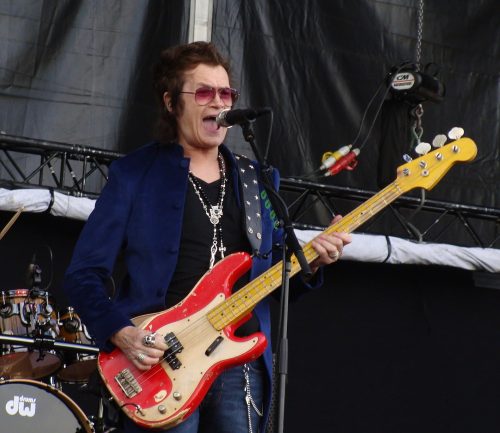
Image credit: Wikimedia Commons
📋 Table of Contents [+]
Glenn Hughes: The Voice of Rock
The title “The Voice of Rock” is not marketing language.
It is a precise description of what Glenn Hughes does when he steps up to a microphone.
His vocal range spans multiple octaves with authority at every point.
He can deliver a whispered soul passage in one bar and a lung-bursting scream in the next without losing control of either.
That technical command is matched by a natural feel for rhythm that makes his bass playing equally hard to argue with.
Glenn Hughes is one of a small group of artists who became truly indispensable to rock history.
His influence runs through funk rock, soul metal, and the broader sound that emerged when hard rock bands started reaching into Black American music traditions in the early 1970s.
Early Life in Cannock, Staffordshire
Glenn Hughes was born on August 21, 1952, in Cannock, Staffordshire, in the English Midlands.
He grew up in a working-class environment where music was a constant presence.
As a teenager, he was drawn to American soul and R&B records, particularly the output of Motown and Stax.
Artists like Stevie Wonder, Marvin Gaye, and Otis Redding left a permanent mark on how he approached melody and phrasing.
He took up bass in his early teens and proved quickly that he had an ear for groove that went beyond imitation.
The English Midlands was producing serious talent in the late 1960s, and Hughes was part of that wave before most people outside the region knew his name.
Trapeze: The Band That Built His Foundation
Before Deep Purple, Glenn Hughes spent formative years developing his craft with Trapeze, a Midlands-based band that mixed heavy rock with strong soul and funk influences.
You can read the full story of that era in the dedicated article on Glenn Hughes and Trapeze.
Trapeze released a series of albums in the early 1970s that built a devoted following, particularly in the United States where the band toured extensively.
Hughes handled both bass and lead vocals, a dual role that became his signature.
The band’s sound was too funky for mainstream hard rock radio and too heavy for soul stations.
That in-between space was exactly where Hughes thrived.
Trapeze never broke through commercially the way their talent deserved, but the years with that band gave Hughes a performance confidence that would carry him into one of rock’s most demanding environments.
💡 Did You Know?
Glenn Hughes joined Deep Purple as both bassist and co-lead vocalist simultaneously, making him the first Deep Purple member to hold both roles at once. The band had used separate singers and bassists before, but Hughes changed the architecture of the lineup entirely by covering both positions without compromise on either.
Glenn Hughes Joins Deep Purple Mark III
In 1973, Deep Purple underwent a dramatic restructuring after Ian Gillan and Roger Glover departed.
The band needed a vocalist and a bassist.
They found both in two people: David Coverdale on vocals and Glenn Hughes on bass and vocals.
This was the Mark III lineup, and it represented a fundamental shift in the band’s character.
Where the Mark II era had been defined by Gillan’s operatic scream and the machine-tight interplay between Glover and Jon Lord, the Mark III sound pushed harder into soul and funk territory.
Coverdale brought bluesy swagger.
Glenn Hughes brought outright fire.
The two vocalists traded leads, harmonized, and challenged each other in ways that gave the Mark III albums a vocal energy no previous Deep Purple lineup had come close to.
You can read the full story of the band’s lineup changes in the Members of Deep Purple overview.
Recording Burn with David Coverdale in 1974
The first album from the Mark III lineup was Burn, released in February 1974.
The title track became one of Deep Purple’s most celebrated recordings.
Glenn Hughes co-wrote several tracks and left his vocal fingerprints across the record.
His bass work on the song “Burn” set a tempo that locked in with Paice’s drumming and drove the band at a pace that felt genuinely dangerous.
Ritchie Blackmore’s guitar work was at its most inventive here, partly because the rhythm section gave him something solid and propulsive to work against.
The album also featured Soldier of Fortune, an acoustic ballad with one of the most unguarded vocal performances of Glenn Hughes’s career.
His falsetto on that track showed a vulnerability that the hard rock world rarely asked for, and he delivered it without a trace of self-consciousness.
Burn reached the top five in the UK and performed well across Europe, confirming that the Mark III lineup was a genuine creative force, not just a stopgap measure.
The same year produced Stormbringer, a second Mark III album released in November 1974.
It pushed deeper into soul and funk than any previous Deep Purple record.
Ritchie Blackmore found the soul direction uncomfortable, and the “Stormbringer” track itself illustrated the tension within the band.
Hughes was pulling toward a looser, groovier sound while Blackmore wanted to stay in hard rock territory.
That creative friction produced interesting music, but it also accelerated the lineup’s unraveling.
💡 Did You Know?
Glenn Hughes has publicly stated that he considers Burn one of the finest albums of his entire career, not just one chapter of it. Despite everything that followed, including years of personal struggle, he has returned to that record as a standard bearer for what he believes a rock band can achieve when every member is fully committed to a shared vision.
Come Taste the Band: The Mark IV’s Only Album
Ritchie Blackmore left Deep Purple in 1975 and was replaced by American guitarist Tommy Bolin.
This became the Mark IV lineup, and it recorded one studio album: Come Taste the Band, released in October 1975.
The album was the most overtly funk-influenced record Deep Purple had ever made.
Bolin brought a different feel to the guitar chair, less classically structured than Blackmore and more willing to bend toward American soul and jazz.
Glenn Hughes thrived in that environment.
His bass lines on tracks like “You Keep On Moving” are as good as anything he recorded with the band.
His vocal contributions were similarly strong, though the overall record received a mixed critical reception at the time.
The touring cycle for Come Taste the Band was troubled.
Bolin was dealing with serious personal problems that affected his performances.
Hughes was beginning his own battle with substances that would define the next phase of his life.
Deep Purple played their final show of that cycle in Liverpool in March 1976 and disbanded shortly afterward.
The Addiction Years: How Glenn Hughes Lost a Decade
The late 1970s and most of the 1980s were a period of serious personal difficulty for Glenn Hughes.
He has spoken openly in interviews about the years he lost to cocaine and alcohol dependency.
He made music during this period and collaborated with various artists, but much of his output reflected a man working against his own circumstances rather than within his full abilities.
He recorded a solo album, Play Me Out, in 1977, and contributed to various projects through the 1980s.
But the creative coherence that had made his Deep Purple work so distinctive was harder to maintain during this stretch.
He was aware of what he was capable of.
That awareness made the gap between his potential and his actual output during this period particularly painful by his own account.
What he built during the addiction years was a body of experience, however difficult, that gave the music that came later a much harder emotional truth.
Solo Comeback: Glenn Hughes Finds His Way Back
Glenn Hughes achieved sobriety in 1991, and what followed was one of the more remarkable second acts in rock history.
Clean and focused, he returned to recording with a clarity and energy that matched and in some ways surpassed his earlier work.
His 1992 album L.A. Blues Authority Vol. II showed he still had everything.
The 1994 album From Now On demonstrated that his voice had grown, not diminished, with age.
The 1995 record Feel is cited by many fans and critics as one of his career peaks.
It drew from deep soul, hard rock, and gospel without trying to split the difference in a safe direction.
Glenn Hughes committed fully to each register on that record and the result was a collection that held its own against anything in his catalogue.
Throughout the 1990s he continued releasing solo material and collaborating with other artists while rebuilding his reputation on the live circuit.
The voice had survived.
The technique had survived.
The charisma had survived.
What he gained through sobriety was the ability to actually use all of it again.
Black Country Communion and the Supergroup Era
Around 2009 and 2010, Glenn Hughes joined forces with guitarist Joe Bonamassa, drummer Jason Bonham, and keyboardist Derek Sherinian to form Black Country Communion.
The band took its name from the Black Country region of the West Midlands, the industrial heartland that produced Hughes.
Black Country Communion was a supergroup in the genuine sense: four musicians who each had serious credentials coming together without any of them being asked to step back from their full capabilities.
Bonamassa brought blues precision and rock power.
Bonham brought the genetic memory of the greatest rock drumming lineage in history.
Sherinian brought a classically influenced keyboard depth that complemented Hughes’s bass work without cluttering it.
And Glenn Hughes brought everything he had accumulated across four decades: the voice, the bass, the stage presence, and the deep knowledge of how a song needs to breathe to reach an audience.
The band released four studio albums: Black Country Communion (2010), 2 (2011), Afterglow (2012), and BCCIV (2017).
All four albums charted in multiple countries and were received well by critics who recognized that this was not a nostalgia exercise.
It was a working band making the music it actually wanted to make.
💡 Did You Know?
Deep Purple, including the Mark III and Mark IV contributions of Glenn Hughes, was inducted into the Rock and Roll Hall of Fame in 2016. The induction recognized the full span of the band’s work across multiple lineups, acknowledging that Hughes’s era was as significant as the classic Mark II period that produced “Smoke on the Water” and “Highway Star.”
Hughes Turner Project and Notable Collaborations
One of the more notable chapter-by-chapter collaborations in Hughes’s career was the Hughes Turner Project, a duo formed with fellow Deep Purple alumnus Joe Lynn Turner.
The two vocalists released two albums under that name: HTP in 2002 and HTP 2 in 2004.
The project worked because both singers were uncompromising about their individual styles, which meant the friction between them produced something more interesting than a straightforward collaborative record would have.
Hughes has also worked with Tony Iommi, Trapeze bandmates, and a wide range of artists across the decades of his solo career.
His willingness to collaborate reflects a quality that has served him throughout his career: he is genuinely interested in what other musicians bring to a session.
He is not merely waiting for his moment to perform.
He listens and then responds to what he hears, which makes him a different kind of collaborator than the typical rock singer who uses a session to showcase their own range.
Glenn Hughes Live: A Voice That Never Aged
The most remarkable thing about Glenn Hughes as a live performer is what has not happened to his voice.
Most rock singers of his vintage have made significant adjustments to accommodate what decades of performing do to the human vocal instrument.
Hughes has not made those adjustments in any obvious way.
He still hits the upper registers with authority.
He still has the stamina to sustain a full show at the level his catalogue demands.
Anyone who has seen him perform the Burn and Come Taste material live in the last decade knows that this is not nostalgia and it is not a comfortable cruise through familiar songs.
He is still performing at full stretch.
If you want to see where he is taking the music next, the Glenn Hughes 2026 tour dates page has everything you need to plan ahead.
His latest solo work, including the single “Chosen,” proves that he is still writing new music at the level of his best output.
He has nothing left to prove, and that seems to free him up to take risks that a younger artist might avoid.
People Also Ask About Glenn Hughes
What is Glenn Hughes best known for?
Glenn Hughes is best known as the bassist and co-vocalist for Deep Purple’s Mark III and Mark IV lineups in the mid-1970s, and for his nickname “The Voice of Rock.” He is recognized for his extraordinary vocal range that spans soul, gospel, and hard rock, and for albums including Burn (1974) and Come Taste the Band (1975). His later work with Black Country Communion further cemented his standing as one of rock’s most complete performers.
Was Glenn Hughes in Deep Purple?
Yes, Glenn Hughes was a member of Deep Purple from 1973 to 1976, appearing on the Mark III and Mark IV lineups. He replaced Roger Glover on bass and joined David Coverdale as a second vocalist, an arrangement unique in the band’s history. He appeared on three studio albums with the group: Burn (1974), Stormbringer (1974), and Come Taste the Band (1975).
What happened to Glenn Hughes after Deep Purple?
After Deep Purple disbanded in 1976, Glenn Hughes pursued a solo career but spent much of the late 1970s and 1980s struggling with addiction to cocaine and alcohol. He released solo material during this period but was not operating at his peak. He achieved sobriety in 1991 and returned to consistent, high-quality output through the 1990s and 2000s, eventually forming Black Country Communion and continuing to record and tour as a solo artist.
Is Glenn Hughes still performing today?
Yes, Glenn Hughes is still actively performing and recording. He has released solo albums in recent years and continues to tour internationally. His voice remains in exceptional condition compared to most rock singers of his era, and he regularly performs material from his full catalogue including the Deep Purple years. His 2026 tour schedule confirms he is still working at full capacity.
What is Black Country Communion?
Black Country Communion is a rock supergroup formed around 2009 featuring Glenn Hughes on bass and vocals, Joe Bonamassa on guitar, Jason Bonham on drums, and Derek Sherinian on keyboards. The band released four studio albums between 2010 and 2017 and is regarded as one of the more successful supergroup projects of that era. The name references the Black Country region of the English West Midlands where Hughes grew up.
Watch Glenn Hughes: “Chosen” Official Video
Glenn Hughes released “Chosen” as a statement of where he is as an artist right now: confident, soulful, and completely in command of everything he brings to a performance.
Watch the official video below.
Essential Glenn Hughes and Deep Purple Albums
Affiliate Disclosure: I am an Amazon affiliate and if you purchase through any amazon links on this site i may earn a small commission at no extra charge to you. This helps support classicrockartists.com and allows me to keep providing deep-dive content on the legends of rock. Thank you for your support!
As an Amazon Associate, I earn from qualifying purchases.

Burn (1974)
Deep Purple Mark III debut — Glenn Hughes’s first studio album with the band
Essential listening for anyone serious about hard rock history.
Features the title track, Mistreated, and Soldier of Fortune.

Come Taste the Band (1975)
Deep Purple Mark IV — the most soul-influenced album in the band’s catalogue
Glenn Hughes and Tommy Bolin push Deep Purple into new sonic territory.
35th Anniversary 2CD edition includes bonus material.

Mark II 3-Pack: In Rock, Fireball, Machine Head
The three definitive albums from the lineup that preceded Glenn Hughes
Understand where Deep Purple came from to fully appreciate where Hughes took them.
Three classic albums in one bundle at exceptional value.

The Very Best of Deep Purple
Compilation spanning all eras including the Glenn Hughes years
The definitive introduction to Deep Purple across every major lineup.
Ideal starting point for listeners discovering the band for the first time.
You Might Also Like
Explore more artist biographies from across the classic rock world.

Glenn Hughes remains one of the most complete performers classic rock has ever produced, and the body of work he has built since achieving sobriety proves that the Voice of Rock is not a title from the past but a description of what Glenn Hughes continues to deliver every time he performs.