

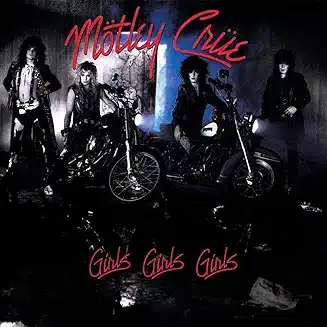
The Girls Girls Girls album by Motley Crue arrived on May 22, 1987, and rock radio would never quite sound the same after those first seconds of Mick Mars’s opening riff rolled out of the speakers.
Quick Navigation
What Made the Girls Girls Girls Album Stand Out
The Girls Girls Girls album arrived at a precise moment when hard rock owned the airwaves, and Motley Crue stepped into that moment with total confidence.
By 1987, the band had already survived the intensity of “Shout at the Devil” and “Theatre of Pain,” emerging with their reputation sharpened rather than worn down.
This fourth studio album had a different energy from its predecessors.
Where “Theatre of Pain” had introduced polish and power ballads, Girls Girls Girls pulled back toward rawness.
Thirteen tracks filled the running time, ranging from straight-ahead hard rock to a pair of well-chosen covers.
The album was not trying to reinvent Motley Crue.
It was trying to document the band at full power, and it succeeded.
Certified 4x Platinum in the United States and peaking at number 2 on the Billboard 200, the record proved that the band’s audience had grown rather than fractured.
Those numbers reflect something beyond chart momentum: they reflect an album that connected with people who were living through the same moment the band was capturing on tape.
Recording the Girls Girls Girls Album in Vancouver
Little Mountain Sound Studios
Producer Tom Werman chose Little Mountain Sound Studios in Vancouver, British Columbia for the Girls Girls Girls album sessions.
The studio had already built its reputation through records by Aerosmith, Loverboy, and Bryan Adams.
For Motley Crue, Vancouver offered distance from the distractions of Los Angeles, though distance from Los Angeles did not mean distance from excess.
Sessions ran through late 1986 and into early 1987.
Nikki Sixx has described this period as both creatively alive and personally destructive in equal measure.
That tension shows up in the music: controlled aggression that sounds like it is being held together by force of will.
The recording captured performances that were loud without losing the individual character of each player.
Sixx’s bass, Lee’s drums, Mars’s guitar, and Neil’s vocals each occupy their own space in the mix.
That separation is part of what makes the album hold up across decades of repeated listening.
Track by Track: Side One
The Title Track That Defined an Era
Side One opens with “Girls Girls Girls,” one of the most immediately recognizable riff introductions in 1980s hard rock.
Mick Mars built the guitar figure around a blues-influenced repeated pattern that locks into Tommy Lee‘s groove with mechanical precision.
The track peaked at number 12 on the Billboard Hot 100, the band’s highest-charting single outside of “Home Sweet Home“.
The MTV video, shot at Seventh Veil in Los Angeles, became one of the network’s most-requested clips during the summer of 1987.
“Wild Side” follows with a heavier character, built on a lumbering riff that sets its own pace and dares the listener to keep up.
Lee’s drum pattern on “Wild Side” is among his most inventive work on any Motley Crue record, pushing against the quarter-note pulse rather than simply locking in with it.
“Sumthin’ for Nuthin'” maintains the momentum: a short, direct rocker that says its piece and steps aside.
“You’re All I Need” shifts tone completely, a ballad that showed the band could write with restraint when a song required it.
Vince Neil‘s performance on “You’re All I Need” is among his most committed vocal deliveries of the decade, despite the track’s notoriously dark subject matter.
“Dancing on Glass” closes Side One with a hypnotic locked groove that many fans consider the album’s most underrated moment.
Track by Track: Side Two
“Bad Boy Boogie,” a cover of the AC/DC track, opens Side Two and signals the band’s willingness to honor the acts that shaped them without apologizing for the debt.
The choice was smart: AC/DC’s hard-charging boogie shares DNA with the sound Motley Crue had been building since their first record.
“Nona” pushes into darker territory, written by Sixx from lived experience that comes through in the vocal delivery.
“Five Years Dead” follows with a similar weight, and Mars’s guitar work here ranks among the most technically precise on the record.
“All in the Name of…” keeps the pressure up, a fast-moving track that does not linger.
“Jailhouse Rock,” the Elvis Presley cover, is the album’s most unexpected moment: a band at full throttle having genuine fun on tape.
“Looks That Kill Live” bridges the new album to earlier material, connecting the audience back to the rawness of “Looks That Kill” from the Shout at the Devil era.
“Saturday Night” closes the record the only way it could: loud, fast, and certain of itself.
The Girls Girls Girls Album Chart Success
The Girls Girls Girls album debuted strong and climbed to number 2 on the Billboard 200.
Whitney Houston’s “Whitney” held the top position and kept Motley Crue from claiming number 1, but second place on the Billboard 200 in the summer of 1987 was a commercial achievement most bands would not reach in their careers.
The album’s certification of 4x Platinum in the United States reflected sales exceeding four million copies.
In Canada, where the album was recorded, the reception was similarly strong.
The title track’s Hot 100 performance at number 12 drove significant crossover airplay, reaching listeners who might not have followed the band through its earlier, harder material.
Radio play for “Wild Side” and “Dancing on Glass” extended the album’s commercial life well past the initial single release cycle.
The chart success of Girls Girls Girls set up the commercial trajectory that led to “Kickstart My Heart” two years later, which became the band’s defining mainstream rock radio moment.
Tom Werman: Who Produced the Girls Girls Girls Album
Tom Werman produced the Girls Girls Girls album, making this his third consecutive full-length project with Motley Crue.
Werman had worked with the band since the Elektra rerelease of “Too Fast for Love,” through “Shout at the Devil,” and through “Theatre of Pain.”
He understood the band’s working style, their strengths, and their tendency to push everything to the edge.
His production decision to keep the mix dry and separated gave the album a directness that some of the band’s later, more polished records lack.
Mars’s guitar sounds unadorned here: no excess reverb, no wall-of-sound layering.
It sits in the mix with the weight of a closed fist.
Sixx’s bass is audible and rhythmically active in a way that many rock productions of the era buried beneath the guitars.
Werman stepped back from the band after this record, and Motley Crue moved on to work with Bob Rock on the Dr. Feelgood album.
In hindsight, Girls Girls Girls stands as the final chapter of the Werman era: raw, direct, and honest about what the band was in 1987.
The Four Members Who Made This Album
The classic four-piece lineup of Motley Crue created this record: Vince Neil on vocals, Nikki Sixx on bass, Tommy Lee on drums, and Mick Mars on guitar.
For the complete background on each of these players, the complete story of Motley Crue’s members covers their histories in detail.
Mars was already managing health challenges during this period, a fact he has since spoken about publicly in interviews.
His guitar work on this album gives no indication of difficulty: it is locked in and deliberate throughout every track.
The chemistry between Sixx and Lee as a rhythm section had been built through years of touring and recording together, and it shows in how tightly they play here.
Neil’s vocals had matured from the recklessness of the earliest records into something more controlled without losing urgency.
Each of the four brought something distinct to these sessions, and the album reflects that combination rather than one player carrying the others.
The Girls Girls Girls Album Tour of 1987
The Girls Girls Girls album launched a touring campaign that ran through 1987 and into 1988, covering North America and major international markets including Japan.
The production matched the record’s excess: pyrotechnics, elaborate staging, and a set design built for arenas.
Night after night, the band opened with the title track and worked through the album alongside earlier fan favorites like “Shout at the Devil“.
Fans who attended those shows consistently describe them as physically relentless: loud, fast, and impossible to look away from.
The personal problems building within the band during this period were becoming harder to ignore, and Nikki Sixx’s near-fatal overdose in December 1987 brought the tour to a crisis point.
The band eventually found a path through that period, returning with the Dr. Feelgood record in 1989.
Today, the Motley Crue 2026 Return of Carnival of Sins tour has brought these songs back to arenas worldwide.
The setlist changes on the 2026 tour have included material from this album, giving longtime fans new chances to hear these tracks at full live volume.
Girls Girls Girls Album in Motley Crue’s Full Catalog
The Girls Girls Girls album occupies a specific position in Motley Crue’s discography: it is the bridge between the band’s aggressive early identity and the polished commercial peak that followed.
The Shout at the Devil album had established the band’s heavy metal identity.
“Theatre of Pain” had introduced the power ballad as a commercial tool, with “Smokin’ in the Boys Room” covering Brownsville Station for chart success.
Girls Girls Girls pulled back toward the band’s instincts while keeping the mainstream accessibility that “Theatre of Pain” had opened up.
What came next was the Dr. Feelgood album: the most produced and commercially successful record of their career.
Later lineup changes, including periods with John Corabi on vocals and eventually John 5 on guitar, shifted the band’s sound in different directions.
But the core character of Motley Crue, the sound this album represents, remained constant through every lineup and every era.
Deeper Cuts Worth Your Attention
“Wild Side” is the album’s most discussed non-single, built around street-level imagery that Sixx drew from lived experience.
Its lumbering riff and unconventional structure make it one of the more adventurous tracks the band recorded in this period.
“Dancing on Glass” is the fan favorite that never received a proper single release but ranks as one of the most replayable tracks on the record.
“Nona” deserves more attention than it typically receives: a darker piece that shows what Sixx was capable of when writing from a personal rather than a crowd-pleasing perspective.
“You’re All I Need” delivers the kind of emotional directness that the band achieved less often in ballad form than in their harder material.
The “Without You” period a few years later showed the band revisiting that emotional register with even more control.
Tracks like “Don’t Go Away Mad” from the Dr. Feelgood era owed something to the songwriting discipline that produced the slower moments on this 1987 album.
Motley Crue Song Catalog Highlights
Girls Girls Girls arrived in the middle of a remarkable run of Motley Crue material that fans have followed since the early 1980s.
Early tracks like “Live Wire” and “Piece of Your Action” from “Too Fast for Love” showed what the band could do before major label resources arrived.
“Too Young to Fall in Love” from “Shout at the Devil” demonstrated their ability to write a hard rock anthem with genuine melodic staying power.
The Dr. Feelgood era produced tracks like “Dr. Feelgood” itself, a song whose locked-in groove owes something to the same energy that made Girls Girls Girls work.
Later material including “Hooligan’s Holiday” from the Corabi era and “Afraid” showed the band exploring different textures while keeping the volume.
Each of those tracks connects in some way to the approach laid down on this 1987 record.
Motley Crue in 2025 and 2026
Motley Crue has remained in the public conversation in ways few bands of their era have managed.
Their appearance on American Idol brought the band to a primetime television audience that included many who were not alive when Girls Girls Girls came out.
The audience reaction to that American Idol performance confirmed that the band’s music connects across generations, not only with those who lived through the 1987 moment.
Health challenges have continued to affect the band’s lineup: the feud between Mick Mars and the rest of the band has been one of the more public ruptures in rock in recent years.
The health issues Vince Neil has faced have also been widely covered, adding a layer of fragility to a band whose image was always built on indestructibility.
Through those challenges, the music from 1987 remains.
For the latest on the band’s activities, the classic rock news section and tour updates on this site keep pace with developments as they happen.
Legacy and Cultural Impact
Few albums from the 1980s captured the swagger of hard rock excess as completely as Girls Girls Girls.
The imagery, the sound, and the attitude of this record became the template that other acts tried to build from for years after its release.
The title track has appeared in film, television, and advertising placements, testimony to how deeply it embedded itself in popular culture.
The official Motley Crue website at motley.com keeps the band’s full catalog accessible for fans navigating their history.
Girls Girls Girls sounds like it was made by people who believed in every note they were playing.
That conviction is not something production can manufacture after the fact, and it is why the album holds up when much of its era does not.
Frequently Asked Questions About the Girls Girls Girls Album
What year was the Girls Girls Girls album released?
Motley Crue released the Girls Girls Girls album on May 22, 1987.
How high did the Girls Girls Girls album chart?
The album peaked at number 2 on the Billboard 200 and was certified 4x Platinum in the United States.
Who produced the Girls Girls Girls album?
Tom Werman produced the album, recording at Little Mountain Sound Studios in Vancouver, British Columbia.
What is the best track on the Girls Girls Girls album?
Beyond the title single, “Wild Side” and “Dancing on Glass” are consistently cited by fans as the strongest cuts on the record.
Is Girls Girls Girls Motley Crue’s best album?
Many consider the Dr. Feelgood era their commercial and production peak, but Girls Girls Girls has a raw directness that its successor traded for polish.
What happened after the Girls Girls Girls album tour?
The band’s personal crises came to a head in late 1987 and 1988, leading to a period of rehabilitation before their return with Dr. Feelgood in 1989.
Explore More Classic Rock
This site covers rock history across every decade, from the artists who built it to the albums that defined it.
Browse artist profiles for deep dives into the musicians behind the records.
The members-of hub pages cover the full stories of classic rock bands and where their lineups stand today.
For album coverage organized by era, the 80s iconic hits and stories section covers the decade this album belongs to.
Earlier decades are covered in the 60s, 70s, and 90s sections.
All album reviews are indexed for easy browsing, and the ClassicRockArtists.com home page is the starting point for everything on the site.
You Might Also Like
Disclosure: This post contains affiliate links.
If you purchase through these links, we may earn a small commission at no extra cost to you.
Nearly four decades after its release, the Girls Girls Girls album by Motley Crue remains essential listening for anyone who wants to understand what hard rock sounded like at its most committed and most confident.