
Alice in Chains Members: Complete Story & Where Are They Now
The Alice in Chains members have spent four decades reshaping what heavy rock music can sound and feel like, from the grinding intensity of Facelift to the cathedral-weight of Rainier Fog.
Six people have held seats in this band across its history.
Each one left a mark on the music that cannot be separated from it.
This is the complete story of who they are, what they built, and where they stand today.
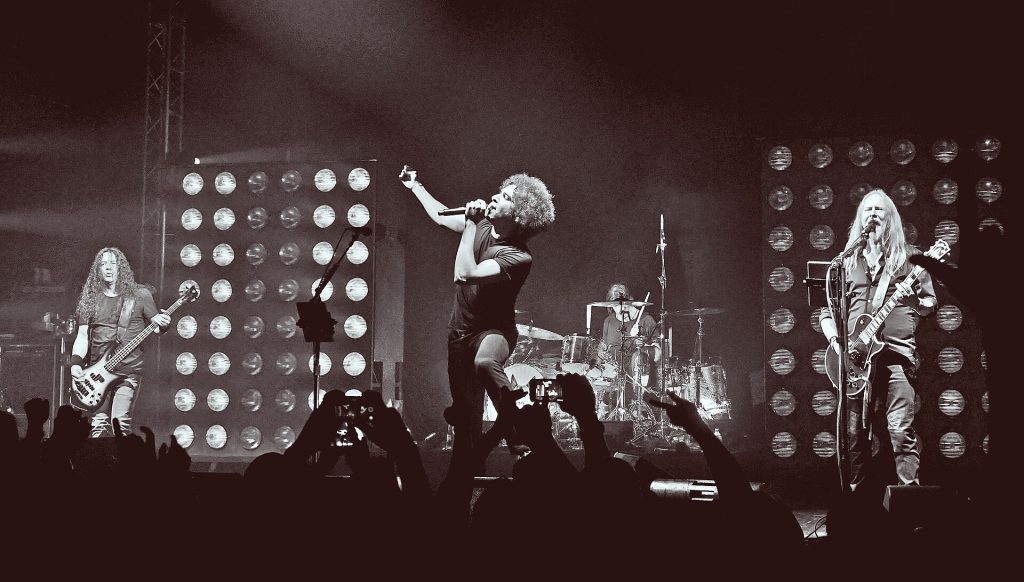
Alice in Chains live at Leeds Festival, 2018.
Affiliate Disclosure: I am an Amazon affiliate and if you purchase through any amazon links on this site i may earn a small commission at no extra charge to you.
Quick Navigation
- Alice in Chains Members: The Full Story Begins
- Jerry Cantrell: Guitar, Voice and Creative Core
- Layne Staley: The Voice of Alice in Chains Members
- Sean Kinney: The Drummer and Co-Founder
- Mike Starr: Original Bassist and Early Foundation
- Mike Inez: The Bassist Who Joined Alice in Chains Members in 1993
- William DuVall: New Voice for Alice in Chains Members
- Album by Album: The Complete Discography
- The Silent Years: What Alice in Chains Members Faced Next
- The Return: How Alice in Chains Members Rebuilt
- Solo Careers and Side Projects
- The Live Legacy of Alice in Chains Members
- Where Are the Alice in Chains Members Now?
Alice in Chains Members: The Full Story Begins
The band that became Alice in Chains took shape in Seattle, Washington, in the late 1980s.
Jerry Cantrell and Sean Kinney connected first, then drew in Layne Staley, who had been fronting a glam-influenced outfit called Alice N’ Chains.
Bassist Mike Starr completed the founding four.
You can watch how that early formation came together in this Facebook reel on Alice In Chains’ origins.
The Alice in Chains members signed to Columbia Records in 1989 and entered the studio to record what would become one of the defining albums of their era.
The official Alice in Chains website remains the best place to follow their current activity.
What separated this band from most of what was forming in Seattle at the time was the density of their sound.
Where other bands leaned toward the loose and melodic, Alice in Chains hit like something being pressed into the floor.
Cantrell’s guitar tunings were lower.
Kinney’s drumming was heavier in the mid-range than most of his contemporaries.
Staley’s voice sat in a range that made dissonance sound like an emotional choice rather than a technical accident.
Starr’s bass filled the space between the guitar and the drums with a thickness that gave every song a physical weight.
That combination did not happen by accident.
It happened because four specific people happened to find each other in a specific city at a specific moment in American rock history.
The Alice in Chains members who made up that original lineup created something that the Seattle scene had not seen before and would not see again in quite the same form.
The world had not heard anything quite like them, and within three years of their formation, it would hear nothing else.
DID YOU KNOW?
In 1991, the Alice in Chains members joined the “Clash of the Titans” tour as a support act alongside Slayer, Megadeth, and Anthrax. The exposure on that heavy metal arena tour introduced Alice in Chains to hundreds of thousands of fans who had never heard them, months before Dirt was even recorded. It remains one of the most unexpected and consequential tour placements in the band’s early history. Explore the early Alice in Chains catalog, including Facelift, on Amazon here.
Jerry Cantrell: Guitar, Voice and Creative Core
Jerry Cantrell was born on July 18, 1966, in Tacoma, Washington.
His father, Jerry Cantrell Sr., served in the Vietnam War, and that family history would later become the emotional center of one of Alice in Chains’ most powerful songs.
Cantrell is the primary songwriter for the band.
He is the architect of the sound, the person most responsible for the tuning, the chord structures, and the melodic decisions that gave Alice in Chains their identity.
His guitar work is immediately recognizable: down tuned, heavy in the mid-range, built around riffs that are as melodic as they are crushing.
His voice, used primarily for harmony vocals alongside the lead vocalist in each of the band’s two eras, adds a dissonant thickness to the sound that no overdub or production trick could replicate.
Cantrell also sang lead on several songs throughout the band’s catalog, including stretches on the self-titled 1995 album where he and Staley traded lead vocal duties.
His full biography, including his upbringing and the personal experiences that shaped his songwriting, is covered at classicrockartists.com.
Cantrell’s guitar playing has been cited as a primary influence by dozens of rock and metal guitarists who came of age in the 1990s and 2000s.
What made his style distinct was the combination of genuine technical accomplishment and emotional restraint.
He was never a shredder in the traditional sense.
He was a songwriter who played guitar, and every note served the composition rather than the player.
Cantrell has spoken openly about the toll the band’s history took on him personally, particularly during the years surrounding Layne Staley’s decline and eventual death.
He has also spoken about how making music was what allowed him to process those years and continue working.
His solo career, which runs parallel to his work with the Alice in Chains members, is substantial.
He released Boggy Depot in 1998, a record that extended the dark melodic language of Alice in Chains into a solo context with a slightly warmer production approach.
Degradation Trip followed in 2002 and is widely regarded as his most personal and uncompromising solo statement.
He returned to solo work with Brighten in 2021, a more melodic and accessible record that surprised some listeners while delighting others.
The single Brighten (the song) became one of his most-streamed solo releases.
I Want Blood arrived in 2023 and marked a return to the heavier sound his longtime fans expected.
In every phase of his career, Cantrell has remained one of the most consistent and distinctive creative forces in American rock.
His contributions to the Alice in Chains members catalog are so central that it is impossible to understand the band without understanding how he thinks as a writer and a guitar player.
The band’s harmonic identity, their tuning choices, their tendency to build songs around a central heavy riff rather than a verse-chorus structure, all of it flows through Cantrell’s creative decisions.
The Alice in Chains members who have shared the stage with him over forty years of live performance understand that the creative engine of this band runs through the person who wrote most of the songs.
That is not a diminishment of anyone else’s contribution.
It is a recognition of how this particular creative partnership has always worked.
Layne Staley: The Voice of Alice in Chains Members
Layne Staley was born on August 22, 1967, in Kirkland, Washington, and his voice defined the emotional register of Alice in Chains from the very beginning.
There is no accurate description of what made Staley’s voice so singular.
It was powerful without being simply loud.
It was melodic in contexts where most singers would have reached for pure power.
It combined a raw, almost broken quality with an operatic control that allowed him to move between softness and devastation in the space of a single line.
His ability to harmonize with Cantrell produced some of the most unsettling and beautiful vocal combinations in rock.
The two voices did not blend so much as they stacked, creating a sound that was greater than either one alone and unlike anything else in the genre.
Staley’s full biography, including his early years as a drummer before becoming a vocalist, is documented at classicrockartists.com.
His personal struggles with addiction became increasingly public as the 1990s progressed.
He was open about those struggles in interviews during the band’s peak years, and the subject matter of the band’s lyrics reflected his experience directly.
Songs like Angry Chair are autobiographical in a way that most rock songs are not.
Staley was not writing about a character or an abstraction.
He was documenting his own interior world with a specificity that made those songs deeply uncomfortable for listeners who understood what they were hearing.
After the 1996 MTV Unplugged performance, Staley withdrew from public life almost entirely.
He stopped touring and recording.
The years between 1996 and his death were characterized by increasing isolation.
On April 5, 2002, Layne Staley died at 35 years old in his Seattle apartment.
The cause was an accidental overdose of heroin and cocaine.
His death marked the end of what most people consider the first era of Alice in Chains.
The loss was not only musical.
It was personal for everyone connected to the band, and it was felt by millions of listeners who had grown up with his voice.
Staley’s legacy in rock is fully documented at his biography page, where his artistic contributions are explored in full.
His voice remains one of the most studied and imitated in rock, even though no one has ever come close to replicating it.
What the Alice in Chains members who worked alongside Staley have consistently said is that his presence in the room elevated everyone’s performance.
His instinct for melody pushed Cantrell to write more emotionally direct material.
His willingness to sing about things that were personally devastating gave the alice in chains members permission to make music that did not flinch from difficulty.
That legacy is audible in every subsequent record the band has made, even those on which he does not appear.
Sean Kinney: The Drummer and Co-Founder
Sean Kinney was born on May 27, 1966, in Seattle, Washington, and he is the only member of Alice in Chains who has lived within the city’s limits for virtually his entire life.
Kinney is a co-founder of the band and has been its drummer through every album, every tour, and every change in lineup.
His drumming style is built around power, precision, and groove.
He is not a technical drummer in the sense of playing for complexity.
He is a drummer who plays for the song, which means that on the band’s heaviest material, he hits hard and rarely overcomplicates the arrangement.
His work on Them Bones is the clearest example of his approach: an odd time signature, played with absolute commitment and no apparent effort.
Kinney also has a significant artistic identity outside of his drumming.
He designed several of the band’s album covers and visual materials over the years, including the face-on-the-dirt cover art for the Dirt album.
That contribution is often overlooked in discussions of his role in the band, but it reflects a broader creative engagement with what Alice in Chains represents visually as well as sonically.
His full biography is at classicrockartists.com.
Among the Alice in Chains members, Kinney occupies a unique position as the only one who has never left and never been absent from the band’s history in any form.
Kinney has spoken in interviews about the difficulty of maintaining the band’s identity through Staley’s decline and death, and about his role in keeping the door open for an eventual return.
He was a consistent voice for the band’s continued existence even when that existence was entirely uncertain.
He has continued playing with Alice in Chains through all of their post-reunion albums and tours, demonstrating that the commitment of the Alice in Chains members to the project has never wavered across its now four-decade history.
Mike Starr: Original Bassist and Early Foundation
Michael Christopher Starr was born on April 4, 1966, in Honolulu, Hawaii, and grew up in the Kent area south of Seattle.
He was the original bassist for Alice in Chains and a co-founding member of the band that would record Facelift, SAP, and Dirt.
His bass lines on those records are built into some of the most celebrated rock recordings of the early 1990s.
The weight he brought to Down in a Hole and Rain When I Die is structural rather than decorative.
His full story and the role he played in the band’s early years are covered at classicrockartists.com/mike-starr.
Starr departed the band in 1993, making him the first of the original Alice in Chains members to exit the lineup.
His departure reflected the mounting personal pressures that surrounded the entire Alice in Chains orbit during that period.
In 2010 he appeared on the fourth season of Celebrity Rehab with Dr. Drew, speaking openly about his struggles with addiction and the aftermath of his years with the band.
He died on March 8, 2011, in Salt Lake City, Utah, from an accidental prescription drug overdose.
He was 44 years old.
The music he made with Alice in Chains between 1987 and 1993 remains a permanent part of rock history.
Those songs are still performed live today, and the bass lines Starr recorded on them have never been replaced or altered.
His death, coming less than a decade after Layne Staley’s, gave the extended Alice in Chains story a weight of loss that few bands in rock have had to carry.
Mike Inez: The Bassist Who Joined Alice in Chains Members in 1993
Michael Andrew Inez was born on May 14, 1966, in San Fernando, California, and brought an entirely different background to Alice in Chains when he joined in 1993.
He had been touring with Ozzy Osbourne before the call came, and that experience on arena stages across North America had given him a level of professionalism and physical endurance that the role demanded.
Inez’s bass work on Jar of Flies was his first studio contribution, and it showed immediately that he was not a fill-in player.
His approach to the acoustic EP’s material was restrained and melodic, serving songs that asked for subtlety in a band better known for weight.
On Nutshell his bass holds space without filling it.
On No Excuses it settles into a groove that supports the song’s warmth without competing with it.
On I Stay Away his playing is gentle at the surface and quietly relentless underneath.
The 1995 self-titled album showed his heavier side.
On tracks like Grind and Again and Heaven Beside You, his bass lines are structural elements that make the songs feel heavier before the guitars even arrive.
After the band’s return in 2009, Inez played on every subsequent album and has remained the band’s bassist to the present day.
His full biography is at classicrockartists.com/mike-inez.
William DuVall: New Voice for Alice in Chains Members
William DuVall was born on June 3, 1966, in Washington, D.C., making him the only Alice in Chains member who did not grow up in the Pacific Northwest.
He came to the band with a background that was significantly different from anyone who had held a microphone in Alice in Chains before him.
He had spent years in the hardcore punk scene, fronting Atlanta-based bands and developing an approach to performance that was physically committed and musically versatile.
He had also been working as a solo artist under his own name before connecting with Jerry Cantrell.
His full story, including his path from Atlanta hardcore to the front of one of rock’s biggest bands, is at classicrockartists.com/william-duvall.
DuVall officially became one of Alice in Chains members in 2006 and made his record debut with the band on Black Gives Way to Blue in 2009.
The question of whether the Alice in Chains members could function without Layne Staley was one that many fans and critics approached with skepticism.
DuVall answered it not by trying to replicate Staley but by bringing his own voice to the material.
He has a natural roughness in his lower register that works well against Cantrell’s harmonics.
His upper range gives the band a brightness that the Staley era rarely touched, and that contrast has expanded the sonic vocabulary of Alice in Chains in ways that serve the new material without dishonoring what came before.
The fan community has had ongoing discussions about the current lineup, including a detailed thread on the Steve Hoffman Music Forums, where longtime listeners have debated and largely come to appreciate what DuVall brings to the band.
DuVall has participated in every Alice in Chains album since 2009 and shows no signs of stepping back from the role.
DID YOU KNOW?
Jerry Cantrell wrote “Rooster” specifically about his father, Jerry Cantrell Sr., who served in Vietnam. His father’s actual military nickname was “Rooster,” and the song draws directly from conversations Cantrell had with him about combat and survival. The emotional core of the song is not fictional. It is a son trying to understand what his father experienced in war and what it cost him to come home. The Dirt album, which features “Rooster” among its most powerful tracks, is available on vinyl and CD on Amazon.
Album by Album: The Complete Discography
The Alice in Chains catalog spans nine studio albums and EPs across four decades, with two distinct lineups separated by a thirteen-year silence.
Understanding what each record meant in its moment is essential to understanding what each of the Alice in Chains members brought to the table at those particular times.
Facelift (1990)
The debut album Facelift arrived in August 1990 and introduced the world to a band that did not fit neatly into grunge, metal, or hard rock but borrowed from all three.
The lead single Man in the Box became one of the defining rock songs of the year and gave the band their first significant radio presence.
Facelift was certified platinum and established the alice in chains members as one of Seattle’s most important new acts.
SAP EP (1992)
The SAP EP, released in February 1992, surprised everyone who had been expecting a heavier follow-up to Facelift.
Instead the band delivered four acoustic songs featuring guest appearances from Heart’s Ann Wilson and Screaming Trees’ Mark Lanegan.
SAP demonstrated that the Alice in Chains members were not a one-dimensional heavy rock band.
They could write and perform quiet, melodic music with the same authority they brought to their heaviest material.
Dirt (1992)
The Dirt album, released in September 1992, remains the defining statement of the band’s original era.
It debuted at number six on the Billboard 200 and went on to achieve four-times-platinum certification in the United States.
The record confronts addiction, despair, and self-destruction with a directness that most mainstream rock albums had never attempted.
Would opens the album with a bass-and-guitar interplay that is simultaneously heavy and melodic.
Rooster uses the weight of the band’s sound to carry the emotional gravity of a story about war and survival.
Down in a Hole sinks slowly and deliberately into a despair that feels earned rather than theatrical.
Jar of Flies (1994)
Jar of Flies, released in January 1994, was Mike Inez’s first studio contribution and became the first EP in history to debut at number one on the Billboard 200.
It is a masterpiece of restraint, featuring acoustic-driven songs that carry as much emotional weight as anything the band had recorded electrically.
Alice in Chains (Self-Titled, 1995)
The self-titled album debuted at number one on the Billboard 200 in November 1995 and represents the final studio album recorded with Layne Staley.
It is slower and denser than Dirt, built around a sound that feels deliberately suffocating.
Black Gives Way to Blue (2009)
Black Gives Way to Blue announced the band’s return with William DuVall and debuted at number five on the Billboard 200.
Check My Brain became a radio hit and demonstrated that the post-Staley lineup could generate genuine commercial momentum.
Your Decision showed DuVall at his most melodically versatile, handling a song that required both emotional delicacy and vocal power.
The Devil Put Dinosaurs Here (2013)
The Devil Put Dinosaurs Here debuted at number two on the Billboard 200 and confirmed the reunion was not a one-album event.
Hollow became one of the album’s signature moments, a slow-building demonstration of how the band uses space and dynamics to create unease.
Rainier Fog (2018)
Rainier Fog was recorded partly at Studio X in Seattle, the same facility where much of the band’s 1990s work was made.
It debuted at number four on the Billboard 200 and is widely regarded as the most fully realized album of the DuVall era.
The record demonstrates the current Alice in Chains members operating at the peak of their collective craft.
Across all nine of these recordings, the Alice in Chains members have maintained a consistent standard of quality that few bands in rock have sustained across four decades.
The shift from the Staley era to the DuVall era represents a genuine transition rather than a decline.
The albums made after the reunion have commercial chart positions and critical responses that are competitive with the band’s peak 1990s releases.
That is an extraordinary achievement for any band, and it reflects the collective commitment of all the alice in chains members to making records that stand on their own rather than simply trading on the legacy of Dirt and Facelift.
The Silent Years: What Alice in Chains Members Faced Next
After the self-titled album in 1995, the Alice in Chains members entered a period of near-complete public silence that lasted more than a decade.
The band’s 1996 MTV Unplugged performance in Brooklyn was their last major public appearance with Layne Staley.
Staley did not tour after that, did not record new material, and reduced his public presence to almost nothing.
The band did not formally break up, but they also did not function as a working group.
The silence that characterized those years was painful for every Alice in Chains members connected to the band, both as a business and as a creative partnership that had been the center of several lives.
Cantrell and Kinney stayed in contact with Staley and with each other.
Cantrell pursued his solo career, releasing Boggy Depot in 1998 and continuing to write and record.
Kinney remained present in Seattle’s music community.
Inez stayed active as a session musician and collaborator.
The band’s absence from active music-making was not a clean break.
It was more like a prolonged and painful suspension.
When Layne Staley died on April 5, 2002, the suspension became permanent for the original lineup.
The grief that followed was real and public.
Cantrell in particular spoke openly in subsequent years about how devastating the loss was and how long it took him to understand what he wanted to do next with the band’s legacy.
The answer did not come quickly.
It came slowly, over several years, as the remaining members found their footing and began to ask what Alice in Chains could be without the voice that had defined it.
The Return: How Alice in Chains Members Rebuilt
The process of returning began carefully.
The Alice in Chains members who were still living faced a choice about whether the band could and should continue.
That choice required them to be honest about what Alice in Chains was: a band built around a sound and a creative approach, not just around one unreplaceable voice.
The band began playing charity shows with various guest vocalists in 2005 and 2006, testing whether a live performance was even possible without Staley.
William DuVall appeared at several of these events and connected with the band in a way that felt genuine rather than cosmetic.
He was officially brought in as a full member in 2006.
The decision to continue was not made lightly, and the band has been transparent about the weight of the choice.
They were not replacing Layne Staley.
They were building the next chapter of a band that had always been more than one person.
The 2009 album Black Gives Way to Blue served as both a commercial success and an artistic statement about continuity.
Its title track, a piano-led ballad that serves as a tribute to Staley, demonstrated that the band could honor its past without being frozen by it.
The return tour that accompanied the album was one of the most successful rock tours of that year.
The Alice in Chains members had found a way to continue that felt honest and sustainable.
What followed was three more studio albums over the next decade, each one stronger and more confident than the last.
DID YOU KNOW?
The 1996 Alice in Chains MTV Unplugged session, filmed at The Majestic Theater in Brooklyn, New York, became one of the best-selling Unplugged albums in the show’s history and is widely regarded as one of the most emotionally powerful performances ever recorded for that program. The album went platinum in the United States. It was Layne Staley’s last major public performance before his death six years later. The MTV Unplugged album is available on Amazon in vinyl and CD formats.
Solo Careers and Side Projects
Beyond their work as a band, several Alice in Chains members have pursued creative projects that illuminate different sides of their musicianship.
Understanding those solo projects is important context for understanding the range of skills the alice in chains members each individually bring to the collective.
Jerry Cantrell’s solo catalog is the most extensive.
His four solo albums span a range from the grunge-adjacent heaviness of Degradation Trip to the melodic accessibility of Brighten.
His most recent solo record, I Want Blood, released in 2023, demonstrates that his appetite for heavy, guitar-driven rock has not diminished across three decades of recording.
William DuVall has maintained a parallel solo career that predates his time in Alice in Chains and continues alongside it.
His solo output tends toward a more intimate sound than the band’s material, featuring acoustic arrangements and a directness in the writing that reveals a different dimension of his creative personality.
Layne Staley contributed vocals to the 1995 Mad Season project, a side group that included guitarist Mike McCready of Pearl Jam, drummer Barrett Martin of Screaming Trees, and bassist John Baker Saunders.
The Mad Season album Above remains one of the most emotionally raw documents of that Seattle generation.
Sean Kinney’s artistic output outside of Alice in Chains has focused primarily on visual design rather than music.
His contributions to the band’s visual identity have been substantial and often underappreciated by audiences who engage primarily with the music.
Mike Inez has remained focused on his role in Alice in Chains and has not pursued major solo projects during his tenure with the band.
His commitment to the group has been total and consistent since 1993.
Of all the Alice in Chains members, Inez has perhaps the most uncomplicated relationship with the band’s identity: he joined to play bass, and thirty-plus years later, he is still playing bass.
That consistency is itself a contribution to what the Alice in Chains members have been able to build in the reunion era.
The Live Legacy of Alice in Chains Members
Alice in Chains built their reputation as a live band in the early 1990s through sustained touring and performances that matched the intensity of their studio recordings.
The Alice in Chains members have always been a band that sounds better live than the recordings prepare you for.
That quality, which is rarer than it sounds, has been present in every touring configuration the Alice in Chains members have operated in, from the Staley-era arena shows of the early 1990s to the current post-reunion touring circuit.
The band was never a production-heavy live act.
They relied on the quality of the playing and the emotional force of the songs to carry their shows.
Under Staley’s leadership, the live shows were confrontational and uncompromising.
The songs from Facelift and Dirt translated directly to the stage without losing any of their weight.
Songs like Them Bones and Would hit harder in a live context than they did on record, which is a rare quality in rock.
The post-reunion live shows have continued in that tradition.
DuVall’s stage presence is physical and engaged, and his voice holds up across full touring schedules in a way that Staley’s, in his later years, could not.
The setlists balance material from both eras without making either feel subordinate to the other.
The documentary below provides a comprehensive look at the real-life story behind the Alice in Chains members and the weight that followed them through their career:
Where Are the Alice in Chains Members Now?
As of 2025, the current Alice in Chains members remain an active, working band with no indication that any of them intend to stop.
The Alice in Chains members in the current lineup, Cantrell, DuVall, Kinney, and Inez, have now been playing together longer as a unit than the original four-person lineup lasted.
Jerry Cantrell continues to write for both Alice in Chains and his solo projects.
His 2025 tour, covered at classicrockartists.com, demonstrated that his appetite for live performance remains as strong as ever.
He has spoken publicly about ongoing work on new Alice in Chains material, suggesting that the band’s recording activity has not stopped.
William DuVall continues performing with Alice in Chains and releasing solo material that reflects a consistent artistic evolution.
He remains one of the more underappreciated vocalists in modern rock, a status that has slowly improved as the DuVall-era band has accumulated a longer and stronger body of recorded work.
Sean Kinney continues as the band’s drummer and remains based in Seattle.
He has spoken in recent interviews about the band’s ongoing creative process and his commitment to continuing for as long as the music remains vital.
Mike Inez remains the band’s bassist and continues to perform with the same reliability and consistency that has characterized his entire tenure.
Together, the current four members of Alice in Chains represent one of the longest-running and most consistent lineups in hard rock.
They have now been making music together, in this configuration, for longer than the original lineup that recorded Facelift and Dirt.
Below, watch the official video for “The One You Know,” from Rainier Fog, a song that captures exactly what the current Alice in Chains members are capable of at full strength:
Every generation that discovers Alice in Chains does so through the music first, and that music was made by six specific people across four decades of commitment to one of the most uncompromising sounds in rock history.
The Alice in Chains members have earned every note of the reputation they carry.
For listeners who came to the band through Dirt and Facelift, the continued existence of Alice in Chains is both a gift and a challenge.
It requires engaging with a band that has changed in significant ways while also remaining fundamentally itself.
The Alice in Chains members who make up the current lineup have met that challenge on every album and every tour since 2009.
What began in a Seattle rehearsal space in the late 1980s with four people who happened to find each other at exactly the right time has grown into one of rock’s most durable and consequential careers.
The music those six people made across four decades tells a story about creativity, loss, resilience, and the stubbornness of a band that refuses to stop being itself.
Whether you first heard them on the radio in 1991 or discovered them on a streaming platform last week, the Alice in Chains members and the music they made together will stay with you.
Affiliate Disclosure: As an Amazon Associate, I earn from qualifying purchases. If you click a link on this site and make a purchase, I may receive a small commission at no extra cost to you. This helps support classicrockartists.com and keeps the content coming. Thank you for your support.
Shop the Complete Alice in Chains Discography on Amazon